
SightRadar
Index, search, compare, and detect faces through a Rekognition-compatible API
Gallery
About SightRadar
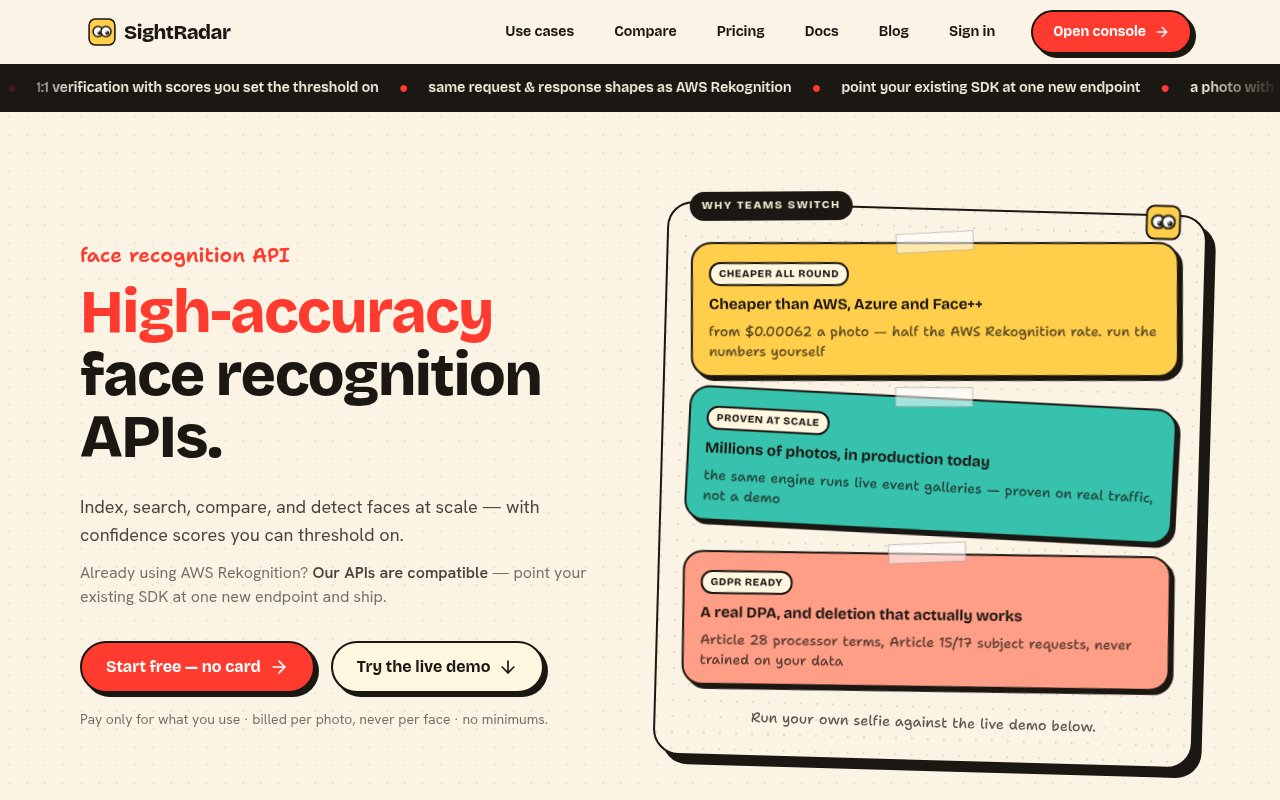
SightRadar is a face recognition API for developers who need to index faces, search a photo collection from a selfie, compare two faces, or detect faces without building the recognition layer themselves. It returns confidence and similarity scores that an application can evaluate against its own threshold. The service is positioned for production workloads such as event photo discovery and one-to-one identity verification, not as a consumer photo organizer. Its central design choice is compatibility with the request and response shapes of AWS Rekognition, which can reduce the work involved in moving an existing integration.
The API supports the familiar collection workflow. A developer creates a collection, sends photos to IndexFaces, and SightRadar detects and stores the face embeddings it finds. SearchFacesByImage can then look for the person in a supplied selfie across that indexed collection, while SearchFaces queries from an existing face identifier. CompareFaces measures similarity between two faces for a one-to-one check. DetectFaces locates faces and can be used as a quality gate without storing them. List and delete operations cover both faces and collections, which gives applications a way to inspect and remove indexed biometric records through the API.
For teams already using Rekognition, migration can be as small as pointing the existing AWS SDK client at the SightRadar endpoint. Existing IndexFaces, SearchFacesByImage, and CompareFaces calls retain the same general request and response shapes, so the application doesn't need an entirely new client library. The live site demonstrates search, compare, and detect responses in Rekognition-shaped JSON. SightRadar also distinguishes between synchronous and batch processing. Real-time requests return the answer in the HTTP response, while a batch call can accept up to 1,000 photo URLs and deliver a result for each photo to a webhook.
The real-time and batch paths run the same recognition model and return the same scores. Their difference is delivery and cost. Real-time calls accept an image by direct upload or URL and keep the request open until the result is ready, backed by an always-warm fleet. Batch calls accept URLs, acknowledge the request immediately, and send each result to the customer's webhook later. Search by face identifier is a direct vector lookup against a face that has already been indexed. This range lets an application reserve synchronous processing for user-facing checks while sending a large gallery through the less expensive deferred path.
The service treats the indexed face vector as the retained unit. Detect and compare requests process images in memory and don't persist them, according to the site's data handling explanation. Faces indexed into collections remain until the customer removes them through the console or API. Account data is namespaced so one tenant's vectors aren't available to another tenant's searches, and traffic is encrypted in transit. SightRadar says it doesn't pool customer data, train general models on it, or sell it. Its terms require a lawful basis and consent and prohibit covert tracking, but the customer remains the data controller and must decide whether a particular deployment is lawful and appropriate.
Pricing is usage based rather than a monthly subscription. Real-time photo processing costs $0.00093 per photo, and standard batch processing costs $0.00062 per photo. A face identifier search also costs $0.00062, while stored vectors cost $6 per million faces per month and are charged daily on a prorated basis. Billing is per photo rather than per detected face. A successfully processed image with no face is still a charged result, and CompareFaces can bill for both images when both require processing. Calls that fail before processing, including inaccessible or corrupt images, aren't charged. The console can be opened without a card, then customers add credits for production use.
SightRadar fits engineering teams that value a compact face API, Rekognition compatibility, and explicit per-photo economics. Event photographers can index galleries and let attendees find their images from a selfie. Identity products can compare a live image with a reference, while media systems can quality-check incoming photographs before storage. The tradeoff is that biometric recognition always carries consent, security, and deletion responsibilities beyond ordinary image processing. Buyers should also note that the site's demo scores are representative and its public benchmark results are still described as forthcoming. The product provides a DPA and documented deletion controls, but each team still needs to validate accuracy thresholds against its own users and conditions.
Key Features
- Face collection indexing
- Selfie-based face search
- One-to-one face comparison
- Rekognition-compatible API shapes
- Real-time and batch processing
- Collection deletion controls
Pros & Cons
What we like
- Existing Rekognition clients can change endpoints
- Charges by photo rather than detected face
- Supports synchronous and lower-cost batch work
- Documents retention and deletion behavior clearly
Room for improvement
- Public benchmark results are still forthcoming
- Zero-face results are still billable
- Customers retain biometric compliance responsibility
- Batch processing requires URL inputs and webhooks
Frequently Asked Questions
What is SightRadar?
How is SightRadar priced?
Does SightRadar keep uploaded images?
Can an AWS Rekognition app migrate to SightRadar?
Best For
Featured in
Alternatives to SightRadar

Apatero AI
The creator studio for AI image, video, audio, 3D, and avatars, now at apatero.ai.

SoloDevStack
A solo developer blog built on head-to-head tool comparisons, 580+ posts deep.
Apatero Studio
Creator studio for AI image, video, audio, 3D, and avatars. Every model worth using, in one workspace.

Melodex
Turn your idea into an AI-generated music video
Reviews (0)
Badge builder
Add SightRadar to your website
Choose a badge style and size, preview it here, then copy the generated HTML. Badge images are self-contained SVGs and do not require an external script.

<a href="https://toolindex.net/tools/sightradar?ref=badge" target="_blank" rel="noopener">
  <img src="https://toolindex.net/badge/sightradar/medium.svg" alt="SightRadar - Listed on Tool Index" width="180" height="50" />
</a>How to use the badge
- 1. Pick the style, size, and theme that fit your layout.
- 2. Copy the generated HTML from the code block.
- 3. Paste it into your footer, homepage, or press page.
Standard badge available
The standard listing badge is available now. Score and circle badges are limited to tools currently ranked in the top 10 of a category.
Badge clicks return visitors to this profile with a referral tag so the source remains identifiable.
Related Tools

Kevin Gabeci
Solo developer building web apps, cozy browser games, and AI creator toolkits.

Coolify
Self-hostable, open source alternative to Heroku and Netlify
Apatero AI
The creator studio for AI image, video, audio, 3D, and avatars, now at apatero.ai.
Kevin Gabeci Toolkits
Seven AI toolkits for writing books, making music, cutting video, and building agents.
Work on SightRadar? Request listing access or correction