
SightSpinner
AI forecasting platform that builds explainable models from your own data
Gallery
About SightSpinner
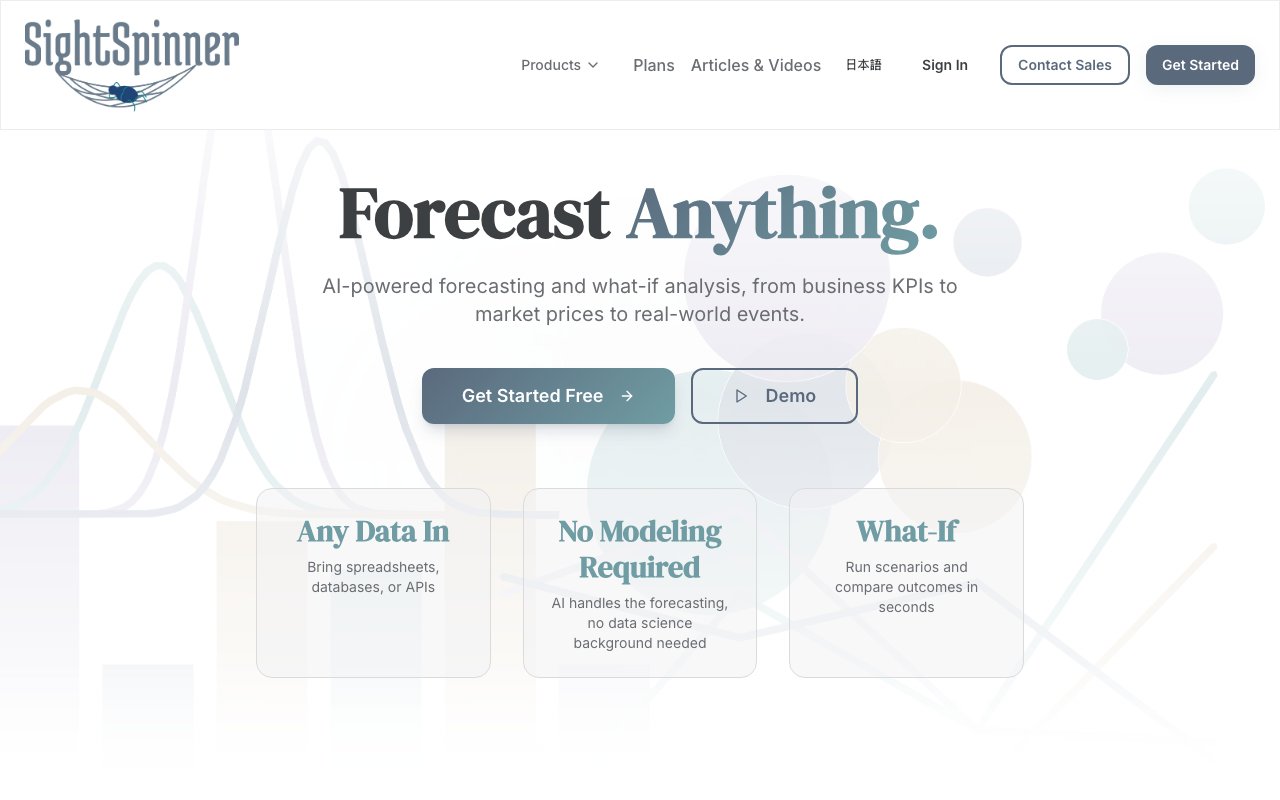
SightSpinner is an AI forecasting platform that turns your own data into predictive models you can actually question. You connect a data source, describe in plain language what you're trying to forecast, and the AI builds the model, wires up the visualizations, and encodes the underlying logic for you. From there you run what-if scenarios and watch how changing a single assumption ripples through the whole picture in seconds. The headline promise is accurate forecasts across business KPIs, market prices, and real-world events, without needing a data science background to get there. The product describes itself as forecasting you can act on, where the model is built from your own business logic rather than a generic template you have to bend to fit.
The problem it goes after is that most forecasting still lives in fragile spreadsheets or waits on a specialist to build. Business owners know their operations drive their financials, but connecting the two into a model that stays current as reality changes is slow, and the resulting spreadsheet tends to rot the moment someone changes a row. SightSpinner reads your data, infers the relationships, and stands up a forecast built from how the business actually works, so the output reflects real drivers instead of a gut-feel guess. It's positioned as a forecasting tool that understands the mechanics of your business rather than fitting a curve to a single line.
The workflow runs in four steps. You plug in a source, whether that's a spreadsheet, a database, an API, or a one-off file, then tell the AI what you want to forecast and which signals might drive it. It analyzes the historical patterns, builds the model, and hands back base, upside, and downside cases you can compare. From there you inspect the drivers, swap assumptions, and re-run, using a visual drag-and-drop interface to shape components that represent your real processes and watch data flow between them. You can also describe transformations and custom plots in plain language and let the AI agent wire them up for you. The interface leans on components you connect together to mirror how your operation runs, so the model reads less like a formula and more like a map of the business.
It's organized around two main solutions. For small and mid-sized businesses there's financial forecasting that links department-level metrics from marketing, sales, and operations directly to revenue, cost, and cash-flow outcomes, so you can project runway and working capital and see the impact of hiring, pricing, or marketing changes weeks in advance. For markets there's securities forecasting, a bottom-up approach that blends fundamentals, alternative data, satellite and web signals, and macro into testable, explainable models for equities, commodities, and rates. The same engine underpins both, framed generally as forecasting anything you can bring data to.
A theme running through both solutions is explainability. The platform makes a point that every output traces back to the assumptions and the data behind it, so there are no black boxes and you can walk an investment committee or a board through exactly why the model says what it says. It generates base, upside, and downside cases meant to be defensible with real driver data rather than a hunch, and re-running as fresh data arrives shows how a thesis holds up over time and where it starts to break down. That auditability is the part it leans on to separate itself from a one-off prediction you can't interrogate. Every forecast comes with the logic that produced it, so when a number looks off you can trace it back to the assumption or the input driving it instead of guessing.
Who it's for is finance teams, founders, and operators who want defensible forecasts without hiring a dedicated modeler, along with analysts building bottom-up cases for equities and commodities. The recurring pain it names is anyone who has bolted forecasting onto spreadsheets and watched them turn into an unmaintainable tangle nobody quite trusts. Because the AI handles the modeling, the pitch is that you bring the data and the domain knowledge and spend your time on the decisions rather than the mechanics of building and maintaining the model by hand. It's pitched at the people who make decisions on these numbers, not at data scientists, so the emphasis falls on trust and speed rather than on tuning a model yourself.
Access is freemium. There's a free tier you can start on with no credit card, a self-serve DIY plan at 100 dollars a month with credits you can top up if you run out, and a managed option where the team handles full onboarding and data setup for you and offers a free consultation. Credits roll over month to month and unused ones don't expire, and there's an API with your own keys for programmatic access alongside the interface. That range makes it approachable to try on a small forecast before committing to the DIY plan or the hands-on setup.
Key Features
- AI-built forecasting models from your data
- Plain-language forecast setup
- What-if scenario engine
- Explainable, driver-level outputs
- Visual drag-and-drop modeling
- Connectors for spreadsheets, databases, and APIs
Pros & Cons
What we like
- Builds forecasts without a data science background
- Every output traces back to its assumptions
- Links operational metrics to financial outcomes
- Free tier to start with no credit card
Room for improvement
- Forecast quality depends on your data
- DIY plan is a real monthly commitment
- Managed setup is quote-based
- Younger product with a short track record
Frequently Asked Questions
What is SightSpinner?
Is SightSpinner free?
Who is SightSpinner for?
How is it different from a spreadsheet model?
Best For
Featured in
Alternatives to SightSpinner
Notionlytics
Page-view analytics and reader feedback widgets for public Notion pages

Cometly
Marketing attribution for B2B SaaS that ties ad spend to pipeline and closed-won revenue

Amplitude
Digital analytics platform for product, growth, and marketing teams to analyze user behavior across web and mobile.

Simple Analytics
Cookieless, GDPR-friendly web analytics that needs no consent banner
Reviews (11)
Two months in, no regrets
Picked SightSpinner for the price, stayed for the quality. Where it really wins is links operational metrics to financial outcomes. Setup was painless and I was productive the same day. No regrets so far.
Quietly excellent
Came to SightSpinner after getting frustrated with what I had before. It handles the boring parts so I can focus on the work that matters. It has shaved real time off my week. Found it works best for presenting defensible forecasts to a board.
Quietly excellent
SightSpinner has quietly become part of my daily flow. Their take on plain-language forecast setup is genuinely good. It earns its place in my stack.
Solid daily driver
Three months of SightSpinner later, here is what holds up. What stands out is how little babysitting it needs. It has shaved real time off my week. Worth it for what I get out of it.
Two months in, no regrets
SightSpinner has quietly become part of my daily flow. Where it really wins is ai-built forecasting models from your data. The output quality holds up better than I expected. It fits well for running what-if scenarios on pricing or hiring. Would sign up again without thinking twice.
Worth a look
Tried SightSpinner on a side project first, then rolled it out everywhere. Their take on links operational metrics to financial outcomes is genuinely good. It fits well for running what-if scenarios on pricing or hiring. Glad I made the switch.
Genuinely impressed
SightSpinner has quietly become part of my daily flow. Got real value out of connectors for spreadsheets, databases, and apis. It fits well for running what-if scenarios on pricing or hiring. It earns its place in my stack.
Exactly what I needed
SightSpinner solves a real problem for me without making a fuss about it. What stands out is how it handles ai-built forecasting models from your data. The output quality holds up better than I expected. Found it works best for running what-if scenarios on pricing or hiring. No regrets so far.
It just works
Three months of SightSpinner later, here is what holds up. The output quality holds up better than I expected. Found it works best for presenting defensible forecasts to a board. Recommending it to people in a similar spot.
Does the job, a few gripes
Three months of SightSpinner later, here is what holds up. The defaults are sensible, so I was not fighting settings on day one. What stands out is how little babysitting it needs. It would be a five if not for diy plan is a real monthly commitment. Would sign up again without thinking twice.
Finally something that fits
Three months of SightSpinner later, here is what holds up. The explainable, driver-level outputs is more useful than I expected. It fits well for building bottom-up equity and commodity models. Recommending it to people in a similar spot.
Badge builder
Add SightSpinner to your website
Choose a badge style and size, preview it here, then copy the generated HTML. Badge images are self-contained SVGs and do not require an external script.

<a href="https://toolindex.net/tools/sightspinner?ref=badge" target="_blank" rel="noopener">
  <img src="https://toolindex.net/badge/sightspinner/medium.svg" alt="SightSpinner - Listed on Tool Index" width="180" height="50" />
</a>How to use the badge
- 1. Pick the style, size, and theme that fit your layout.
- 2. Copy the generated HTML from the code block.
- 3. Paste it into your footer, homepage, or press page.
Standard badge available
The standard listing badge is available now. Score and circle badges are limited to tools currently ranked in the top 10 of a category.
Badge clicks return visitors to this profile with a referral tag so the source remains identifiable.
Related Tools

Sleep Suivour
Track your sleep, improve your rest
Notionlytics
Page-view analytics and reader feedback widgets for public Notion pages
Mixpanel
Product analytics tool for tracking user events, funnels, retention, and cohorts to understand how people use your app.

Simple Analytics
Privacy-friendly web analytics with a clean dashboard, event tracking, and a strong stance against personal data collection.
Work on SightSpinner? Request listing access or correction