
Sixb
A TypeScript framework for ontology powered business apps, workflows, and AI
Gallery
About Sixb
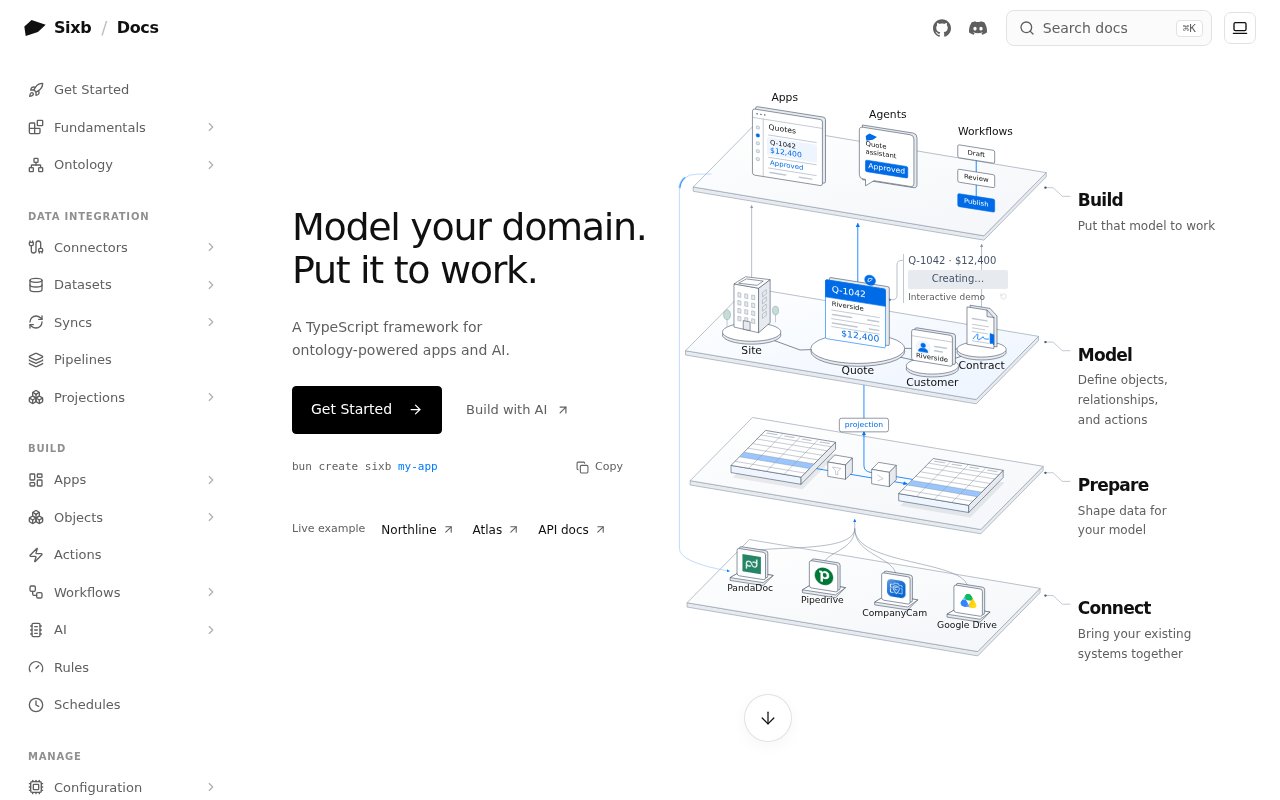
Sixb is an open source TypeScript framework for building business applications, workflows, and AI on a shared model of how an organization works. It is designed for cases where an AI system needs more than a prompt and a loose collection of documents. Teams define the objects, relationships, rules, permissions, and actions in their domain, then use that context across interfaces, automation, and agents. The project describes this as an operating layer that helps software know what is true, what is allowed, and what should happen.
A Sixb project starts with data from the systems a business already uses. Developers can choose a connector from the library or bring their own client, then define typed datasets for the records they want to keep. Syncs pull data into those datasets, including incremental changes, while pipelines can clean, join, and reshape records with SQL or TypeScript. That preparation step matters because raw source data rarely arrives in the form an application or AI workflow needs. Sixb keeps the ingestion and shaping logic inside the same project as the software that consumes it. The documentation also covers source ordering, OAuth, and webhooks, giving teams several ways to keep external records moving into a project.
The ontology layer gives the prepared data shared meaning. Developers define object types, their properties, and the links between them, then project dataset rows into that model. Apps and AI features can query the objects with typed filters instead of each feature inventing its own interpretation of a customer, quote, site, or other business concept. The documentation shows this model supporting analysis through AI prompts as well as ordinary application queries. Object telemetry provides another route for observing what the modeled entities are doing. Models sit underneath the business layer and are intended to remain swappable, so the domain model and operational rules aren't tied to one model provider. The result is one vocabulary that can be used by a React screen, a scheduled rule, an AI tool, and a workflow action.
Sixb also covers the execution side of business software. Workflows connect steps into repeatable processes and can pause for a person's approval before running an action that writes back to an external system. React interfaces use the same object model through client queries and hooks, so screens, agents, and automation work from the same data and logic. The framework includes rules and schedules for AI, sandbox support, actions, telemetry, testing, and logging. A command line interface, HTTP API, and WebSocket subscriptions extend a project beyond its browser interface. Developers can run a project locally, build it for deployment, or start its production API through the Sixb command line tool.
Security is modeled explicitly rather than left to each feature. Teams can organize people into groups, give groups roles, and grant access to particular data and operations. Sixb's documentation also covers authentication, members, service accounts, and shared access. That makes it a better fit for operational systems where an assistant may prepare or recommend an action but shouldn't be allowed to perform every step without review. Human approval and role based grants can stay in the workflow alongside the action they govern.
The framework is aimed at developers and organizations turning recurring operational work into software. The company examples include quote automation, sales follow up, approval workflows, and operations dashboards. Its recommended approach is to begin with one valuable process, learn the people and systems involved, and expand from that base. Context, rules, integrations, and permissions can carry into later deployments rather than being rebuilt for each isolated AI experiment. A public Northline example demonstrates a complete service operations application built on the framework.
Deployment remains under the user's control. Sixb says projects can run in a company's cloud, on its own infrastructure, or on premises, with AWS, Google Cloud, Microsoft Azure, and DigitalOcean shown as options. The framework is published under the MIT license and can be scaffolded with Bun, so the product itself fits an open source pricing model. The site doesn't publish a hosted plan or a fixed services price. Teams evaluating it should expect a development framework and deployment foundation, not a ready made no code automation service. The payoff is ownership of the application, its context, and the environment where it runs.
Key Features
- Typed business ontology
- Connectors and incremental syncs
- SQL and TypeScript pipelines
- Human approval workflows
- Role based access controls
- React, HTTP, and WebSocket clients
Pros & Cons
What we like
- Keeps apps, agents, and workflows on one model
- Supports controlled writeback to external systems
- Runs in a chosen cloud or on premises
- MIT licensed with a documented TypeScript stack
Room for improvement
- Requires developers comfortable with TypeScript and Bun
- Teams must define and maintain their domain model
- Custom systems may need custom connector work
- No hosted pricing is published on the site
Frequently Asked Questions
What is Sixb?
How does Sixb work with existing business data?
Can Sixb workflows require human approval?
Is Sixb open source?
Best For
Featured in
Alternatives to Sixb

Kevin Gabeci
Solo developer building web apps, cozy browser games, and AI creator toolkits.

SoloDevStack
A solo developer blog built on head-to-head tool comparisons, 580+ posts deep.

Codedex
A gamified, story-driven platform that teaches Python, web dev, and more like an RPG quest
Vibe Built
Building real apps with agentic AI. What worked, what broke, what shipped.
Our take
Tool Index Editorial · Oct 2026· 3.5/5
Sixb is an open source TypeScript framework for building business apps, workflows, and AI tools on one typed model of an organization. It is aimed at development teams that need connectors, data shaping, permissions, human approvals, React interfaces, and agents to agree on the same objects and rules. The MIT licensed framework is available without a published hosted price.
We found the documentation broad and concrete, from incremental syncs and projections through WebSockets, testing, and deployment. The shared ontology is the real value, especially when an agent can write back to operational systems only through approved actions. It is also the main cost. Teams must define and maintain that model, build missing connectors, and be comfortable with TypeScript and Bun. This is infrastructure for serious application work, not a ready made automation service.
Editorial opinion from the Tool Index team, written from the public product pages. Not a user review.
Reviews (0)
Badge builder
Add Sixb to your website
Choose a badge style and size, preview it here, then copy the generated HTML. Badge images are self-contained SVGs and do not require an external script.

<a href="https://toolindex.net/tools/sixb?ref=badge" target="_blank" rel="noopener">
  <img src="https://toolindex.net/badge/sixb/medium.svg" alt="Sixb - Listed on Tool Index" width="180" height="50" />
</a>How to use the badge
- 1. Pick the style, size, and theme that fit your layout.
- 2. Copy the generated HTML from the code block.
- 3. Paste it into your footer, homepage, or press page.
Standard badge available
The standard listing badge is available now. Score and circle badges are limited to tools currently ranked in the top 10 of a category.
Badge clicks return visitors to this profile with a referral tag so the source remains identifiable.
Related Tools
Kevin Gabeci
Solo developer building web apps, cozy browser games, and AI creator toolkits.

Coolify
Self-hostable, open source alternative to Heroku and Netlify

Warp
The modern terminal reimagined with AI and collaboration

Bolt.new
Prompt-to-deployed full-stack app inside the browser
Work on Sixb? Request listing access or correction