
Spice.ai
Real-time analytical query on operational data, without ETL
Gallery
About Spice.ai
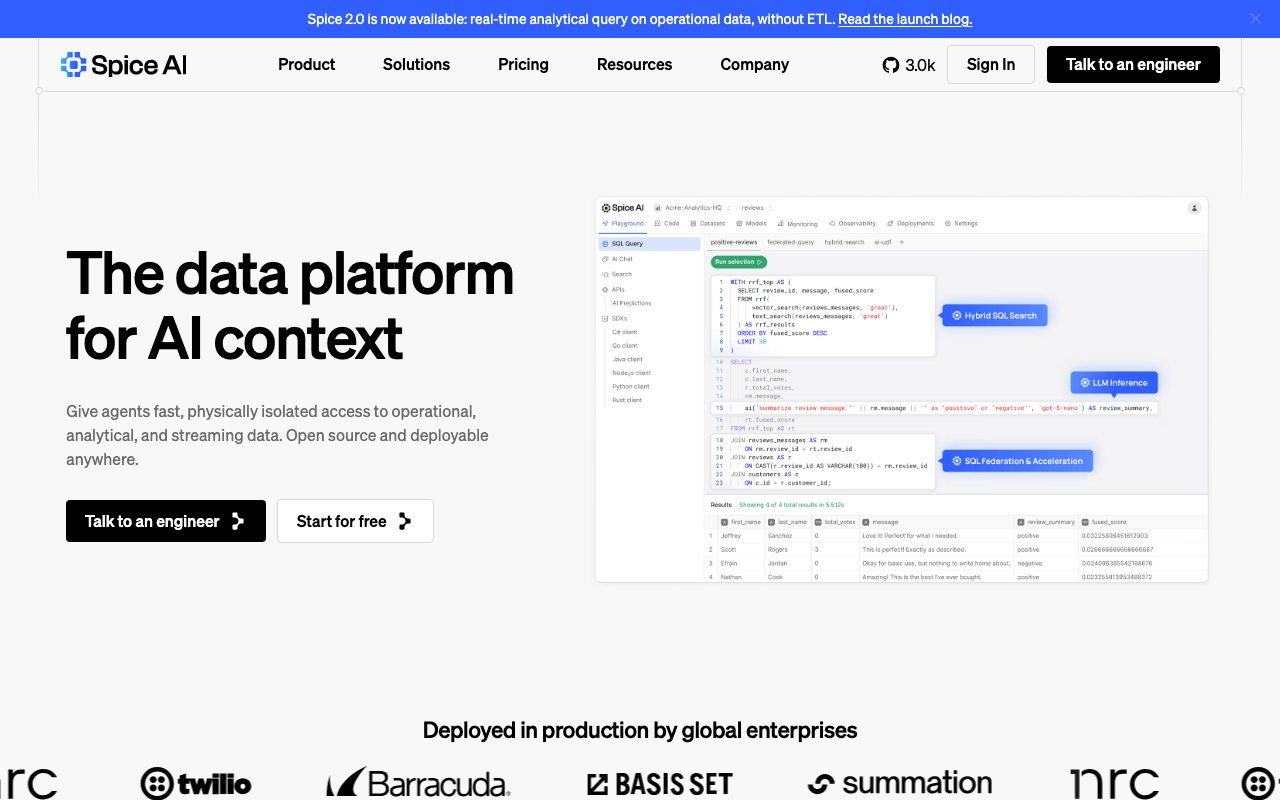
Spice.ai is an open-source engine that puts a real-time analytics node right next to your operational database, so AI apps and agents can run fast analytical queries without standing up a separate ETL pipeline. It's written in Rust, ships as a portable engine you can drop in beside your existing systems, and pulls SQL query, search, and LLM inference into one layer that sits alongside your data rather than replacing it. The framing on the site is blunt, real-time analytical query on operational data without ETL, and the whole engine is built around making that practical instead of aspirational. The premise is that you shouldn't have to choose between a database tuned for writes and a warehouse tuned for analytics just to answer a question quickly.
The problem it goes after is one most data teams know well. Operational databases are tuned for transactions, warehouses and lakes are tuned for analytics, and getting fresh, fast answers across both usually means copying data around on a schedule. By the time a nightly job finishes, the numbers are already stale, and any query feeding an agent is either slow or pointed at a lagging copy. Spice federates across those sources and materializes the slices you actually query, so reads land in sub-second time without a batch job sitting in the middle. That shaves out both the pipeline you'd otherwise maintain and the lag that pipeline introduces.
Under the hood it connects to more than thirty data sources, spanning operational databases, data warehouses, and object storage, then accelerates the working datasets locally. Change data capture keeps those accelerated sets in step with the source, so answers stay current instead of drifting between refreshes. Because the acceleration is local, the engine can serve queries at the edge or embedded inside an application rather than round-tripping to a central warehouse on every request, and it can scale past a single node with distributed query when the workload grows. You're effectively caching the hot part of your data with the freshness of a live feed rather than the staleness of a nightly export.
Beyond plain SQL it unifies vector similarity, full-text, and keyword search inside the same query language, and it can call a language model directly from a query. That means a retrieval step and a generation step can live in one place, with end-to-end tracing across the SQL, the embeddings, and the model call, so you can actually see what an agent read before it answered. For teams building on top of retrieval, keeping all three in one engine cuts out a lot of glue code and a lot of guesswork about where an answer came from. The tracing in particular matters when you need to explain, or debug, why an agent said what it said.
It's aimed at teams building AI agents and data-grounded applications that need governed, sub-second access to enterprise data, which shows up often in cybersecurity, financial services, and SaaS platforms. One notable design choice is AI sandboxing, where an agent gets least-privilege access through Spice instead of a direct connection to your database. Credentials stay contained and the blast radius of a misbehaving agent stays small, which matters far more once these systems start touching production data on their own. For a security or finance team, that boundary is often the difference between shipping an agent and shelving it.
Where it stands apart is that it treats the operational database as the starting point rather than something to escape. A lot of tooling assumes you'll first move everything into a warehouse and query there, then live with the copy aging between loads. Spice keeps the source in place, mirrors just what you need, and keeps that mirror fresh, which makes it a good companion to a system you already run instead of a migration you have to justify. Answers trace back to live data rather than a snapshot that went out of date overnight, and because it speaks SQL, existing tools and dashboards can point straight at it.
Access is open-source first. Spice.ai OSS is released under the Apache 2.0 license and ships as a portable engine you can run yourself locally, at the edge, or on your own infrastructure. There's also a managed cloud platform for teams that would rather have it hosted, with tiered plans referenced on the site, though specific cloud pricing isn't published there. If you've tried to bolt analytics straight onto a transactional database and ended up with either stale copies or slow reads, that's the exact gap this is built to close. The open-source core means you can try the whole thing on your own hardware before deciding whether the managed option is worth paying for.
Key Features
- Federated SQL across 30+ data sources
- Local data acceleration and materialization
- Hybrid vector, full-text, and keyword search
- Embedded LLM inference inside SQL
- Real-time change data capture sync
- Local, edge, or managed cloud deployment
Pros & Cons
What we like
- Open-source Rust engine you can self-host
- Sub-second reads without moving data into a warehouse
- Sandboxes agent access instead of exposing the database directly
- Combines SQL, search, and LLM calls in one layer
Room for improvement
- Positioned for enterprise and agent workloads, heavier for hobby use
- Requires technical setup to wire connectors and acceleration
- Managed cloud pricing isn't spelled out on the site
- Younger project with a smaller community than mature warehouses
Frequently Asked Questions
What is Spice.ai?
Is Spice.ai free and open source?
Who is Spice.ai for?
How is Spice.ai different from a data warehouse?
Best For
Featured in
Alternatives to Spice.ai
MongoDB Atlas
The fully-managed cloud version of MongoDB with built-in search, vector search, time series, and serverless tiers.

Neon
Serverless Postgres with database branching, scale-to-zero compute, and a generous free tier.

Airtable
Spreadsheet-database hybrid with linked records, multiple views, automations, and an interface designer for internal apps.

DataExpert.io Academy
Live and self-paced academy that trains you for real data engineering and AI jobs
Reviews (11)
Exactly what I needed
Started using Spice.ai casually, now it is pinned in my dock. Setup was painless and I was productive the same day. Performance has been steady even when I lean on it hard.
Good, with a few caveats
Hadn't planned on switching, but Spice.ai was hard to ignore. Setup was painless and I was productive the same day. The interface stays out of my way, which I appreciate. Mostly using it for running hybrid search across structured and text data. It would be a five if not for positioned for enterprise and agent workloads, heavier for hobby use.
Genuinely impressed
Came to Spice.ai after getting frustrated with what I had before. It slotted into my routine without much fuss. The defaults are sensible, so I was not fighting settings on day one. Would sign up again without thinking twice.
Recommended without reservation
Started using Spice.ai casually, now it is pinned in my dock. The open-source rust engine you can self-host is more useful than I expected. The core workflow is smooth once you are set up. It fits well for serving sub-second queries to a customer-facing app. Recommending it to people in a similar spot.
It just works
Picked Spice.ai for the price, stayed for the quality. Got real value out of open-source rust engine you can self-host. Mostly using it for serving sub-second queries to a customer-facing app. No regrets so far.
Solid daily driver
Found Spice.ai on a Show HN thread and I am glad I clicked. Got real value out of local data acceleration and materialization. Mostly using it for adding a real-time analytics node beside a production database. Easy yes for anyone weighing the same trade offs.
It just works
Found Spice.ai on a Show HN thread and I am glad I clicked. Where it really wins is federated sql across 30+ data sources. Found it works best for serving sub-second queries to a customer-facing app. Would sign up again without thinking twice.
Finally something that fits
Spice.ai solves a real problem for me without making a fuss about it. Performance has been steady even when I lean on it hard. Found it works best for grounding ai agents in live operational data.
Good, with a few caveats
Spice.ai solves a real problem for me without making a fuss about it. Where it really wins is open-source rust engine you can self-host. My only gripe is managed cloud pricing isn't spelled out on the site. Would sign up again without thinking twice.
Genuinely impressed
Have been running Spice.ai for a while, here is where I land. The thing I keep coming back to is how reliable it is. The defaults are sensible, so I was not fighting settings on day one. It fits well for running hybrid search across structured and text data. Glad I made the switch.
It just works
Started using Spice.ai casually, now it is pinned in my dock. Where it really wins is combines sql, search, and llm calls in one layer.
Badge builder
Add Spice.ai to your website
Choose a badge style and size, preview it here, then copy the generated HTML. Badge images are self-contained SVGs and do not require an external script.

<a href="https://toolindex.net/tools/spice-ai?ref=badge" target="_blank" rel="noopener">
  <img src="https://toolindex.net/badge/spice-ai/medium.svg" alt="Spice.ai - Listed on Tool Index" width="180" height="50" />
</a>How to use the badge
- 1. Pick the style, size, and theme that fit your layout.
- 2. Copy the generated HTML from the code block.
- 3. Paste it into your footer, homepage, or press page.
Standard badge available
The standard listing badge is available now. Score and circle badges are limited to tools currently ranked in the top 10 of a category.
Badge clicks return visitors to this profile with a referral tag so the source remains identifiable.
Related Tools

Supabase
The open source Firebase alternative

Sleep Suivour
Track your sleep, improve your rest

Upstash
Serverless Redis, Kafka, and QStash for modern applications
PlanetScale
Serverless MySQL platform with branching and zero-downtime migrations
Work on Spice.ai? Request listing access or correction