
Stridee
Unified API for reading and writing data across wearable fitness devices
Gallery
About Stridee
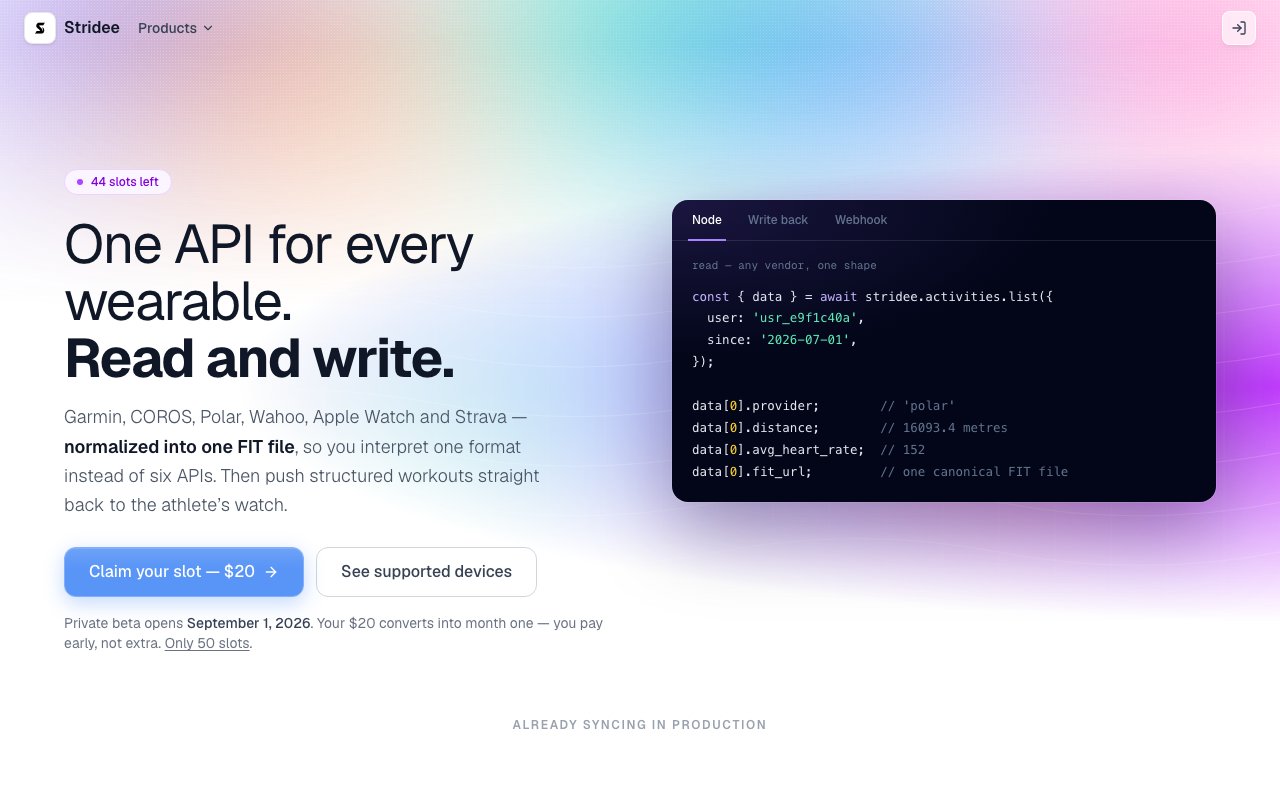
Developers building fitness applications face a fragmented nightmare when it comes to wearable data integration. Every major device manufacturer maintains its own API with different authentication flows, data formats, rate limits, and undocumented quirks that surface only during production usage. Connecting a single fitness app to Garmin, COROS, Polar, Wahoo, Apple Watch, and Strava means integrating six separate systems, each with its own maintenance burden and breaking changes that arrive without warning. Stridee solves this by providing a unified API that normalizes fitness data from all major wearable platforms into a single standardized format, letting developers focus on building features that differentiate their products rather than wrestling with vendor-specific implementation details.
The platform handles data reading by converting activity information from any supported device into canonical FIT file format. Whether an athlete logs a run on a Garmin Forerunner, tracks a cycling session on a Wahoo ELEMNT, swims laps with an Apple Watch, or syncs a trail run from a COROS VERTIX, Stridee delivers the same structured output to your application. Heart rate data, GPS coordinates with elevation, pace metrics, power measurements, and cadence information all arrive in consistent formats that your parsing code handles once rather than requiring conditional branches for every manufacturer's interpretation of fitness data standards. This normalization eliminates the constant edge-case handling that plagues multi-platform fitness apps.
Beyond reading data, Stridee supports workout writing, enabling developers to push structured training sessions directly to athletes' watches. This bidirectional capability distinguishes Stridee from simple data aggregators that only pull information. The platform encodes workout definitions into each vendor's native format, preserving pace targets, power zones, heart rate thresholds, and interval structures across different device ecosystems. A coaching app can define a complex interval session once in Stridee's format, then deliver it to any supported watch without building brand-specific encoding logic that requires deep knowledge of each manufacturer's proprietary workout file formats.
The webhook system reflects production-grade engineering decisions that matter for reliability at scale. Events use Ed25519 signatures verified against published keys, eliminating shared secrets that create security vulnerabilities when rotated or leaked. The platform stores all webhook events and supports replay functionality, meaning developers can recover from downstream outages without permanently losing activity data. A 72-hour retry window with exponential backoff ensures that temporary service disruptions do not result in permanent data gaps that frustrate users and undermine trust in your application.
Current device support covers the major endurance sports ecosystem comprehensively. Garmin's full range from Forerunner through Fenix to Edge cycling computers receives support. COROS PACE, APEX, and VERTIX lines cover trail and ultramarathon athletes. Apple Watch with HealthKit integration brings the iOS user base into scope. Wahoo cycling and running devices including ELEMNT computers and KICKR trainers connect seamlessly. Polar Vantage, Grit X, and Pacer series round out dedicated sports watches. Full history import from Strava means athletes with years of training data do not start fresh. The roadmap includes Suunto, Whoop, Oura, Fitbit, Google Health Connect, Samsung Health, Zwift, and Peloton.
Pricing follows a straightforward model at $20 per month flat rate for full API access across all providers without hidden fees. There is no per-user pricing that scales unpredictably as your application grows, which makes costs predictable for budgeting. The platform launches private beta on September 1, 2026, with only 50 founding slots available. The $20 deposit converts directly into the first month of service rather than representing an additional fee, and full refunds are available if the platform does not ship or if participants change their minds before receiving production keys.
The target audience includes developers at fitness startups who cannot afford months on integration work, training platform companies expanding device support, sports analytics firms needing comprehensive data from athletes using diverse equipment, and any software team that needs unified wearable data without maintaining multiple vendor integrations. For teams who have burned weeks building brittle device connections that break whenever a manufacturer updates their API, Stridee offers an abstraction layer that eliminates that ongoing maintenance burden while providing better reliability than most teams achieve building integrations themselves.
Key Features
- Normalized data from six wearable vendors
- Bidirectional sync for reads and writes
- FIT file canonical format output
- Structured workout push to devices
- Webhook-driven event architecture
- 72-hour retry with stored event replay
Pros & Cons
What we like
- One API replaces six vendor integrations
- Write support pushes workouts to athlete watches
- Flat monthly pricing with no per-user fees
- Webhook replay handles downtime gracefully
Room for improvement
- Private beta with limited founding slots
- Some major platforms still on the roadmap
- No free tier, paid from the start
- Young product, so documentation and community are still building
Frequently Asked Questions
What is Stridee?
Can Stridee write data to devices, not just read?
How much does Stridee cost?
What devices does Stridee support?
Best For
Featured in
Alternatives to Stridee

Kevin Gabeci
Solo developer building web apps, cozy browser games, and AI creator toolkits.

SoloDevStack
A solo developer blog built on head-to-head tool comparisons, 580+ posts deep.

Codedex
A gamified, story-driven platform that teaches Python, web dev, and more like an RPG quest

Vibe Built
Building real apps with agentic AI. What worked, what broke, what shipped.
Reviews (0)
Badge builder
Add Stridee to your website
Choose a badge style and size, preview it here, then copy the generated HTML. Badge images are self-contained SVGs and do not require an external script.

<a href="https://toolindex.net/tools/stridee?ref=badge" target="_blank" rel="noopener">
  <img src="https://toolindex.net/badge/stridee/medium.svg" alt="Stridee - Listed on Tool Index" width="180" height="50" />
</a>How to use the badge
- 1. Pick the style, size, and theme that fit your layout.
- 2. Copy the generated HTML from the code block.
- 3. Paste it into your footer, homepage, or press page.
Standard badge available
The standard listing badge is available now. Score and circle badges are limited to tools currently ranked in the top 10 of a category.
Badge clicks return visitors to this profile with a referral tag so the source remains identifiable.
Related Tools
Kevin Gabeci
Solo developer building web apps, cozy browser games, and AI creator toolkits.

Coolify
Self-hostable, open source alternative to Heroku and Netlify

Warp
The modern terminal reimagined with AI and collaboration

Bolt.new
Prompt-to-deployed full-stack app inside the browser
Work on Stridee? Request listing access or correction