
Supafork
Version control for AI coding sessions that syncs, searches, shares, and forks them across harnesses
Gallery
About Supafork
Supafork is version control for AI coding sessions. It collects every prompt, session, tool call, and skill from the coding agents you use, whatever harness they run in, into one searchable place, and lets you share a session with a teammate, move it between harnesses, or continue it in the cloud. The problem it targets is that each agent keeps its own session store on your machine in its own format, so the reasoning behind a change is trapped in whichever tool produced it and disappears when you switch tools or laptops.
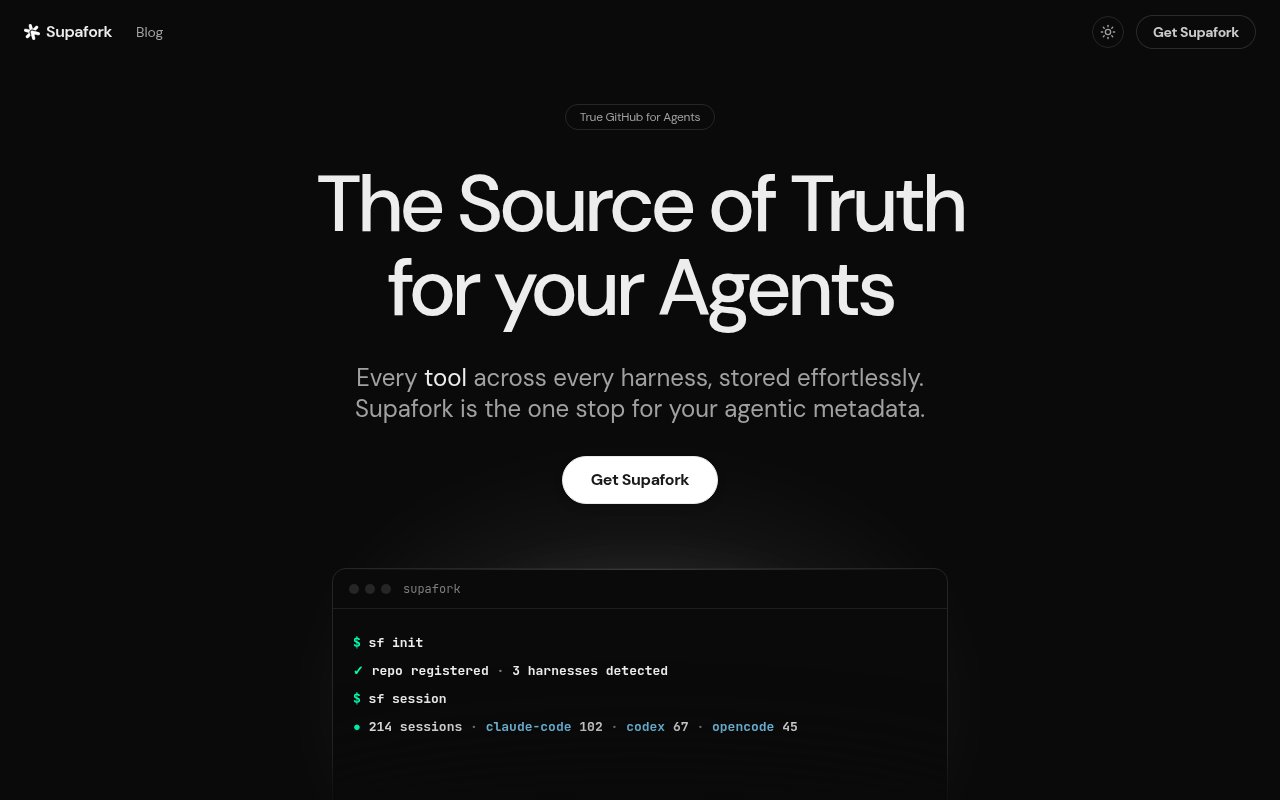
You install a CLI on Linux or macOS with a one-line script, npm, or bun, or paste a prompt and let your agent set it up for you. Running sf init registers the repository, detects the harnesses installed on the machine, and imports their existing sessions from their native stores. After that, new sessions sync automatically. Supafork reads the harnesses' own session files after the fact, so nothing sits in the agent's hot path and the company says it doesn't slow agents down. The supported list covers Claude Code, Codex, OpenCode, DeepSeek, Pi, Gemini CLI, Cursor, GitHub Copilot CLI, and Droid, with more on the way, and sf harness shows what's detected locally. The site's own terminal walkthrough shows what that looks like, with sf init reporting a registered repo and three detected harnesses, then importing 214 existing sessions, and sf session listing them split across Claude Code, Codex, and OpenCode. Installs come from the beta.supafork.com script, the supafork package on npm at the beta tag, bun, or a Homebrew tap.
Once sessions are in, sf session search runs full-text search across all of them, so a question like why the retry logic was written a certain way finds the session where it happened, whichever agent ran it. sf session share sends an invite by email or mints a public link, both revocable, and a teammate can pick the session up exactly where it left off. Sessions can be packaged and moved from one harness to another, and continued in the cloud rather than on the original machine, which is the part that starts to look like forking. Pulling a single session with the full flag shows the complete timeline, every prompt and every tool call in order, which is the raw material for both the search and the handoff.
It's for developers and teams who run more than one coding agent and have lost work or context between them, and for anyone who wants an audit trail of what agents did in a repository. The early adopters named on the site include TensorMux, Heisenberg Research, and RayClip. If your team has ever asked why an agent did something and had to dig through a colleague's local session folder to find out, that's the moment Supafork is built for, and sharing by link means the answer can travel without a screenshot.
The agent-installable setup is a small but telling touch. Rather than reading docs, you copy a prompt from the site, paste it into whichever agent you're running, and it installs and configures the CLI itself, which fits a product whose users are already delegating most typing to an agent. Once it's in place there's nothing to remember, since new sessions sync on their own and the CLI is only needed when you want to search, share, or move something.
Where it's headed is broader than session storage. Supafork describes itself as Git for agents, a version control system that stays wire-compatible with Git while making forks and branches cheap enough for swarms of parallel agents, plus a versioned filesystem on S3-compatible storage that an agent's sandbox can mount. What's concrete and installable today is the session layer, and that's what this listing describes. The site's description of that larger system talks about branches being free, forks being instant, history being exhaustive, and every read and write being tracked, attributable, and reversible, with a POSIX-style filesystem backed by S3-compatible storage and sub-50 millisecond hot reads and writes. None of that is something you can install from the getting-started page yet, so treat it as direction rather than a feature list.
It's a beta. Access is requested through the site as capacity opens up, Windows isn't supported, and the source isn't public beyond a Homebrew tap on GitHub, so you're trusting a hosted service with your session data. Supafork is free during the beta, with no pricing published for afterwards, and the team answers email at hey@supafork.com, usually within two business days according to the contact page. That page is refreshingly plain, one inbox, no ticket portal, with security reports prioritised if you put the word security in the subject line, and a registered mailing address in Delaware while the team works from San Francisco.
Key Features
- Automatic session import from nine harnesses
- Full-text search across all sessions
- Share sessions by invite or revocable public link
- Move a session between harnesses
- Continue a session in the cloud
- Agent-installable CLI setup
Pros & Cons
What we like
- One place for sessions from every coding agent
- Reads session stores after the fact, no slowdown
- Teammates can pick up a session where it stopped
- Free during the beta
Room for improvement
- Beta with request-based access
- Linux and macOS only, no Windows
- No pricing published for after the beta
- Source isn't public, so it's a hosted service you trust
Frequently Asked Questions
What is Supafork?
Is Supafork free?
Which coding agents does it support?
Will it slow my agents down?
Best For
Featured in
Alternatives to Supafork

Kevin Gabeci
Solo developer building web apps, cozy browser games, and AI creator toolkits.

SoloDevStack
A solo developer blog built on head-to-head tool comparisons, 580+ posts deep.

Codedex
A gamified, story-driven platform that teaches Python, web dev, and more like an RPG quest

Vibe Built
Building real apps with agentic AI. What worked, what broke, what shipped.
Reviews (0)
Badge builder
Add Supafork to your website
Choose a badge style and size, preview it here, then copy the generated HTML. Badge images are self-contained SVGs and do not require an external script.

<a href="https://toolindex.net/tools/supafork?ref=badge" target="_blank" rel="noopener">
  <img src="https://toolindex.net/badge/supafork/medium.svg" alt="Supafork - Listed on Tool Index" width="180" height="50" />
</a>How to use the badge
- 1. Pick the style, size, and theme that fit your layout.
- 2. Copy the generated HTML from the code block.
- 3. Paste it into your footer, homepage, or press page.
Standard badge available
The standard listing badge is available now. Score and circle badges are limited to tools currently ranked in the top 10 of a category.
Badge clicks return visitors to this profile with a referral tag so the source remains identifiable.
Related Tools
Kevin Gabeci
Solo developer building web apps, cozy browser games, and AI creator toolkits.

Coolify
Self-hostable, open source alternative to Heroku and Netlify

Warp
The modern terminal reimagined with AI and collaboration

Bolt.new
Prompt-to-deployed full-stack app inside the browser
Work on Supafork? Request listing access or correction