
Taste Brand API
Extract, search, and verify brand systems for design agents and apps
Gallery
About Taste Brand API
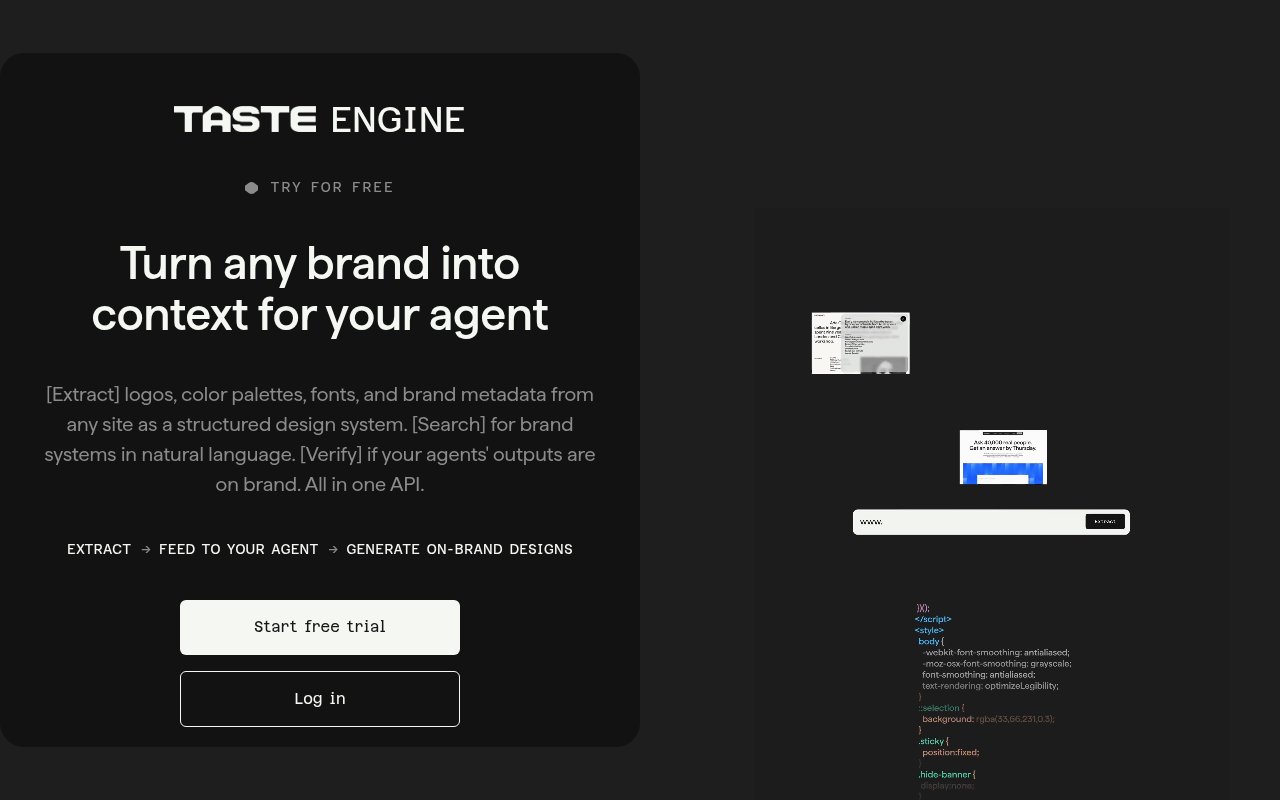
Taste Brand API is a developer service that helps AI agents and applications understand visual brands. Give it a website and it can turn the rendered page into a structured design system, find brands with a related look, or compare a new page with a reference and report how closely it follows the brand. Taste Labs describes this as infrastructure for subjective design decisions. The practical value is more concrete. An agent gets structured context about a brand instead of trying to infer colors, type, layout, and visual character from a loose prompt. It can then reuse the same representation across creation, discovery, and quality control.
The extraction endpoint starts with a URL. It crawls the rendered page and returns a design system with colors, typography, layout, components, logos, motion, textures, shadows, and a broader brand profile. The response also includes captured source artifacts such as HTML, CSS, and screenshots. Extractions run as asynchronous jobs that clients poll, with sections becoming available as the work progresses. A new analysis usually takes a few minutes, while a previously cached URL can return immediately. Clients can force a fresh run when they need the current page rather than the cached result. Streaming partial sections means an agent can begin inspecting the available material without waiting for every part of a deep analysis.
Style Search covers the case where a user doesn't already have a defined brand. An agent can describe a direction in natural language, such as a dark brutalist developer product, and search Taste Labs' curated corpus for relevant brand systems. It can also start from one of the user's own extractions and look for visual neighbors. Results include brand cards with a palette, typography, tags, and a full page screenshot. Industry, hue, page type, and layout filters are treated as firm constraints. A light search favors speed, while deep search takes longer and aims for a stronger ranking. That gives a product team a more inspectable source of inspiration than asking a model to invent a visual mood from memory.
The verification endpoint compares two URLs. One is the reference brand and the other is the page being judged. Taste extracts both sides, returns an adherence verdict, and provides written recommendations plus structured fixes ordered from the biggest issue downward. That ordering gives an agent a usable improvement loop rather than a vague style score. It can address the largest divergence, render another version, and submit the result again. Extraction and verification are asynchronous, and permanent failures stop cleanly with a reason. Taste Labs says credits are refunded when an extraction, search, or verification job fails, which matters for automated systems that may process many pages.
Developers can integrate through a normal HTTP API or an MCP server. The MCP option works with clients such as Claude Code, Cursor, and Codex, using OAuth for interactive access or an API key as a bearer token for headless and continuous integration use. Agents receive the same extraction, search, and verification tools exposed by the API and can read only the sections they need, helping keep context use under control. Taste Labs also publishes agent skills intended to teach clients how to use the tools effectively. That makes the product useful inside website builders, design assistants, internal brand review tools, and automated quality checks rather than limiting it to the Taste interface.
The sharp distinction is the combination of retrieval and evaluation. Many brand extraction tools stop after listing a site's fonts and colors. Taste connects that structured reference to a curated visual search system and a verifier that can judge a generated result against the source. It is aimed at developers, agent builders, and creative technology teams rather than marketers looking for a manual brand asset library. The tradeoff is maturity. Brand Extraction is marked beta, while Style Search and Verify Adherence are marked alpha, so teams should expect the interface and results to keep evolving. Website based analysis is also a focused slice of brand work, not a replacement for managing every source file and offline asset.
This is a paid, credit based product with a free way to try it. The monthly Starter plan is listed at $99 for 600 credits and includes every endpoint plus MCP access. Pro is $749 per month for 6,000 credits and adds onboarding support, while enterprise pricing is negotiated. Annual billing lowers the displayed monthly equivalents to $84 and $636. Light search uses one credit, deep search uses two, and extraction and verification each use two. Teams can therefore estimate a basic workload directly from the number of searches, source sites, and pages they expect to check. There is no ongoing free tier shown on the pricing table, so a production integration should be budgeted as paid from the start.
Key Features
- URL based brand extraction
- Natural language style search
- Brand adherence verification
- Structured design system JSON
- API and MCP integration
- Async jobs with credit refunds
Pros & Cons
What we like
- Combines brand context with evaluation
- Returns structured and source artifacts
- Works through HTTP or MCP
- Filters support focused visual search
Room for improvement
- No ongoing free tier is listed
- Search and verification remain alpha
- Fresh extractions can take minutes
- Focus is limited to website brands
Frequently Asked Questions
What is Taste Brand API?
What does brand extraction return?
Can an AI agent use Taste directly?
Is Taste Brand API free?
Best For
Featured in
Alternatives to Taste Brand API

Kevin Gabeci
Solo developer building web apps, cozy browser games, and AI creator toolkits.
SoloDevStack
A solo developer blog built on head-to-head tool comparisons, 580+ posts deep.

Codedex
A gamified, story-driven platform that teaches Python, web dev, and more like an RPG quest
Vibe Built
Building real apps with agentic AI. What worked, what broke, what shipped.
Reviews (0)
Badge builder
Add Taste Brand API to your website
Choose a badge style and size, preview it here, then copy the generated HTML. Badge images are self-contained SVGs and do not require an external script.
<a href="https://toolindex.net/tools/taste-brand-api?ref=badge" target="_blank" rel="noopener">
  <img src="https://toolindex.net/badge/taste-brand-api/medium.svg" alt="Taste Brand API - Listed on Tool Index" width="180" height="50" />
</a>How to use the badge
- 1. Pick the style, size, and theme that fit your layout.
- 2. Copy the generated HTML from the code block.
- 3. Paste it into your footer, homepage, or press page.
Standard badge available
The standard listing badge is available now. Score and circle badges are limited to tools currently ranked in the top 10 of a category.
Badge clicks return visitors to this profile with a referral tag so the source remains identifiable.
Related Tools
Kevin Gabeci
Solo developer building web apps, cozy browser games, and AI creator toolkits.

Coolify
Self-hostable, open source alternative to Heroku and Netlify

Warp
The modern terminal reimagined with AI and collaboration

Bolt.new
Prompt-to-deployed full-stack app inside the browser
Work on Taste Brand API? Request listing access or correction