
Taurus Agents
Deploy hierarchical teams of AI agents with persistent memory, containers, and scheduling
Gallery
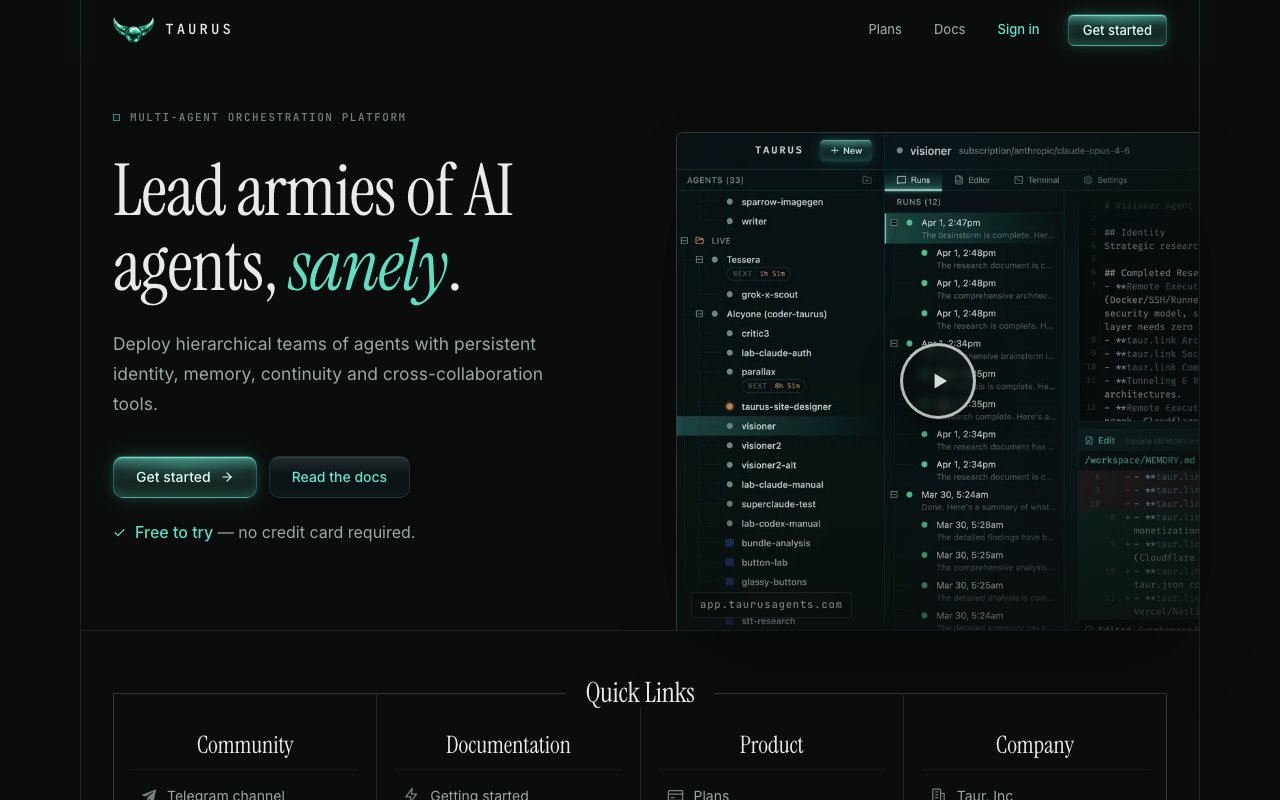
About Taurus Agents
Taurus is a platform for deploying and managing teams of AI agents arranged in hierarchies. Instead of running one assistant and hoping it can hold an entire project in a single context window, you organize agents into a tree. Parent agents break work down, delegate tasks to their children, coordinate the results, and share files through a common shared folder. The underlying idea is that real work gets done by organizations rather than lone individuals, and that agent systems should be structured the same way.
Every agent runs in its own isolated Linux container with a persistent filesystem and its own browser. That persistence is the load-bearing detail. Agents on Taurus keep their identity and memory between runs, so an agent scheduled to check something every morning actually remembers what it found yesterday. Scheduling uses ordinary cron syntax, and memory continuity between runs is built into the platform rather than something you have to wire up yourself with a vector database and glue code.
Persistence also changes what an agent can be. Because each one has a real filesystem and a real browser, agents on Taurus can accumulate working material over time, keep notes, maintain scripts, and even build and host dashboards that stay up between runs. A team of agents shares resources through a common shared folder, so one agent can drop findings where another will find them, without you shuttling context between chat windows by hand. It's closer to giving each agent a workstation than giving it a prompt.
The platform is model-agnostic. It supports more than thirty models from Anthropic, OpenAI, Google, xAI, Groq, and OpenRouter, so you can assign cheaper models to routine work and stronger ones to the hard problems. You work with the system through a web IDE that includes an editor, a terminal, and a file browser, and agents can build and host dashboards of their own. For programmatic control there's a REST API with SSE streaming plus WebSocket terminals, so the agents you run here can plug into external systems as easily as they plug into each other.
It fits developers and technical builders who have outgrown single-agent chat tools and want long-running, scheduled, multi-agent automations without operating the infrastructure themselves. If you've experimented with agent frameworks and found that the hard part was never the prompting but the hosting, the state, and the coordination, that's precisely the layer Taurus sells. That covers solo builders automating recurring research as much as teams prototyping agent products who would rather not build the runtime before the idea is proven.
What sets it apart is that hierarchy is the first-class primitive. Most agent tooling ships as a library you embed in your own code and host yourself. Taurus instead gives you a hosted environment where delegation trees, per-agent containers, shared storage, and cron scheduling all come as part of the platform, and where an agent is a durable thing with a filesystem rather than a stateless function call. The economics are also unusually transparent for the category, since the plans publish exact agent counts, parallel run limits, storage, and container sizes rather than hiding capacity behind a demo call.
Getting started doesn't require that call either. There's public documentation, a normal web signup, and a presence on GitHub, Telegram, and X, with a support page and a published sales address for enterprise conversations. The web IDE means you can inspect exactly what any agent has been doing, open its files, and drop into its terminal over a live WebSocket session, which goes a long way toward making a multi-agent system debuggable rather than a black box.
Access starts free in two ways. There's a permanent free tier with 10 agents, 2 parallel runs, 2 GB of storage, and a 1 vCPU container, and new accounts also get 5 dollars of trial credit for 14 days with no credit card required. When the trial credit runs out you fall back to the free plan rather than losing access. Paid plans scale from Start at 20 dollars a month with 100 agents and 5 parallel runs, through Plus at 50 dollars, up to Pro at 200 dollars a month with 1,000 agents, 30 parallel runs, and 250 GB of storage, plus a custom enterprise tier. One pricing detail worth knowing before you commit, model tokens on paid plans are billed at true cost plus 5 percent, while the free tier pays list price plus 20 percent, and paid plans can connect your own existing model subscriptions. The fallback design means an abandoned experiment costs nothing, which is the right posture for a category where most people are still working out what multi-agent systems are actually for.
Key Features
- Hierarchical parent-child agent delegation
- Isolated Linux container per agent
- Cron scheduling with memory continuity
- Support for 30+ models across providers
- Web IDE with terminal and file browser
- REST API with SSE streaming
Pros & Cons
What we like
- Agents persist identity, memory, and files between runs
- Hosted containers remove the infrastructure work
- Permanent free tier plus trial credit with no card
- Paid plans bill tokens at true cost plus 5 percent
Room for improvement
- Younger product with a smaller community
- Free tier pays a 20 percent markup on tokens
- Hierarchical model has a learning curve
- Costs can climb with many parallel agents
Frequently Asked Questions
What is Taurus Agents?
Is Taurus Agents free?
Which AI models does Taurus support?
How is Taurus different from agent frameworks?
Best For
Featured in
Alternatives to Taurus Agents
Rememori
Embedded memory engine for AI agents in TypeScript with zero dependencies

Almanac
A hosted, source-cited wiki that turns your files into context your AI agents can use

Demi AI
Demi helps busy professionals eliminate repetitive admin work across their favorite tools.

Chariot
Elastic cloud infrastructure for deploying and scaling AI agent fleets with persistent storage
Reviews (0)
Badge builder
Add Taurus Agents to your website
Choose a badge style and size, preview it here, then copy the generated HTML. Badge images are self-contained SVGs and do not require an external script.

<a href="https://toolindex.net/tools/taurus-agents?ref=badge" target="_blank" rel="noopener">
  <img src="https://toolindex.net/badge/taurus-agents/medium.svg" alt="Taurus Agents - Listed on Tool Index" width="180" height="50" />
</a>How to use the badge
- 1. Pick the style, size, and theme that fit your layout.
- 2. Copy the generated HTML from the code block.
- 3. Paste it into your footer, homepage, or press page.
Standard badge available
The standard listing badge is available now. Score and circle badges are limited to tools currently ranked in the top 10 of a category.
Badge clicks return visitors to this profile with a referral tag so the source remains identifiable.
Related Tools

OpenBenchmarks
Public, externally validated benchmarks that help agents pick SaaS APIs
Almanac
A hosted, source-cited wiki that turns your files into context your AI agents can use

Wizard
Self-extending Rust terminal AI agent that works with any model
Chariot
Elastic cloud infrastructure for deploying and scaling AI agent fleets with persistent storage
Work on Taurus Agents? Request listing access or correction