
TokenGO
Access and route leading AI models through one OpenAI-compatible API
Gallery
About TokenGO
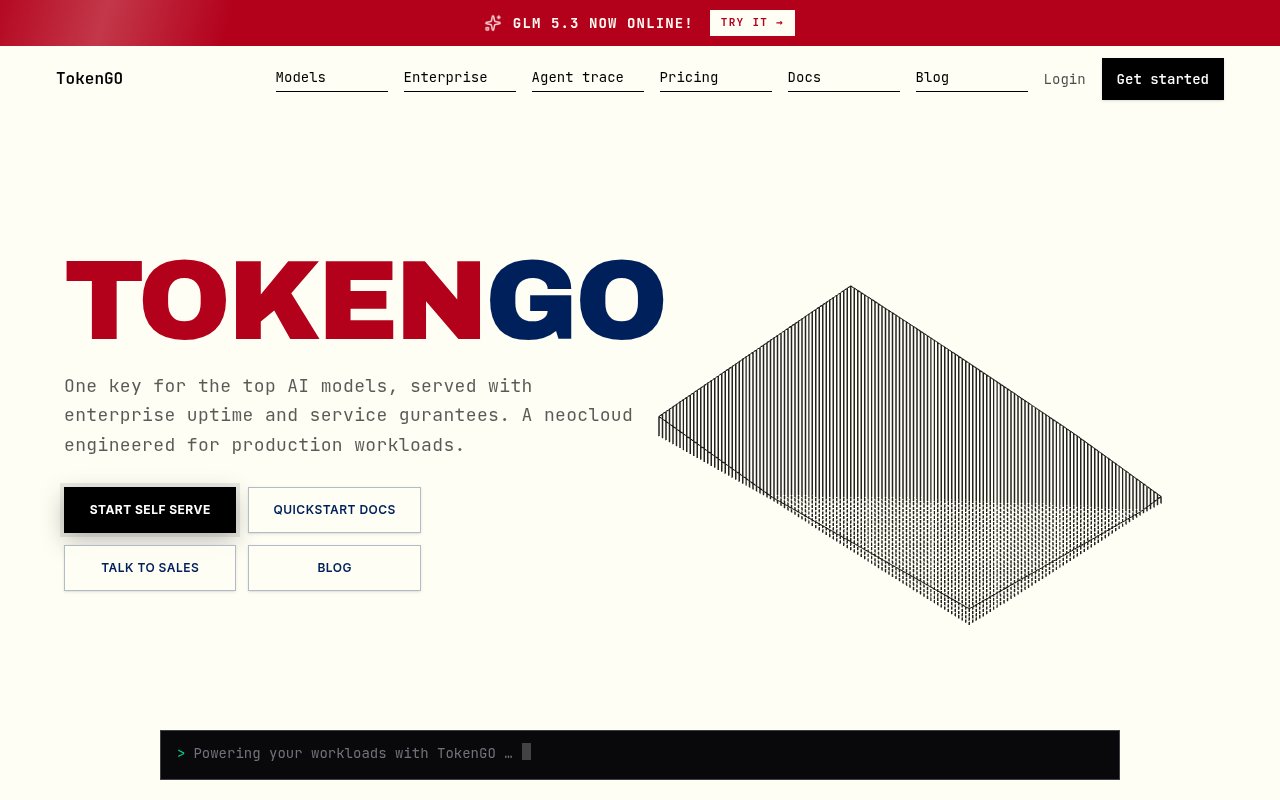
TokenGO is a hosted API platform that gives developers one route to language and multimodal models from multiple providers. Instead of maintaining separate credentials, request formats, billing accounts, and fallback logic for every model company, a team can use one TokenGO key and a consistent interface. The product is aimed at production applications where model spend, availability, and operational visibility matter as much as getting a first completion to work. It combines model access with routing, usage controls, logs, and a browser playground, making it both an inference gateway and a small control plane for AI workloads.
The API follows the OpenAI format, which lowers the effort of connecting an application that already uses an OpenAI SDK or compatible client. Developers authenticate with a bearer token, point the client at TokenGO's base URL, and call familiar endpoints for chat completions, model listings, embeddings, and supported media operations. The documentation includes examples for cURL, Python, TypeScript, Go, Java, and Ruby. That compatibility doesn't remove the need to test each selected model, since capabilities and behavior still differ, but it does make switching models less disruptive than rebuilding the integration around every provider's native API.
A searchable Model Hub helps teams compare the available catalog by provider, name, capability tags, and per-million-token prices. Model detail pages show input, output, and available cache rates alongside ready-to-use integration examples. A chat-style Playground lets users try models before adding them to an application, with controls for the system prompt, temperature, top p, penalties, and maximum tokens. Together, the catalog and playground support a sensible evaluation loop. A developer can shortlist models, inspect the cost structure, run representative prompts, and then copy the identifier and code into a project.
For live workloads, TokenGO emphasizes smart routing and resilience. Its homepage says upstream providers are vetted and requests can move to fallback channels when a failure occurs. It advertises a 99.99% uptime guarantee for production service, while enterprise plans add service agreements and professional support. The platform also describes hardware-aware request placement, inference engine optimizations, and a cache layer that can reuse repeated prompt prefixes and key value state. Those infrastructure details matter most to teams with sustained volume, but the practical benefit is a single place to balance availability, latency, and token cost without operating a separate gateway stack.
Account controls cover both access and spending. API keys can have custom quotas and expiration dates, and the console tracks balance, requests, tokens, and spending trends. Usage logs break requests down by model, key, cost, token count, duration, channel, and status, which can help investigate an error or identify expensive traffic. Content previews are limited rather than presenting entire conversations in the log view. TokenGO states that prompts and outputs aren't used for training, that retention is limited to what is operationally necessary under US law, and that it signs zero retention agreements with datacenter partners. Buyers with strict requirements should confirm the applicable data processing terms for their account.
The service fits developers building model-powered products, AI-native businesses with meaningful token spend, and platform teams that want centralized governance across several models. It is less compelling for a small experiment that depends on only one provider and already has simple billing. Its value grows when an application needs fallbacks, model comparison, per-key limits, usage auditing, or the freedom to shift traffic without changing client code. The unlimited seat count on the entry tier also avoids making basic team access another source of cost, although higher tier management and access controls are reserved for larger commitments.
Pricing is usage based rather than a conventional free subscription. Standard access has no commitment and charges list price for accounts spending under $1,000 per month, but users must add balance before sending requests. Growth, Scale, and Enterprise tiers provide volume discounts and progressively stronger support, controls, compliance review, and billing options. Published discounts begin at 20 percent for quarterly spend from $1,000 to $15,000 per month, with larger discounts at higher levels. Since each model has its own input, output, and sometimes cache price, the true cost depends on traffic mix. Teams should compare current rates in the Model Hub and treat the gateway as an operational choice, not assume every route will always be the cheapest.
Key Features
- Unified multi-model API
- OpenAI-compatible API endpoints
- Smart routing and fallbacks
- Per-key quotas and expiration
- Detailed usage and cost logs
- Interactive model testing playground
Pros & Cons
What we like
- Reduces separate integrations across model providers
- Existing OpenAI clients need only small changes
- Centralizes model pricing, testing, and usage controls
- Volume tiers include support and service commitments
Room for improvement
- API requests require a prepaid account balance
- Model rates and availability can change
- Meaningful discounts require substantial monthly spend
- Adds an aggregation layer between apps and providers
Frequently Asked Questions
What is TokenGO?
Is TokenGO compatible with OpenAI SDKs?
Is TokenGO free?
Who is TokenGO for?
Best For
Featured in
Alternatives to TokenGO

Kevin Gabeci
Solo developer building web apps, cozy browser games, and AI creator toolkits.

SoloDevStack
A solo developer blog built on head-to-head tool comparisons, 580+ posts deep.

Codedex
A gamified, story-driven platform that teaches Python, web dev, and more like an RPG quest
Vibe Built
Building real apps with agentic AI. What worked, what broke, what shipped.
Our take
Tool Index Editorial · Oct 2026· 3.5/5
TokenGO offers one API key for several open-weight language and video models, with routing, fallbacks, usage controls, and OpenAI-style endpoints. It is aimed at product and platform teams that need to move traffic across providers without maintaining a separate integration for each one. Standard is pay as you go at list price below $1,000 a month. Published volume discounts begin at 20 percent for $1,000 to $15,000 in monthly usage on quarterly billing.
We found the model rate display and tier thresholds unusually legible, and the documentation exposes quick starts, streaming guides, billing, logs, and endpoint schemas. The gateway adds another vendor between an application and the underlying model, however, and the largest discounts require substantial commitments. Model availability, context limits, and token rates can also change faster than an integration. TokenGO makes the most sense when fallback and centralized governance matter, not for a small app using one stable provider.
Editorial opinion from the Tool Index team, written from the public product pages. Not a user review.
Reviews (0)
Badge builder
Add TokenGO to your website
Choose a badge style and size, preview it here, then copy the generated HTML. Badge images are self-contained SVGs and do not require an external script.

<a href="https://toolindex.net/tools/tokengo?ref=badge" target="_blank" rel="noopener">
  <img src="https://toolindex.net/badge/tokengo/medium.svg" alt="TokenGO - Listed on Tool Index" width="180" height="50" />
</a>How to use the badge
- 1. Pick the style, size, and theme that fit your layout.
- 2. Copy the generated HTML from the code block.
- 3. Paste it into your footer, homepage, or press page.
Standard badge available
The standard listing badge is available now. Score and circle badges are limited to tools currently ranked in the top 10 of a category.
Badge clicks return visitors to this profile with a referral tag so the source remains identifiable.
Related Tools
Kevin Gabeci
Solo developer building web apps, cozy browser games, and AI creator toolkits.
Coolify
Self-hostable, open source alternative to Heroku and Netlify

Warp
The modern terminal reimagined with AI and collaboration

Bolt.new
Prompt-to-deployed full-stack app inside the browser
Work on TokenGO? Request listing access or correction