
Twigg
Open source code review platform inspired by Google Critique with stacked commits and built in CI
Gallery
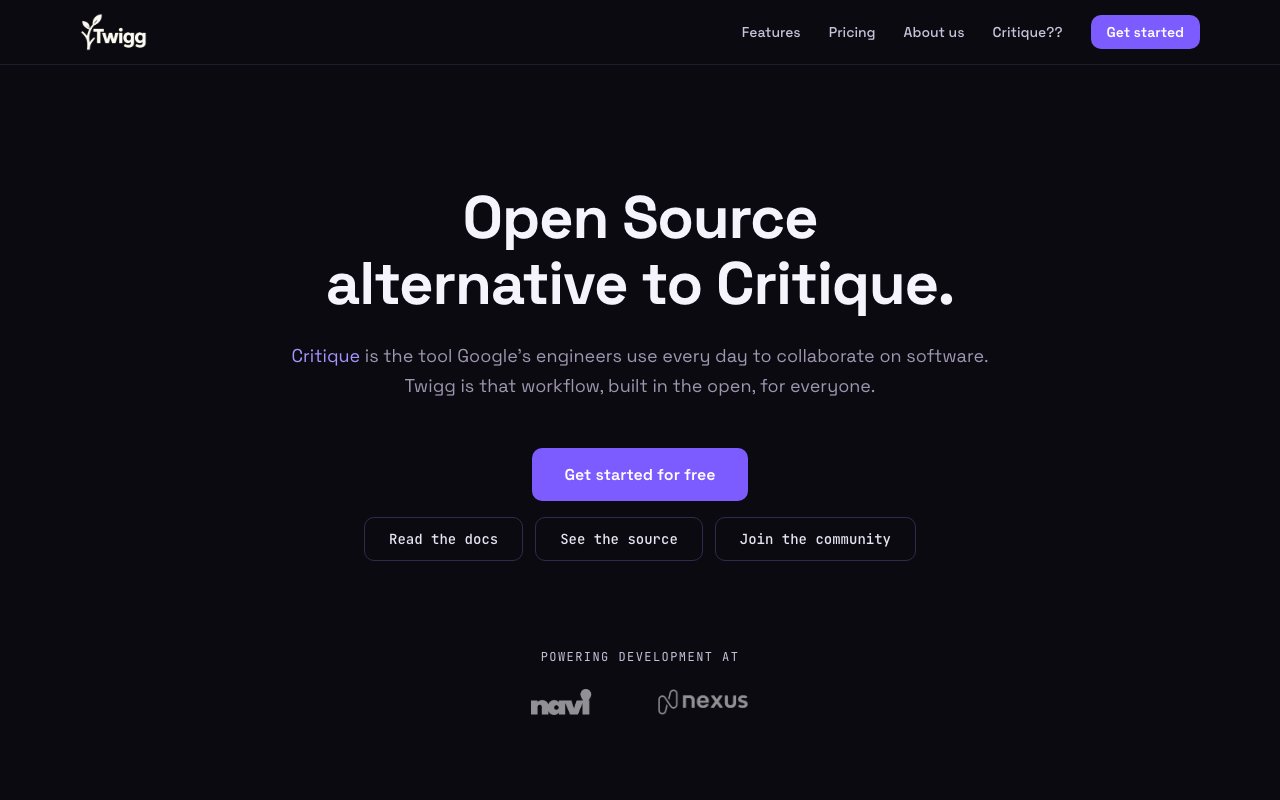
About Twigg
Twigg is an open source code review and collaboration platform built in the spirit of Critique, the internal tool Google engineers use to review code. Instead of the branch and pull request model most Git hosts are built around, Twigg organizes work as small stacked commits that get reviewed and merged independently. The idea is that a change should be reviewed while it's still small and fresh, not after it has sat on a feature branch for a week collecting conflicts. It's aimed squarely at the gap between how big tech companies review code internally and what the rest of the industry gets from mainstream Git hosting, and the whole project is developed in the open in a public monorepo on GitHub.
The problem it goes after is one most teams know well. A pull request starts small, then grows as the author keeps pushing to the same branch, and by the time someone actually reviews it the diff covers days of work. The reviewer has to hold too much in their head at once, feedback arrives late, and merging becomes an event instead of a routine step. Engineers who've worked inside companies with internal stacked-change tooling often describe it as the thing they miss most after leaving, because those systems were designed around small changes from the start. Twigg is an attempt to bring that workflow to everyone else without needing a platform team to build it.
The mechanics are deliberately simple. When you push a commit it receives a versioned identifier, something like c/67v0, and each time you address review feedback and push again the version ticks up to c/67v1, then c/67v2. Every iteration stays visible, so a reviewer can see exactly what changed between versions instead of re-reading the whole diff. Collaboration happens through short commands, tw pull to fetch a commit, tw amend to change it, and tw push to send the new version up. There are no branches, no staging area, and no unfinished rebase states to untangle. The model is just commits and commit versions, stacked on top of each other, each one reviewable and mergeable on its own.
Ownership is handled through hierarchical OWNERS files, the same pattern large companies use to manage shared code at scale. You declare who's responsible for which paths in the repository, and Twigg checks those rules during review, so approvals come from the people who actually own the code being changed. CI is built into the platform rather than bolted on as a separate service. Jobs are path aware, which means a change only triggers the checks relevant to the files it touches, and CI minutes are unlimited on every plan, including the free one. That combination matters for monorepos in particular, where a naive CI setup runs everything on every change and ownership questions multiply as more teams share one repository.
Adopting it doesn't require a leap of faith. Twigg can mirror to a Git repository automatically, keeping your code synced with a repo you host elsewhere while you find out whether stacked commits suit your team. Because the platform is open source, self-hosting is also on the table for teams that want to run it on their own infrastructure. There's a Discord community and versioned documentation that walks through the workflow from the first push. The company behind it is bootstrapped, founded by Andre, Joao, and Marcos Bianchessi, and positions itself as independent of both Google and Meta despite the obvious lineage of the idea.
It fits teams that already value small atomic commits and want tooling that rewards the habit instead of fighting it, and it will feel familiar to anyone who has used a stacked workflow at a big company and missed it ever since. The tradeoff is real, though. The tw commands and commit versions are new muscle memory, and the ecosystem of integrations that has grown up around pull requests won't follow you over on day one, so teams deeply invested in GitHub-centric automation should weigh the switch honestly. Twigg genuinely replaces pull requests rather than layering on top of them.
Pricing is freemium and posted plainly. The free plan covers one user with one repository and 250 MB of storage. Solo runs twelve dollars a month for up to three users, unlimited repositories, and 10 GB of storage. Team is eighteen dollars per user per month with unlimited users and repositories and 50 GB. Every tier includes stacked changes, code review, CI with unlimited minutes, and OWNERS support, so the paid plans buy capacity rather than unlocking the core workflow. Between the free tier, the mirror support, and the option to self-host, finding out whether the Critique way of working fits your team costs very little.
Key Features
- Stacked commits with independent review
- Versioned commit tracking and history
- Hierarchical code ownership via OWNERS files
- Built in CI with unlimited minutes
- Path aware test execution
- Git repository mirroring for evaluation
Pros & Cons
What we like
- Encourages small commits that are easier to review
- Unlimited CI minutes on every pricing tier
- Ownership rules enforced automatically before merge
- Mirror existing repos to try without full migration
Room for improvement
- Requires learning a new workflow distinct from branches
- Open source project with a smaller community than GitHub
- Team plan pricing can add up for larger organizations
- Best suited for teams already comfortable with atomic commits
Frequently Asked Questions
What is Twigg?
Is Twigg free?
Do I have to migrate my entire repository?
Who is Twigg for?
Best For
Featured in
Alternatives to Twigg

Kevin Gabeci
Solo developer building web apps, cozy browser games, and AI creator toolkits.

SoloDevStack
A solo developer blog built on head-to-head tool comparisons, 580+ posts deep.

Codedex
A gamified, story-driven platform that teaches Python, web dev, and more like an RPG quest

Vibe Built
Building real apps with agentic AI. What worked, what broke, what shipped.
Reviews (0)
Badge builder
Add Twigg to your website
Choose a badge style and size, preview it here, then copy the generated HTML. Badge images are self-contained SVGs and do not require an external script.

<a href="https://toolindex.net/tools/twigg?ref=badge" target="_blank" rel="noopener">
  <img src="https://toolindex.net/badge/twigg/medium.svg" alt="Twigg - Listed on Tool Index" width="180" height="50" />
</a>How to use the badge
- 1. Pick the style, size, and theme that fit your layout.
- 2. Copy the generated HTML from the code block.
- 3. Paste it into your footer, homepage, or press page.
Standard badge available
The standard listing badge is available now. Score and circle badges are limited to tools currently ranked in the top 10 of a category.
Badge clicks return visitors to this profile with a referral tag so the source remains identifiable.
Related Tools
Kevin Gabeci
Solo developer building web apps, cozy browser games, and AI creator toolkits.

Coolify
Self-hostable, open source alternative to Heroku and Netlify

Warp
The modern terminal reimagined with AI and collaboration

Bolt.new
Prompt-to-deployed full-stack app inside the browser
Work on Twigg? Request listing access or correction