
U Language
Compile a safety-focused programming language to portable C
Gallery
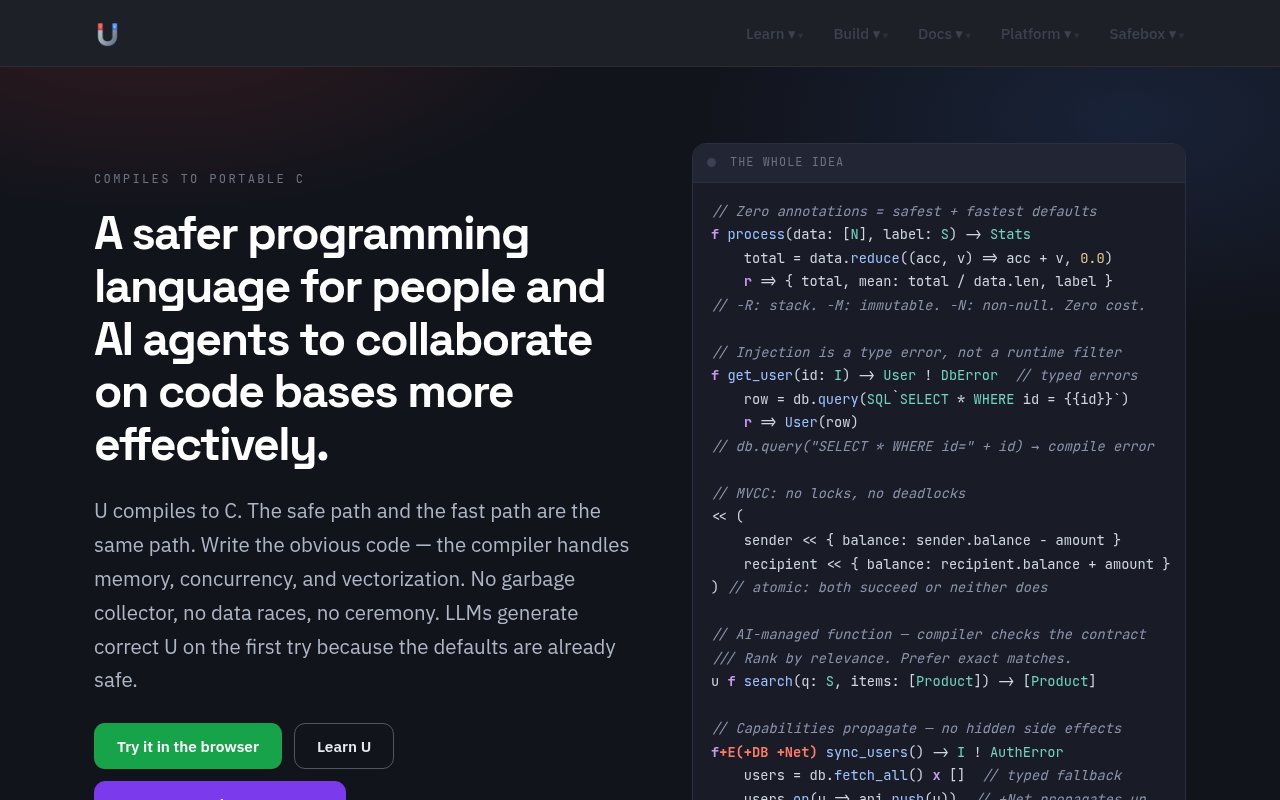
About U Language
U is a small programming language and reference compiler built around the idea that common production failures should become compile-time errors. Source code is transpiled to readable C, which can then be compiled into a native binary with a standard C toolchain. The language emphasizes safe defaults for memory, mutation, effects, errors, database access, and concurrency, while keeping its surface deliberately compact. It is also designed with AI coding in mind. Function signatures expose contracts and capabilities so a person or model can understand more of a program's behavior without repeatedly reading every implementation body.
The reference compiler, named u2c, is written in Python and turns U programs into C. The project provides a browser playground, an editor, tutorials, copyable snippets, a compiler API, a language specification, and implementation notes. A quick-start flow can scaffold a project and build bundled examples such as a hello program, Fibonacci calculation, JSON processing, and typed errors. The generated C is intended to be portable and inspectable rather than hidden behind a virtual machine. The website says there is no separate runtime to install for a compiled program, though particular library features may still depend on the platform and its available C libraries.
Safety comes from the language's types, modifiers, and compile-time analysis. Parameters and local values are immutable by default unless mutation is requested explicitly. Typed errors appear in function contracts, while capabilities describe effects such as database access or networking and propagate through the call graph. Database query constructs are designed to use parameter binding, and the compiler includes checks intended to catch injection patterns and dangerous capability combinations. U also supports fibers, concurrency primitives, rational arithmetic, and targets such as WebAssembly. These are broad ambitions for a young language, so buyers should read the project's feature matrix instead of assuming every documented design is complete.
That feature matrix is unusually direct about implementation status. It labels major areas as working, simplified, or placeholder and points to tests behind individual claims. The project reports more than one thousand parser, linter, code generation, and optimization tests, with code generation cases compiling the emitted C and running the resulting binary. At the same time, the homepage calls U a working reference compiler rather than a finished product. Some areas have important scope limits, including partial generic behavior, platform-specific networking paths, and protocol features that are present only in reduced form. The matrix is valuable because it makes experimentation more informed, but it also confirms that production adoption requires careful evaluation.
U is most relevant to language designers, systems-minded application developers, and teams exploring safer compilation targets for code written with AI assistance. PHP, JavaScript, and TypeScript transpilation are prominent on the site, with examples showing existing web application structures converted through U and then compiled to native binaries. The project also presents use cases for small servers, edge workloads, constrained devices, auditable application code, and AI-managed functions. These paths aren't equally mature. A team considering migration should begin with isolated services or test programs, compare generated behavior with the original, and use the status matrix to identify unsupported corners before treating the compiler as a drop-in production replacement. Teams should also check target-specific library behavior because native, WASI, and browser environments don't expose the same operating system facilities.
What makes U distinct is the attempt to unify several concerns through one visible contract system. Memory behavior, mutation, effects, errors, and parallel execution aren't presented as separate layers of framework configuration. They are meant to be represented in the language and checked during compilation. That can make source easier to audit and gives an AI assistant narrower choices than a permissive general-purpose language. The tradeoff is ecosystem maturity. U has a much smaller community and library base than established languages, and its own site warns that the reference compiler is still in development. The documentation, playground, and examples are available without a paid plan, so it is best approached today as a free developer tool for serious evaluation and experimentation rather than a finished commercial platform.
Key Features
- U to C transpilation
- Browser editor and playground
- Compile-time capability checks
- Immutable values by default
- Typed errors and contracts
- Public feature status matrix
Pros & Cons
What we like
- Emits readable C for standard toolchains
- Documents incomplete features with explicit status labels
- Makes effects and errors visible in signatures
- Offers tutorials, snippets, and browser experimentation
Room for improvement
- Reference compiler is still in development
- Some language and runtime areas remain simplified
- Much smaller ecosystem than established languages
- Production migration requires careful compatibility testing
Frequently Asked Questions
What is U Language?
Is U ready for production use?
Can U run in a browser?
Is U Language free?
Best For
Featured in
Alternatives to U Language

Kevin Gabeci
Solo developer building web apps, cozy browser games, and AI creator toolkits.

SoloDevStack
A solo developer blog built on head-to-head tool comparisons, 580+ posts deep.

Codedex
A gamified, story-driven platform that teaches Python, web dev, and more like an RPG quest
Vibe Built
Building real apps with agentic AI. What worked, what broke, what shipped.
Reviews (0)
Badge builder
Add U Language to your website
Choose a badge style and size, preview it here, then copy the generated HTML. Badge images are self-contained SVGs and do not require an external script.

<a href="https://toolindex.net/tools/ulanguage?ref=badge" target="_blank" rel="noopener">
  <img src="https://toolindex.net/badge/ulanguage/medium.svg" alt="U Language - Listed on Tool Index" width="180" height="50" />
</a>How to use the badge
- 1. Pick the style, size, and theme that fit your layout.
- 2. Copy the generated HTML from the code block.
- 3. Paste it into your footer, homepage, or press page.
Standard badge available
The standard listing badge is available now. Score and circle badges are limited to tools currently ranked in the top 10 of a category.
Badge clicks return visitors to this profile with a referral tag so the source remains identifiable.
Related Tools
Kevin Gabeci
Solo developer building web apps, cozy browser games, and AI creator toolkits.
Coolify
Self-hostable, open source alternative to Heroku and Netlify

Warp
The modern terminal reimagined with AI and collaboration

Bolt.new
Prompt-to-deployed full-stack app inside the browser
Work on U Language? Request listing access or correction