VernLLM
Add resilience, control, and observability to TypeScript LLM calls
Gallery
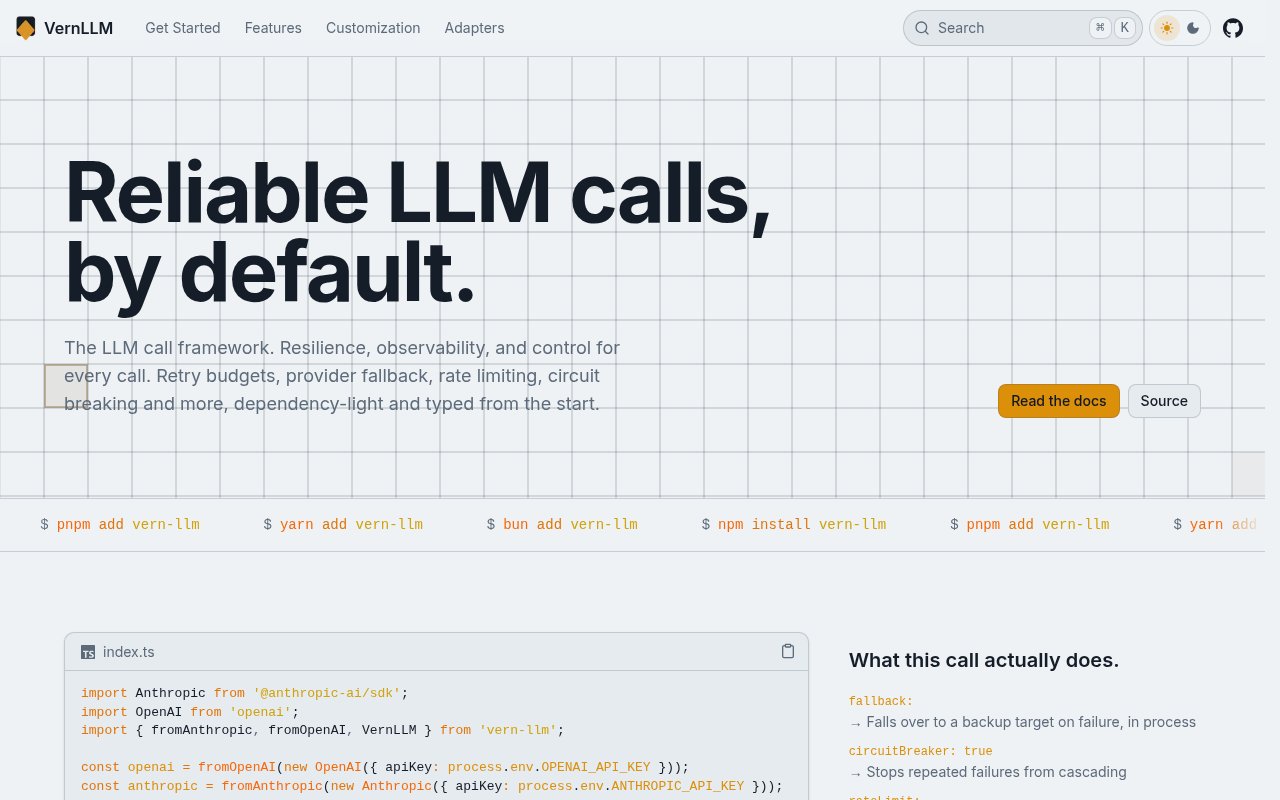
About VernLLM
VernLLM is an open-source TypeScript framework that wraps calls to large language model providers with the reliability controls an application usually has to build itself. It sits inside the application's own process and keeps the existing provider client in place. Developers get one call interface plus configurable retries, timeouts, fallback, rate limiting, circuit breaking, caching, structured output, streaming, usage tracking, middleware, and observability. The goal is to make a production LLM call predictable without sending traffic through another hosted gateway or forcing a team to adopt a large application framework.
The basic setup is deliberately small. A developer installs the vern-llm package, adapts an existing provider client, chooses a model, and creates a VernLLM instance. A plain call gets JSON parsing, retries, and timeouts by default, while raw text is available by switching JSON mode off. Calls can override instance settings such as the model or reasoning effort, which supports patterns where routine work uses a cheaper default and difficult work escalates selectively. Streaming returns incremental chunks alongside a final validated result, so an interface can render output immediately without giving up the same result handling used by nonstreaming calls.
Its resilience features address several different failure modes instead of treating every error as a retry. Retries use exponential backoff with jitter and understand provider retry guidance, while parse errors, validation failures, and nonretryable responses can fail fast. A retry budget can cap the share of recent traffic spent on repeated attempts. Provider fallback tries declared backup targets in order when policy allows a transition. Client-side rate limiting queues work against requests, tokens, and concurrency ceilings before the provider rejects it. The circuit breaker stops sending calls to an unhealthy target after repeated failures and can recover after its cooldown conditions are met.
VernLLM also covers the work around a successful model response. A call can request structured output and validate it with Zod or another validator that exposes a compatible safeParse interface. Provider-native JSON Schema mode can constrain generation where the provider supports it. Tool calling is represented in the response but execution stays in the host application, which keeps side effects under the developer's control. The cachedCall helper can reuse completed work through an in-memory store or a custom backend such as Redis. Middleware can transform or redact outgoing requests, wrap a complete logical call, and observe outcomes for tracing, logging, or cost accounting.
Observability is built around a single event stream for retries, fallovers, circuit transitions, and rate-limit waits. Usage tracking reads token counts from provider responses, while optional usage metering can reserve capacity before a call and refund failed work. Logging is replaceable, and debug output can be redacted before it reaches the logger. These extension points follow small interfaces rather than one fixed deployment design. A team can bring a distributed rate limiter, a shared cache, its preferred logging stack, or a custom circuit policy without rewriting the rest of the call path.
Provider coverage is broad but doesn't hide the underlying provider. OpenAI-compatible services can use a near-direct adapter path, while official adapters translate Anthropic, Gemini, and AWS Bedrock into the common interface. A raw HTTP adapter handles providers that lack a packaged integration. The project lists OpenAI, Groq, Mistral, DeepSeek, Cerebras, Together, Fireworks, Ollama, and many other compatible endpoints. VernLLM has zero runtime dependencies and doesn't bundle provider SDKs or schema validators, so developers install only the clients they need. That keeps the library light, though it also means model credentials, provider billing, and provider-specific limitations remain the application's responsibility.
This is best suited to TypeScript teams that want a reusable call layer inside one service and prefer code-level control over a centrally managed proxy. Keeping execution in process removes an extra network hop and lets reliability decisions react to application state. A gateway can still be a better fit when many services in different languages need one shared policy and credential boundary. VernLLM is distributed under the MIT license, with source, documentation, and an npm package available publicly. The library itself is free and open source, but calls made through it still incur whatever charges the selected model provider applies.
Key Features
- Policy-aware retries and timeouts
- Ordered multi-provider fallback
- Rate limiting and circuit breaking
- Typed structured output validation
- Streaming, caching, and middleware
- Unified reliability event stream
Pros & Cons
What we like
- Runs in process without another proxy
- Works across many model providers
- Uses small replaceable infrastructure interfaces
- Adds zero runtime dependencies
Room for improvement
- Focused on TypeScript applications
- Provider costs and credentials remain separate
- Requires configuration for advanced reliability policies
- Young project with a small community
Frequently Asked Questions
What is VernLLM?
Which providers does VernLLM support?
Is VernLLM free?
How is VernLLM different from an LLM gateway?
Best For
Featured in
Alternatives to VernLLM

Kevin Gabeci
Solo developer building web apps, cozy browser games, and AI creator toolkits.

SoloDevStack
A solo developer blog built on head-to-head tool comparisons, 580+ posts deep.

Codedex
A gamified, story-driven platform that teaches Python, web dev, and more like an RPG quest

Vibe Built
Building real apps with agentic AI. What worked, what broke, what shipped.
Reviews (0)
Badge builder
Add VernLLM to your website
Choose a badge style and size, preview it here, then copy the generated HTML. Badge images are self-contained SVGs and do not require an external script.

<a href="https://toolindex.net/tools/vernllm?ref=badge" target="_blank" rel="noopener">
  <img src="https://toolindex.net/badge/vernllm/medium.svg" alt="VernLLM - Listed on Tool Index" width="180" height="50" />
</a>How to use the badge
- 1. Pick the style, size, and theme that fit your layout.
- 2. Copy the generated HTML from the code block.
- 3. Paste it into your footer, homepage, or press page.
Standard badge available
The standard listing badge is available now. Score and circle badges are limited to tools currently ranked in the top 10 of a category.
Badge clicks return visitors to this profile with a referral tag so the source remains identifiable.
Related Tools
Kevin Gabeci
Solo developer building web apps, cozy browser games, and AI creator toolkits.

Coolify
Self-hostable, open source alternative to Heroku and Netlify

Warp
The modern terminal reimagined with AI and collaboration

Bolt.new
Prompt-to-deployed full-stack app inside the browser
Work on VernLLM? Request listing access or correction