
VerusCite
Verify academic citations and catch hallucinated references before you publish
Gallery
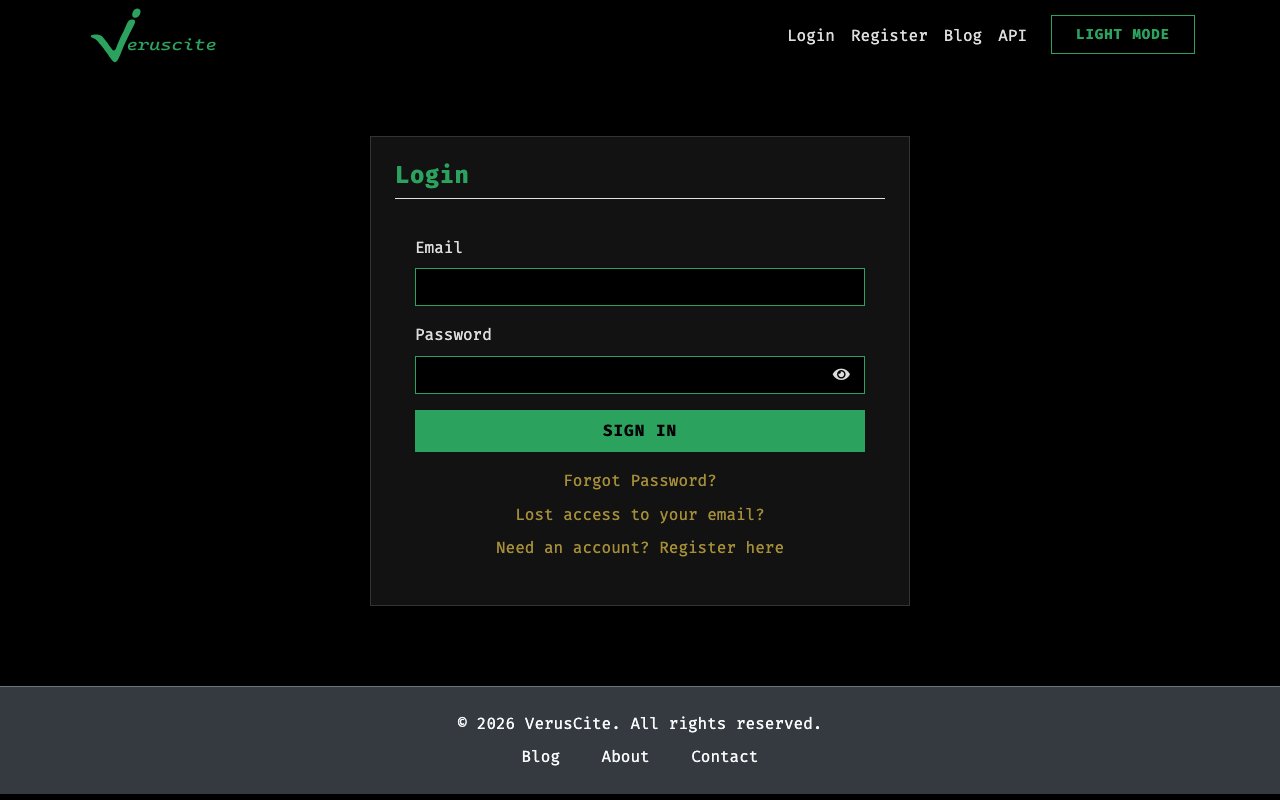
About VerusCite
VerusCite is a verification tool that checks academic citations for accuracy. You upload a PDF, it extracts your references using AI, then cross checks each one against scholarly databases like Crossref and web search results. The output is a report showing which citations verified, which ones have errors, and which appear to be hallucinated entirely. The goal is to catch mistakes in your bibliography before a reviewer or reader does. For anyone working with AI writing assistants or inheriting papers from collaborators, this addresses a problem that has grown significantly since generative AI tools became common in academic workflows. The tool acts as a safety net between drafting and submission.
The scale of the problem is substantial. A Lancet audit of 2.5 million biomedical papers found hallucinated reference rates rising 12 fold between 2023 and early 2026. Separate estimates project roughly 147,000 hallucinated citations across arXiv, bioRxiv, SSRN, and PMC in 2025 alone. The problem spans disciplines including biomedical research, AI and machine learning conferences, legal filings, and government reports. Preprint server arXiv announced stricter enforcement in 2026 holding authors responsible for unchecked AI output, including hallucinated references. The principle is clear: authors are responsible for everything in their paper, however it was generated. This regulatory and reputational pressure makes verification tools increasingly necessary for anyone publishing academic work.
Citation hallucination happens in several ways. An AI tool might invent a reference entirely, creating an author, title, and journal that do not exist. It might corrupt real bibliographic metadata, getting the year wrong or attributing a claim to the wrong issue. It might pair a real DOI with the wrong title, or attribute a claim to a source that does not actually support it. Some hallucinations are partial, where most of the citation is correct but a key detail like the volume number or page range is fabricated. While no automated tool can prove with certainty that a citation was AI generated, it is difficult to construct a scenario where a bibliography contains volume and page numbers that do not exist in any comparable document through manual error alone. The variety of error types makes manual checking tedious and error prone.
Under the hood, VerusCite works in three stages. First, LLM agents parse the document and pull out citation metadata like author names, titles, publication years, and journal names. This extraction step handles different citation formats and styles, so you do not need to preprocess your bibliography. Second, each citation gets checked against Crossref for peer reviewed articles, plus web search for books and online sources. Third, another layer of AI reasoning compares what you cited against what the search actually found, flagging discrepancies and outright fabrications. The platform handles papers up to 1,000 pages and 100 megabytes, which covers dissertations and lengthy technical reports without artificial limits. The three stage approach combines machine parsing with database lookup and semantic comparison.
According to their published benchmark on 36 documents with over 2,000 citations, VerusCite achieves under a one percent false positive rate for hallucinations and over 70 percent recall for citations with some type of error. Of the 2,288 citations tested, 82.6 percent verified cleanly, 8.9 percent had minor errors, 6.2 percent were hallucinations, and 2.4 percent were not found. That means it rarely flags a correct reference as bad, and it catches most of the real mistakes. The low false positive rate is particularly important because academics do not want to spend time defending correct citations that were incorrectly flagged. For academic work where credibility hinges on accurate sourcing, that is a meaningful safety net, though some errors will still slip through given the 70 percent recall rate.
The interface is straightforward. After verification finishes, you see a dashboard where each citation is marked as verified, suspicious, or hallucinated. You can edit flagged references right there, correcting metadata or replacing fabricated sources with real ones. The tool will add verified URLs or DOIs to the ones it confirmed, which helps readers and reviewers access your sources. When you are done, you export the corrected bibliography. For privacy, the platform only processes the citation sections through its models, not the full text, and deletes original PDFs after analysis. This matters for researchers working with unpublished manuscripts or confidential material where sharing full documents would be inappropriate.
Pricing is pay as you go. One credit covers up to 100 citations and costs two dollars. Larger papers that exceed 100 references simply require additional credits, so a dissertation with 300 references would need three credits. New users receive two free credits on signup, which is enough to test the tool on a standard journal article before deciding whether to keep using it. There are no subscriptions or monthly fees, so occasional users pay only when they have a document to verify. The target audience is researchers, graduate students, academics, and anyone else who needs to ensure their bibliography is accurate before submission. For anyone who has been burned by a reviewer finding a nonexistent reference, this is the tool that catches those errors earlier.
Key Features
- AI citation extraction from PDFs
- Cross reference against Crossref and web search
- Hallucination and error detection
- In browser reference editing
- DOI and URL attachment to verified citations
- Support for papers up to 1000 pages
Pros & Cons
What we like
- Catches hallucinated and erroneous citations before publication
- Pay as you go pricing with no subscriptions
- Under one percent false positive rate on their benchmark
- Privacy focused with immediate PDF deletion
Room for improvement
- Recall for errors is around 70 percent so some issues may slip through
- Credit cost can add up for very large documents
- Focused on academic citations rather than general fact checking
- Requires uploading your document to a third party
Frequently Asked Questions
What is VerusCite?
Is VerusCite free?
How accurate is VerusCite at catching hallucinated citations?
What happens to my uploaded documents?
Best For
Featured in
Alternatives to VerusCite

SoloDevStack
A solo developer blog built on head-to-head tool comparisons, 580+ posts deep.

Confluence
Atlassian's long-running team wiki that anchors many enterprise knowledge stacks

Lunchbreak AI
Run text through six AI detectors at once, then humanize whatever gets flagged

Postdex
An exclusive marketplace for finished, human-made articles. Every piece sells once.
Reviews (0)
Badge builder
Add VerusCite to your website
Choose a badge style and size, preview it here, then copy the generated HTML. Badge images are self-contained SVGs and do not require an external script.

<a href="https://toolindex.net/tools/veruscite?ref=badge" target="_blank" rel="noopener">
  <img src="https://toolindex.net/badge/veruscite/medium.svg" alt="VerusCite - Listed on Tool Index" width="180" height="50" />
</a>How to use the badge
- 1. Pick the style, size, and theme that fit your layout.
- 2. Copy the generated HTML from the code block.
- 3. Paste it into your footer, homepage, or press page.
Standard badge available
The standard listing badge is available now. Score and circle badges are limited to tools currently ranked in the top 10 of a category.
Badge clicks return visitors to this profile with a referral tag so the source remains identifiable.
Related Tools
Confluence
Atlassian's long-running team wiki that anchors many enterprise knowledge stacks
SoloDevStack
A solo developer blog built on head-to-head tool comparisons, 580+ posts deep.

Logseq
An open-source outliner notes app where every bullet is a first-class block

Bear
A beautiful Markdown notes app for Apple devices that doubles as a writing tool
Work on VerusCite? Request listing access or correction