Wasmer SDK
Open-source SDK for running code in local WebAssembly sandboxes from Python, JavaScript, and Rust
Gallery
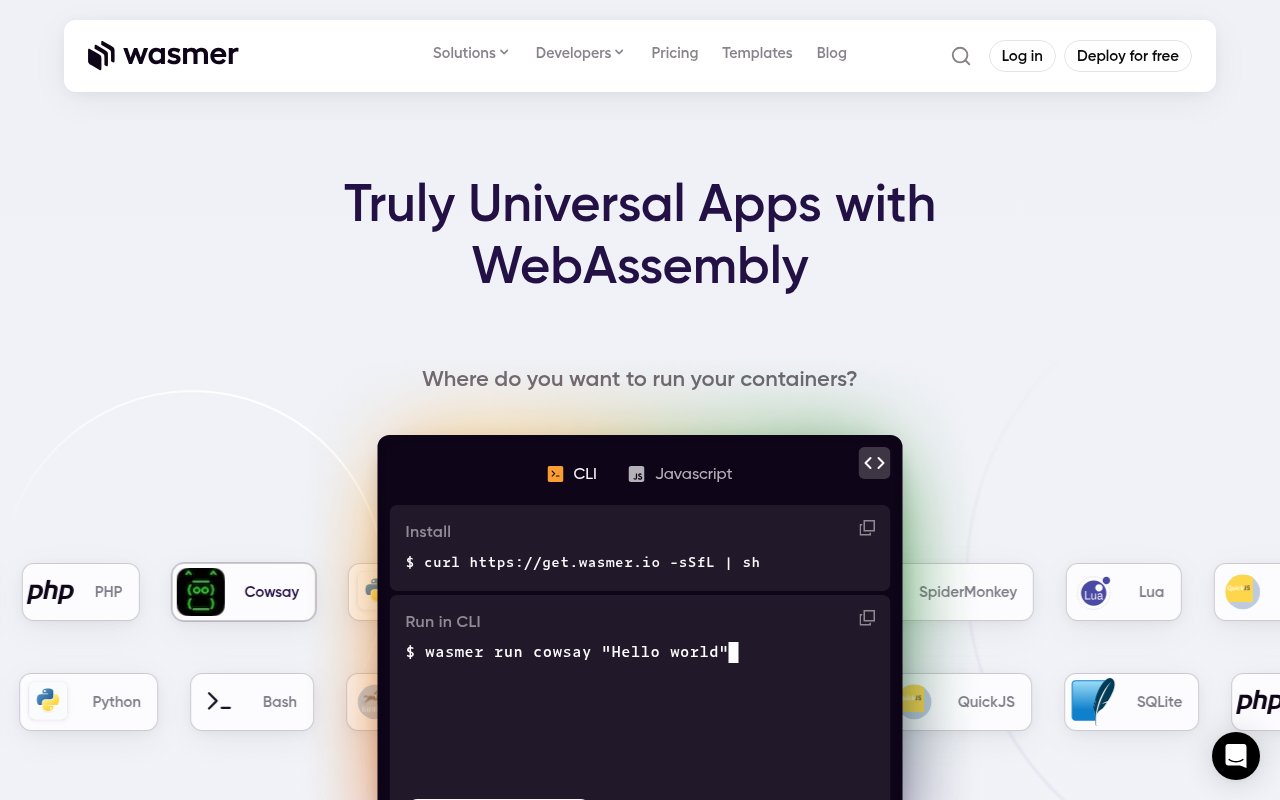
About Wasmer SDK
Wasmer SDK is an open-source library for running programs inside lightweight WebAssembly sandboxes from your own code, with Python, JavaScript, and Rust bindings. The pitch, made in the launch post from early September 2026, is local sandboxes for AI agents. When an agent writes code and needs somewhere to execute it, the usual answers are a Docker container or a remote sandbox service, one heavy and one that sends your workload to someone else's machine. The Wasmer SDK runs the sandbox in-process on the machine you're already on, and creating one takes a fraction of a millisecond.
Under the hood the sandboxes are WebAssembly modules built against WASIX, Wasmer's extension of the WASI system interface. Isolation comes from the runtime itself, with bounds-checked memory and validated control flow rather than a kernel namespace. The runtimes you can drop in come from the Wasmer registry and include Python 3.13, Node.js through the Edge.js and QuickJS packages, PHP, PostgreSQL 18, and shell tools, and you can install extra packages into a sandbox at runtime. Files, environment variables, mounts, and network access are configured when the sandbox is created. Networking works in the browser through Service Workers and through proxy routing for outbound connections elsewhere, and the Python runtime supports threads, greenlets, asyncio, and ordinary pip workflows. The packages the launch post references by name are python/python, wasmer/edgejs-quickjs, and php/php-32, and the README adds Postgres, shell tools, and WASIX-based services such as pnpm with networking to the list of things that have been run inside.
The API is the same shape in every language. A sandbox exposes a command that you either run to completion, with non-zero exits failing by default, or spawn as a long-lived process with control over stdin, stdout, and stderr. The sandbox filesystem is readable and writable from the host, ports can be discovered for services running inside, and an installPackage call pulls more software in. Installation is pip install wasmer-sdk, npm install @wasmer/sdk, or a Cargo dependency for Rust, and downloaded packages are cached in a shared .wasmer directory so they're reused across sandboxes and SDKs. The native Rust, Python, and Node.js clients share cache partitions, the JavaScript build keeps its own, and compiled artifacts are cached per target, which is the kind of detail that suggests the team has already run this in CI. The examples in the repository share fixture programs across languages so the same guest code is exercised from every SDK.
The performance claims are the reason to look. The launch post cites sandbox creation in about 0.1 ms and command execution 10 to 20 times faster than Docker, with single-digit millisecond startup, and the benchmark scripts and results are published in the repository so you can rerun them on your own hardware. There's a live demo at wasmer.sh if you'd rather see it before installing anything.
It's for developers building agents, code interpreters, plugin systems, or anything else that has to execute untrusted code and wants that to happen locally and cheaply. It's also a fit for teams who've been paying by the minute for hosted sandboxes and would like the same thing on their own hardware, and for anyone who needs a sandbox to run inside a browser tab, which containers can't do at all. Wasmer as a company sells the same runtime as a platform. The wider product line covers a runtime that runs WebAssembly on servers, browsers, mobile, and embedded devices, a registry of packages, and Wasmer Edge, a serverless host that deploys frameworks such as Next.js, Django, WordPress, and Laravel with managed PostgreSQL and cron jobs. The SDK is the piece that embeds that runtime in your own process.
What sets it apart from container-based sandboxes is the startup cost and the fact that it's a library rather than a daemon, so there's no Docker socket to manage and nothing to install beyond a package. The trade-off is that it's not a Linux VM. There are no kernel modules, no direct hardware access, and no eBPF, and software has to exist as a WASIX package before you can run it. The SDK is also marked alpha, with around 1,100 GitHub stars and 98 forks at the time of writing, so the API may still move between releases.
The SDK is MIT-licensed and free, and the wider Wasmer runtime is open source too, with more than 15,000 stars. Wasmer also sells hosting through Wasmer Edge, with a free Hobby tier, a Pro plan at $10 a month, and custom enterprise pricing, but none of that is required to use the SDK locally. Documentation lives in the GitHub repository alongside per-language guides, and there's no published support email beyond the community Discord.
Key Features
- In-process WebAssembly sandboxes
- Python, JavaScript, and Rust SDKs
- Python, Node.js, PHP, and Postgres runtimes
- Run or spawn commands with full stdio control
- Host access to the sandbox filesystem and ports
- Browser networking through Service Workers
Pros & Cons
What we like
- Sandbox creation in a fraction of a millisecond
- No Docker daemon or remote service required
- Same API shape across every language
- MIT-licensed with published benchmarks
Room for improvement
- Alpha status, so the API may still change
- Not a full Linux VM, no kernel modules or hardware access
- Only software packaged for WASIX can run
- Younger SDK with a smaller track record than containers
Frequently Asked Questions
What is the Wasmer SDK?
Is the Wasmer SDK free?
How is it different from Docker?
Who is it for?
Best For
Featured in
Alternatives to Wasmer SDK

Kevin Gabeci
Solo developer building web apps, cozy browser games, and AI creator toolkits.

SoloDevStack
A solo developer blog built on head-to-head tool comparisons, 580+ posts deep.

Codedex
A gamified, story-driven platform that teaches Python, web dev, and more like an RPG quest

Vibe Built
Building real apps with agentic AI. What worked, what broke, what shipped.
Reviews (0)
Badge builder
Add Wasmer SDK to your website
Choose a badge style and size, preview it here, then copy the generated HTML. Badge images are self-contained SVGs and do not require an external script.

<a href="https://toolindex.net/tools/wasmer-sdk?ref=badge" target="_blank" rel="noopener">
  <img src="https://toolindex.net/badge/wasmer-sdk/medium.svg" alt="Wasmer SDK - Listed on Tool Index" width="180" height="50" />
</a>How to use the badge
- 1. Pick the style, size, and theme that fit your layout.
- 2. Copy the generated HTML from the code block.
- 3. Paste it into your footer, homepage, or press page.
Standard badge available
The standard listing badge is available now. Score and circle badges are limited to tools currently ranked in the top 10 of a category.
Badge clicks return visitors to this profile with a referral tag so the source remains identifiable.
Related Tools
Kevin Gabeci
Solo developer building web apps, cozy browser games, and AI creator toolkits.

Coolify
Self-hostable, open source alternative to Heroku and Netlify

Warp
The modern terminal reimagined with AI and collaboration

Bolt.new
Prompt-to-deployed full-stack app inside the browser
Work on Wasmer SDK? Request listing access or correction