
WeaveScope
Trace, debug, and monitor AI agents built with Elixir and the BEAM
Gallery
About WeaveScope
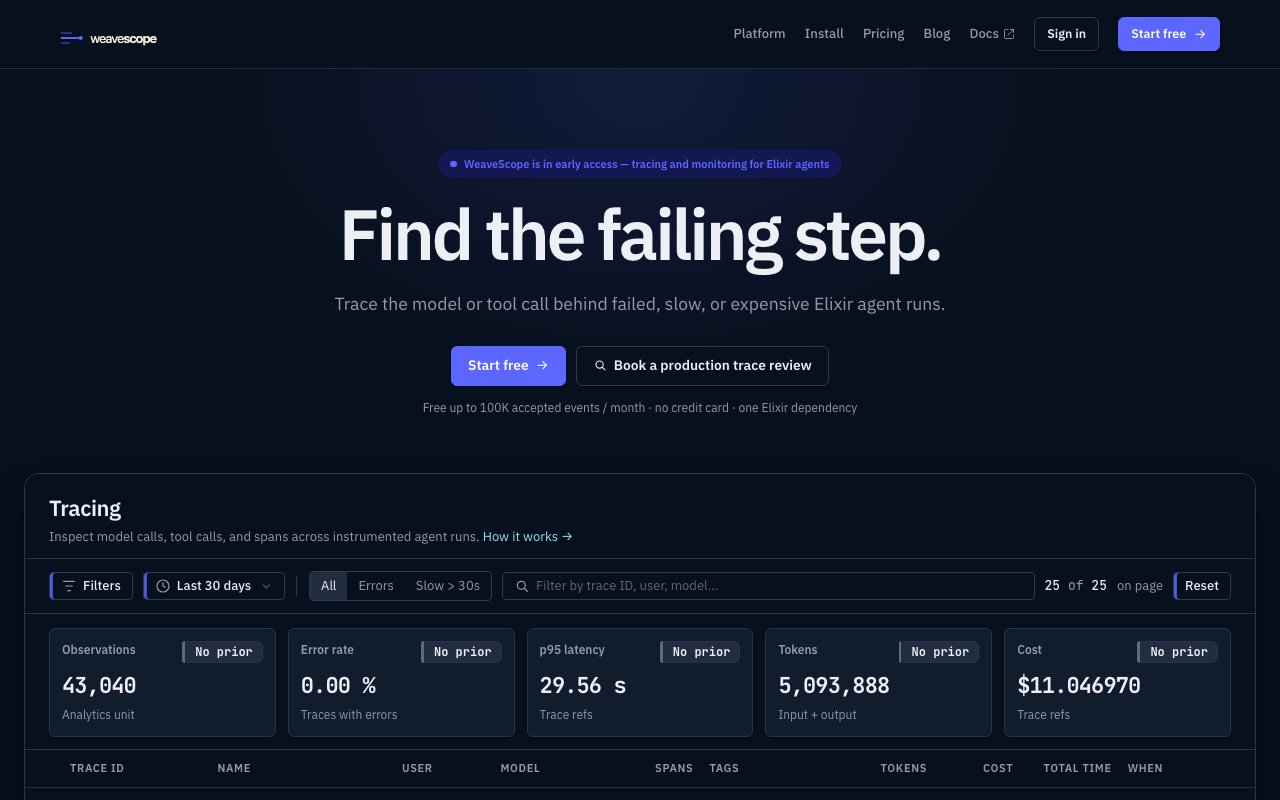
WeaveScope is an observability platform built specifically for AI agents running on Elixir and the BEAM. If your agents live in the Elixir ecosystem, WeaveScope gives you tracing, debugging, and monitoring that understands how those systems actually behave, instead of forcing you to squint at a generic APM dashboard or an LLM observability tool that assumes everyone writes Python.
The gap it fills is real. The mainstream AI observability stack has grown up around Python and TypeScript, so teams building agents on the BEAM have been left stitching together telemetry by hand or going without. That's a bad place to be with agent workloads, where a single run can fan out into dozens of model calls and tool calls, costs accumulate token by token, and the interesting failures happen three steps deep in a chain you can't see. WeaveScope treats the Elixir agent as a first-class citizen and instruments that whole chain.
Integration goes through a single dependency called BeamWeaver, published on Hex. You add it to your mix project, configure an API key and endpoint, and it starts exporting instrumented agent runs, model calls, and tool calls in the background. There's no separate collector to deploy and no manual span plumbing to write, the library handles the export asynchronously so it stays out of the way of your actual agent code. Documentation lives at docs.weavescope.com for the configuration details beyond that one-line pitch.
Once traces are flowing, WeaveScope reconstructs each run as a unified timeline, so you can inspect every model call, tool call, and span in the order they happened and see exactly where a run went sideways. That's the debugging half, and it's the part that changes day-to-day work the most. Instead of grepping logs and mentally reassembling what an agent did across a dozen processes, you get the whole run laid out as one coherent story. The monitoring half tracks throughput, latency, errors, token usage, and costs across your agents over time, which turns questions like which agent is burning the budget or where latency crept in from guesswork into a dashboard lookup. Token and cost tracking in particular is something generic APM tools simply don't have a concept for, and it's often the metric that decides whether an agent feature is economically viable at all.
It's aimed at development teams building AI agents on Elixir and the BEAM who need visibility into what their agents are doing in production. That includes teams debugging misbehaving runs, teams optimizing cost per task, and anyone who wants error and latency trends before users start reporting them. The Elixir AI ecosystem has been growing steadily, and the teams betting on it tend to be exactly the kind of pragmatic engineering shops that expect real observability from day one rather than treating it as a later problem. Alerts are listed as coming soon, building on the tracing and monitoring data that's already collected, so proactive notification is on the roadmap rather than in the product today. If alerting is a hard requirement right now, that's worth knowing before you commit, though the underlying data it will draw on is already being captured.
What makes it different is the focus. There are plenty of LLM observability platforms, but almost none of them speak Elixir natively, and generic BEAM monitoring tools don't understand agents, model calls, or token costs. WeaveScope sits precisely at that intersection, and the one-line integration reflects it. Because the instrumentation library is built for the runtime you're already on, you're not writing adapter glue or shipping traces through a sidecar meant for another ecosystem. For a niche this specific, being the tool that actually fits the stack is the whole pitch, and it's a credible one given how much friction the alternative involves. Anyone who has tried to bolt a Python-first tracing SDK onto a BEAM application knows the pain being avoided here.
Pricing follows a straightforward tiered model. The free plan costs nothing and covers 100K events per month with 14 days of retention and two users, which is enough to instrument a real project and live with the product for a while. Pro runs 29 euros per month for 1M events, 30 days of retention, and unlimited users, Scale is 99 euros for 10M events and 90 days of retention, and an Enterprise tier handles 50M+ events with custom retention and terms through a talk-to-sales motion. Event-based pricing maps cleanly onto agent workloads, since busy agents generate more spans, and the free tier means an Elixir team can wire in BeamWeaver this afternoon and see their first traced run before deciding whether to pay anything at all.
Key Features
- Native Elixir and BEAM agent instrumentation
- Unified timeline of model calls, tool calls, and spans
- Throughput, latency, and error monitoring
- Token usage and cost tracking
- One-dependency setup via BeamWeaver on Hex
- Tiered event-based pricing with free plan
Pros & Cons
What we like
- One of the only observability tools built natively for Elixir AI agents
- Setup is a single Hex dependency plus an API key
- Tracks cost and token usage per agent run, not just errors
- Free tier with 100K events is enough for a real project
Room for improvement
- Only useful if your agents run on Elixir and the BEAM
- Alerts are still listed as coming soon
- Free tier retention is limited to 14 days
- Younger product in a narrow niche with a small community
Frequently Asked Questions
What is WeaveScope?
How do I integrate WeaveScope?
Is WeaveScope free?
Who is WeaveScope for?
Best For
Featured in
Alternatives to WeaveScope

Kevin Gabeci
Solo developer building web apps, cozy browser games, and AI creator toolkits.

SoloDevStack
A solo developer blog built on head-to-head tool comparisons, 580+ posts deep.

Codedex
A gamified, story-driven platform that teaches Python, web dev, and more like an RPG quest
Vibe Built
Building real apps with agentic AI. What worked, what broke, what shipped.
Reviews (0)
Badge builder
Add WeaveScope to your website
Choose a badge style and size, preview it here, then copy the generated HTML. Badge images are self-contained SVGs and do not require an external script.

<a href="https://toolindex.net/tools/weavescope?ref=badge" target="_blank" rel="noopener">
  <img src="https://toolindex.net/badge/weavescope/medium.svg" alt="WeaveScope - Listed on Tool Index" width="180" height="50" />
</a>How to use the badge
- 1. Pick the style, size, and theme that fit your layout.
- 2. Copy the generated HTML from the code block.
- 3. Paste it into your footer, homepage, or press page.
Standard badge available
The standard listing badge is available now. Score and circle badges are limited to tools currently ranked in the top 10 of a category.
Badge clicks return visitors to this profile with a referral tag so the source remains identifiable.
Related Tools
Kevin Gabeci
Solo developer building web apps, cozy browser games, and AI creator toolkits.
Coolify
Self-hostable, open source alternative to Heroku and Netlify

Warp
The modern terminal reimagined with AI and collaboration

Bolt.new
Prompt-to-deployed full-stack app inside the browser
Work on WeaveScope? Request listing access or correction