
Webstractor
Pay-as-you-go web data API that turns pages, URLs, and PDFs into Markdown or JSON
Gallery
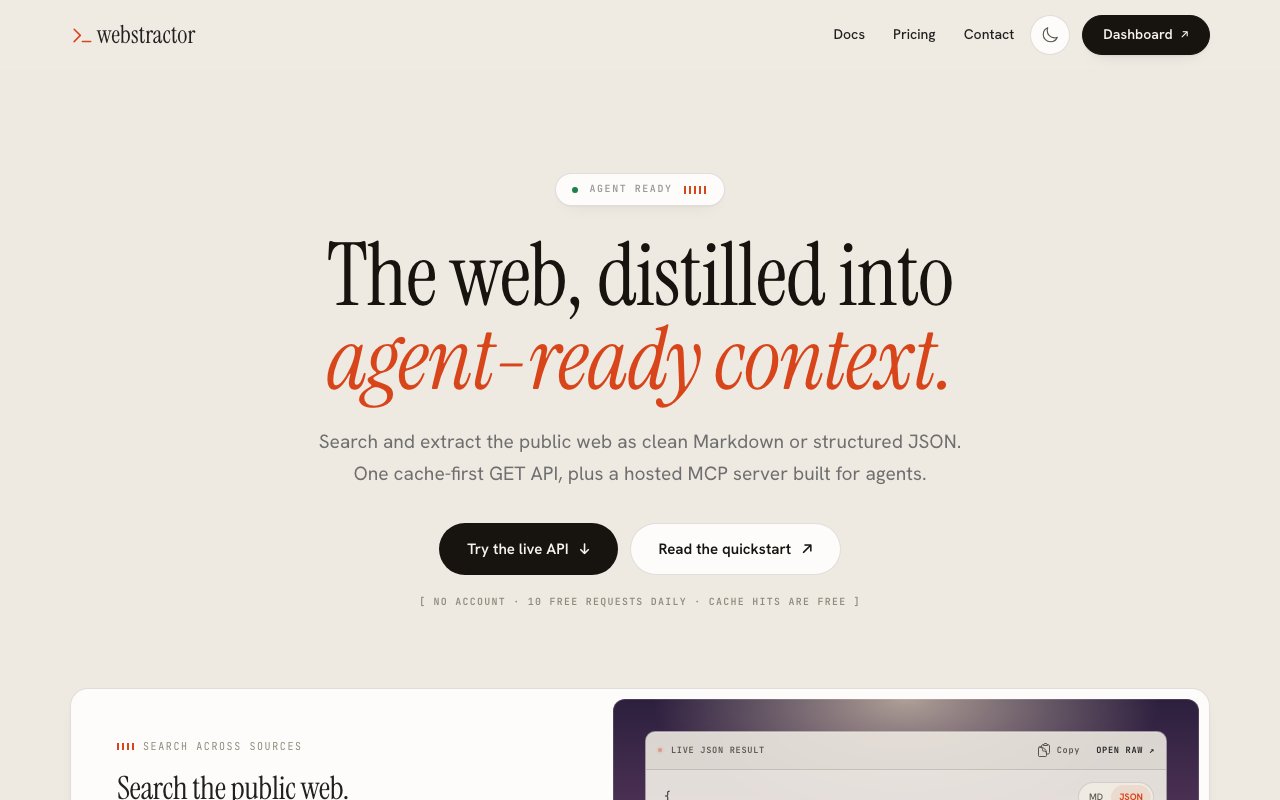
About Webstractor
Webstractor is a pay-as-you-go web data API that turns public web pages, known URLs, and bounded PDF uploads into clean Markdown or normalized JSON. It's aimed squarely at AI agents and the developers building them, since an agent is only as useful as the data you can feed it, and raw HTML scraped off the modern web is mostly noise. Webstractor sits between your code and the open web and hands back content in a shape a language model or a data pipeline can actually digest without a cleanup pass.
The problem it solves is the unglamorous plumbing behind every agent demo. Getting structured data out of the public web means fighting markup soup, inconsistent rendering, and a different layout on every site you touch. Most teams either build and babysit their own scrapers or stitch together several single-purpose APIs for search, extraction, and screenshots, each with its own billing meter and failure modes. Webstractor consolidates all of that into one set of REST endpoints with one credit meter, so the plumbing becomes a single dependency instead of five separate subscriptions. That consolidation also simplifies failure handling, since one consistent response shape means one error path in your code instead of a bespoke wrapper around every provider.
The endpoint list is broad for a focused API. There's web search with configurable output formats, news search returning up to 50 results, image search with metadata, and video search that includes creator and duration information. Place search supports coordinate biasing for location-aware queries. A screenshot endpoint captures websites as WebP or PNG with 30-day caching, and a finance endpoint retrieves stock market data with currency conversion built in. The extraction endpoint handles known URLs across more than 18 platforms, including Reddit, TikTok, YouTube, Spotify, Instagram, Amazon, and Shopify, and normalizes whatever comes back into a consistent structure.
Everything works over plain REST GET requests with query parameters, and you pick the output format per call. That keeps integration close to trivial, there's no SDK to learn and any HTTP client or agent framework can hit it directly. For agent builders specifically, the format choice is the point. Markdown is what language models digest most cleanly, and normalized JSON is what the deterministic parts of your pipeline want, so getting both from the same endpoints saves you from writing conversion glue. Caching helps here too, since repeated calls for the same content come back from cache at no charge, which rewards agents that revisit the same sources during a session.
The pricing model is the most distinctive part of the product. There's no subscription at all. Credits cost $0.49 per 1,000, bought as one-time top-ups anywhere from $10 to $4,900, with optional capped auto-funding that triggers when your balance runs low. Every operation costs exactly one credit per uncached request, whether it's an extraction, a search, a finance query, or a screenshot, and failed requests and cache hits are free. That flat, predictable metering is rare in a category where scraping APIs usually price by page complexity, JavaScript rendering tiers, or per-endpoint schedules that make cost estimation a spreadsheet exercise.
Trying it costs nothing. Anonymous users get 10 uncached requests per IP per UTC day without creating an account, and new accounts receive 1,000 welcome credits that never expire, which is enough to wire it into a project and see how the output looks against your real targets. Rate limits sit at 60 uncached requests per minute in general and 5 per minute for the heavier extraction and screenshot operations, numbers worth knowing before you point a high-throughput agent loop at it. There's no trial clock ticking either, so an abandoned side project can pick the same credits back up months later without losing anything.
It fits developers, researchers, and teams that need programmatic access to public web data without standing up and maintaining scraping infrastructure of their own. If your usage is spiky or experimental, the no-subscription model is genuinely friendly, you top up once and the credits sit there until you spend them, with nothing renewing in the background. Heavier production loads will want to do the math on volume, and custom pricing plus nonprofit and startup discounts are available through the contact page. The consistent one-credit metering also makes cost forecasting trivial, requests in equals credits out, no matter which mix of endpoints your agent leans on. As low-commitment infrastructure for feeding agents clean web data, it's an easy piece to slot in and an easy one to walk away from, which is exactly what you want from plumbing.
Key Features
- URL extraction across 18+ platforms
- Markdown or normalized JSON output
- Web, news, image, and video search
- Website screenshots with 30-day caching
- Stock data with currency conversion
- Flat one-credit pricing per request
Pros & Cons
What we like
- No subscription, credits never expire
- Failed requests and cache hits cost nothing
- 1,000 free welcome credits plus 10 free daily requests without an account
- Simple REST GET calls, no SDK required
Room for improvement
- Rate limits of 5 per minute on heavy extraction and screenshot calls
- Limited to public web content and bounded PDF uploads
- Younger product with a smaller community
- No monthly plan for teams that prefer predictable subscription billing
Frequently Asked Questions
What is Webstractor?
How much does Webstractor cost?
Can I try Webstractor for free?
How is Webstractor different from other scraping APIs?
Best For
Featured in
Alternatives to Webstractor

Kevin Gabeci
Solo developer building web apps, cozy browser games, and AI creator toolkits.

SoloDevStack
A solo developer blog built on head-to-head tool comparisons, 580+ posts deep.

Codedex
A gamified, story-driven platform that teaches Python, web dev, and more like an RPG quest

Vibe Built
Building real apps with agentic AI. What worked, what broke, what shipped.
Reviews (0)
Badge builder
Add Webstractor to your website
Choose a badge style and size, preview it here, then copy the generated HTML. Badge images are self-contained SVGs and do not require an external script.

<a href="https://toolindex.net/tools/webstractor?ref=badge" target="_blank" rel="noopener">
  <img src="https://toolindex.net/badge/webstractor/medium.svg" alt="Webstractor - Listed on Tool Index" width="180" height="50" />
</a>How to use the badge
- 1. Pick the style, size, and theme that fit your layout.
- 2. Copy the generated HTML from the code block.
- 3. Paste it into your footer, homepage, or press page.
Standard badge available
The standard listing badge is available now. Score and circle badges are limited to tools currently ranked in the top 10 of a category.
Badge clicks return visitors to this profile with a referral tag so the source remains identifiable.
Related Tools
Kevin Gabeci
Solo developer building web apps, cozy browser games, and AI creator toolkits.

Coolify
Self-hostable, open source alternative to Heroku and Netlify

Warp
The modern terminal reimagined with AI and collaboration

Bolt.new
Prompt-to-deployed full-stack app inside the browser
Work on Webstractor? Request listing access or correction