
Widefleet
Deploy agent-built internal apps with company access, data, storage, and logs
Gallery
About Widefleet
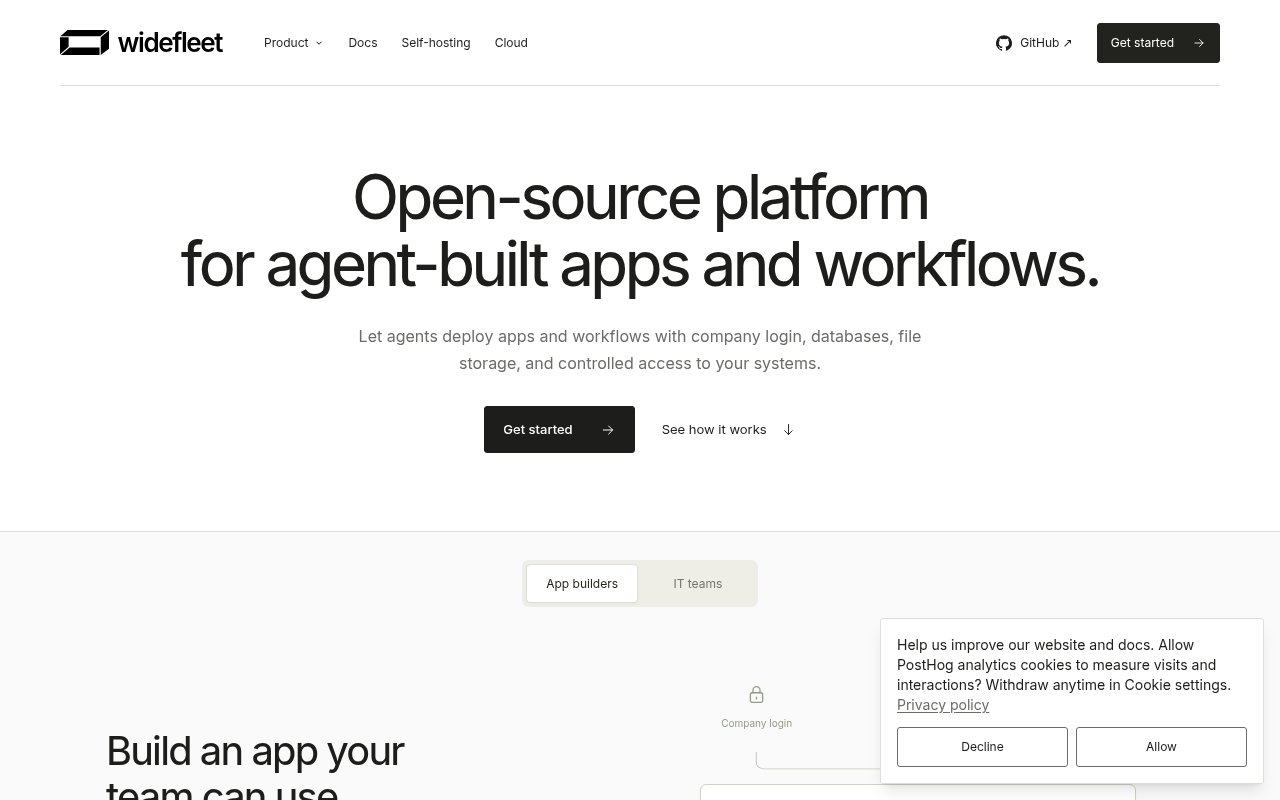
Widefleet is an open-source platform for building, deploying, and operating internal apps and workflows created with coding agents. A developer keeps each app in its own project and works in Claude Code, Codex, or another editor, while Widefleet supplies the shared infrastructure around the code. That includes company sign-in, app access controls, databases, private file storage, deployment, previews, and logs. The result is a middle layer between a locally generated app and a production service that colleagues can actually open and use.
The workflow starts outside the platform. A developer creates a regular application project, with SvelteKit as the current default starter and TanStack Start available for React, then edits it with the coding tool of choice. The Widefleet command line interface handles authentication, builds the project locally, uploads it, and creates the app on the first deployment. Later deployments update the same app. An isolated preview can be published before a release, and the deployment history supports viewing logs, inspecting errors, and rolling back code when an update goes wrong. Widefleet isn't the code generator itself. It provides the runtime and operational path for code produced by a person, agent, or both.
Each app can declare the resources it needs. Widefleet can give it a database, private file storage, and key-value bindings, with the data preserved across code deployments. Background work can run through scheduled jobs, queues, and durable workflows that support retries and waits for later events. Apps can also reach selected company systems through controlled network permissions or services managed by IT. That design gives infrastructure owners a clearer boundary than simply handing every generated tool broad credentials. Teams connect their identity provider, organize access groups, decide who can open each app, and make approved tools discoverable in a shared catalog.
The platform is aimed at developers and IT teams who want to turn small internal app ideas into maintained services without assembling authentication, storage, and deployment separately every time. It makes the most sense when people are comfortable owning application code but don't want every experiment to grow its own infrastructure stack. Examples include request trackers, reporting tools, project utilities, and background workflows that need company access and durable data. It can also give an internal platform team a consistent way to review how agent-built software reaches production, even when different builders use different coding assistants.
Widefleet can run in two ways. The complete platform is available under the MIT license and can be installed on a Linux server with Docker Compose. A self-hosted installation keeps the management service, deployment agent, app runtimes, identity configuration, databases, files, and application data in the organization's environment. The reference setup can use included PostgreSQL and object storage or connect to managed alternatives. Widefleet Cloud offers a fully hosted option where the company runs the control plane, apps, and storage. A hybrid option is marked as coming soon, so it shouldn't be treated as available yet.
The open-source coverage is unusually broad for this category. Widefleet states that the platform, CLI, runtime, and app starter are all covered by the MIT license, rather than reserving core operating features for a separate proprietary edition. It also provides a local demo with synthetic identities so evaluators can try an app, its database, and private file storage before connecting real infrastructure. That openness comes with operational responsibility. The current self-hosting reference targets one Linux x86-64 Docker host, and the operator owns identity configuration, DNS, certificates, backups, and upgrades. App development also expects Node.js and pnpm when deploying a real project.
Pricing for Widefleet Cloud isn't published on the public product pages, so the clearest access posture is open source rather than a documented SaaS price. Anyone can inspect and self-host the MIT-licensed platform, and the managed cloud has a public sign-in path for teams that prefer not to operate it. Buyers comparing the two should treat infrastructure effort as part of the self-hosted cost and ask Widefleet directly about cloud terms. The product is strongest for technical teams that want control over code and systems while standardizing deployment. A team looking for a purely visual no-code builder may find that Widefleet begins later in the process, once an actual app project exists.
Key Features
- Agent-friendly deployment CLI
- Company SSO and access groups
- Per-app databases and file storage
- Background jobs and durable workflows
- Isolated previews and rollbacks
- Self-hosted or managed deployment
Pros & Cons
What we like
- Keeps app code in independent projects
- Covers the full platform with an MIT license
- Combines identity, storage, and deployment
- Offers a local demo with synthetic data
Room for improvement
- Self-hosting requires Linux infrastructure work
- Cloud pricing isn't publicly documented
- Current reference installation targets x86-64
- Builders still need application development skills
Frequently Asked Questions
What is Widefleet?
Does Widefleet generate application code?
Can Widefleet be self-hosted?
Is Widefleet Cloud free?
Best For
Featured in
Alternatives to Widefleet
View all
Kevin Gabeci
Solo developer building web apps, cozy browser games, and AI creator toolkits.

SoloDevStack
A solo developer blog built on head-to-head tool comparisons, 580+ posts deep.

Codedex
A gamified, story-driven platform that teaches Python, web dev, and more like an RPG quest

Vibe Built
Building real apps with agentic AI. What worked, what broke, what shipped.
Reviews (0)
Badge builder
Add Widefleet to your website
Choose a badge style and size, preview it here, then copy the generated HTML. Badge images are self-contained SVGs and do not require an external script.

<a href="https://toolindex.net/tools/widefleet?ref=badge" target="_blank" rel="noopener">
  <img src="https://toolindex.net/badge/widefleet/medium.svg" alt="Widefleet - Listed on Tool Index" width="180" height="50" />
</a>How to use the badge
- 1. Pick the style, size, and theme that fit your layout.
- 2. Copy the generated HTML from the code block.
- 3. Paste it into your footer, homepage, or press page.
Standard badge available
The standard listing badge is available now. Score and circle badges are limited to tools currently ranked in the top 10 of a category.
Badge clicks return visitors to this profile with a referral tag so the source remains identifiable.
Related Tools
Kevin Gabeci
Solo developer building web apps, cozy browser games, and AI creator toolkits.

Coolify
Self-hostable, open source alternative to Heroku and Netlify

Warp
The modern terminal reimagined with AI and collaboration

Bolt.new
Prompt-to-deployed full-stack app inside the browser
Work on Widefleet? Request listing access or correction