
Zipbox
Cloud sandboxes for running AI coding agents on isolated virtual machines
Gallery
About Zipbox
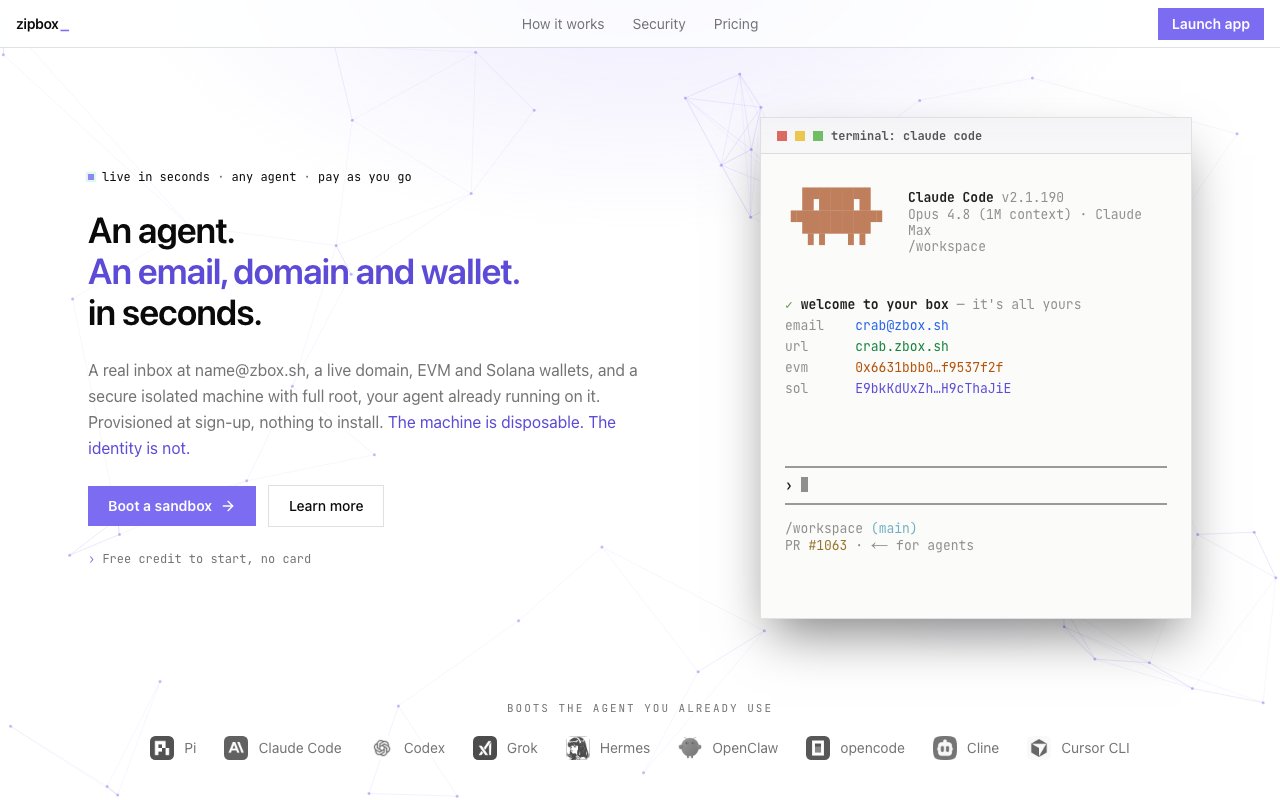
Zipbox spins up isolated cloud machines specifically for running AI coding agents. Instead of letting Claude Code or Codex loose on your local machine where a bad command could wipe your home directory or expose your SSH keys, you boot a sandbox in seconds and let the agent work there. Each environment comes pre warmed with the agent already installed and running, so you skip the setup and go straight to coding. The sandbox is disposable. When you're done, you pause it and the meter stops, or you delete it and everything vanishes. Your local machine stays untouched throughout.
The isolation model is where Zipbox makes its strongest case. Each sandbox runs inside a Firecracker microVM with KVM hardware boundaries. That's the same virtualization technology AWS uses for Lambda to separate customers. The agent gets full root access to do whatever it needs, but that root access is scoped to its own guest kernel and network. If something goes wrong, you trash the sandbox and spin up another one. There are no shared resources between tenants, no database stored passwords, and terminal sessions are bound to cryptographic keys rather than credentials that could leak. The blast radius of any mistake is one sandbox, not your entire development environment.
Every sandbox comes with its own infrastructure that would normally take time to set up. You get a unique email address at zbox.sh that actually receives mail, useful for agents that need to sign up for services or verify accounts as part of their work. You get a live HTTPS subdomain at your chosen slug dot zbox.sh, which lets you preview web apps the agent builds without setting up port forwarding or tunneling. You also get EVM and Solana crypto wallets if your workflow needs them. These feel like small conveniences individually, but they add up when you're running multiple agents in parallel and want each one to have its own identity and endpoints.
Agent support is broad. Zipbox works with Pi, Claude Code, Codex, Grok, Hermes, OpenClaw, opencode, Cline, Cursor CLI, and plain bash out of the box. You pick your agent, pick your machine size, and launch. There's also an auto approve mode for agents that need to run unattended, though obviously that means accepting more risk. Every command your agent runs streams live to your browser, and your scrollback is restored the instant you reconnect if your session drops. The terminal gives you full root access with no guards beyond the sandbox boundary itself.
Machine sizes range from a Tiny instance with 1 vCPU and 2 GB RAM at around ten dollars per month of continuous use, to XXL instances with 32 vCPU and 64 GB RAM at around 320 dollars per month. The recommended starting point is Small with 2 vCPU and 4 GB RAM at about 25 dollars per month. Larger configurations are available on request. Billing is by the second while a sandbox runs. When you pause, the meter stops and you're not charged for idle time. There are no monthly minimums and no lock in. You prepay credits starting at five dollars and draw them down as you use machines. Credits don't expire, and you can cap your spending at your credit balance so there are no surprise invoices.
The target audience is developers who want to run AI agents safely without risking their local environment. If you've ever hesitated before letting an agent run a shell command because you weren't sure what it would do, Zipbox removes that hesitation. It's also useful for running multiple agents in parallel on separate projects, since each gets its own isolated space with its own email, domain, and wallets. The use cases highlighted on the site include running untrusted repositories end to end, large scale web scraping behind clean IPs, reproducing security proofs of concept in safe isolation, and overnight unattended tasks like refactors or migrations where you don't want to leave your laptop awake.
What makes Zipbox different from spinning up a regular cloud VM is the specialization. The sandboxes boot in seconds because they're pre warmed and the agent is already there waiting. The per second billing with pause support means you're not paying for a monthly instance you forget about. The identity infrastructure with email, subdomain, and wallets means you don't have to configure those things yourself every time you spin up a new environment. It's purpose built for the agent workflow rather than general compute, and the pricing reflects that with micro increments instead of hourly or monthly blocks.
Zipbox is built by Tribes, Inc. There's free credit on signup with no card required to try the service. When your credits run out, you get an email notification and a one hour grace period before sandboxes are archived. Archived sandboxes are preserved rather than deleted, so you can restore them later without losing work. The parent identity elements like your inbox and domain persist even when the machine itself is paused or destroyed, which means you can reboot tomorrow without losing context.
Key Features
- Firecracker microVM hardware isolation
- Pre-warmed sandboxes with agents ready
- Unique email and HTTPS subdomain per sandbox
- Support for 9+ AI coding agents
- Per-second billing with pause support
- Full root access and auto-approve mode
Pros & Cons
What we like
- Isolated environments protect your local machine
- Sandboxes boot in seconds with agents pre-installed
- Pay only for active runtime with no idle fees
- Works with most popular AI coding agents
Room for improvement
- Credits are prepaid and non-refundable
- Larger machine sizes not yet available
- Requires trusting a third party with your code
- No free tier beyond initial signup credit
Frequently Asked Questions
What is Zipbox?
Is Zipbox free?
Which AI agents does Zipbox support?
Why not just use a regular cloud VM?
Best For
Featured in
Alternatives to Zipbox

Kevin Gabeci
Solo developer building web apps, cozy browser games, and AI creator toolkits.

SoloDevStack
A solo developer blog built on head-to-head tool comparisons, 580+ posts deep.

Codedex
A gamified, story-driven platform that teaches Python, web dev, and more like an RPG quest
Vibe Built
Building real apps with agentic AI. What worked, what broke, what shipped.
Reviews (0)
Badge builder
Add Zipbox to your website
Choose a badge style and size, preview it here, then copy the generated HTML. Badge images are self-contained SVGs and do not require an external script.

<a href="https://toolindex.net/tools/zipbox?ref=badge" target="_blank" rel="noopener">
  <img src="https://toolindex.net/badge/zipbox/medium.svg" alt="Zipbox - Listed on Tool Index" width="180" height="50" />
</a>How to use the badge
- 1. Pick the style, size, and theme that fit your layout.
- 2. Copy the generated HTML from the code block.
- 3. Paste it into your footer, homepage, or press page.
Standard badge available
The standard listing badge is available now. Score and circle badges are limited to tools currently ranked in the top 10 of a category.
Badge clicks return visitors to this profile with a referral tag so the source remains identifiable.
Related Tools
Kevin Gabeci
Solo developer building web apps, cozy browser games, and AI creator toolkits.
Coolify
Self-hostable, open source alternative to Heroku and Netlify

Warp
The modern terminal reimagined with AI and collaboration

Bolt.new
Prompt-to-deployed full-stack app inside the browser
Work on Zipbox? Request listing access or correction