
Zizq
Fast single-binary job queue with built-in persistence that fits into any stack without Redis
Gallery
About Zizq
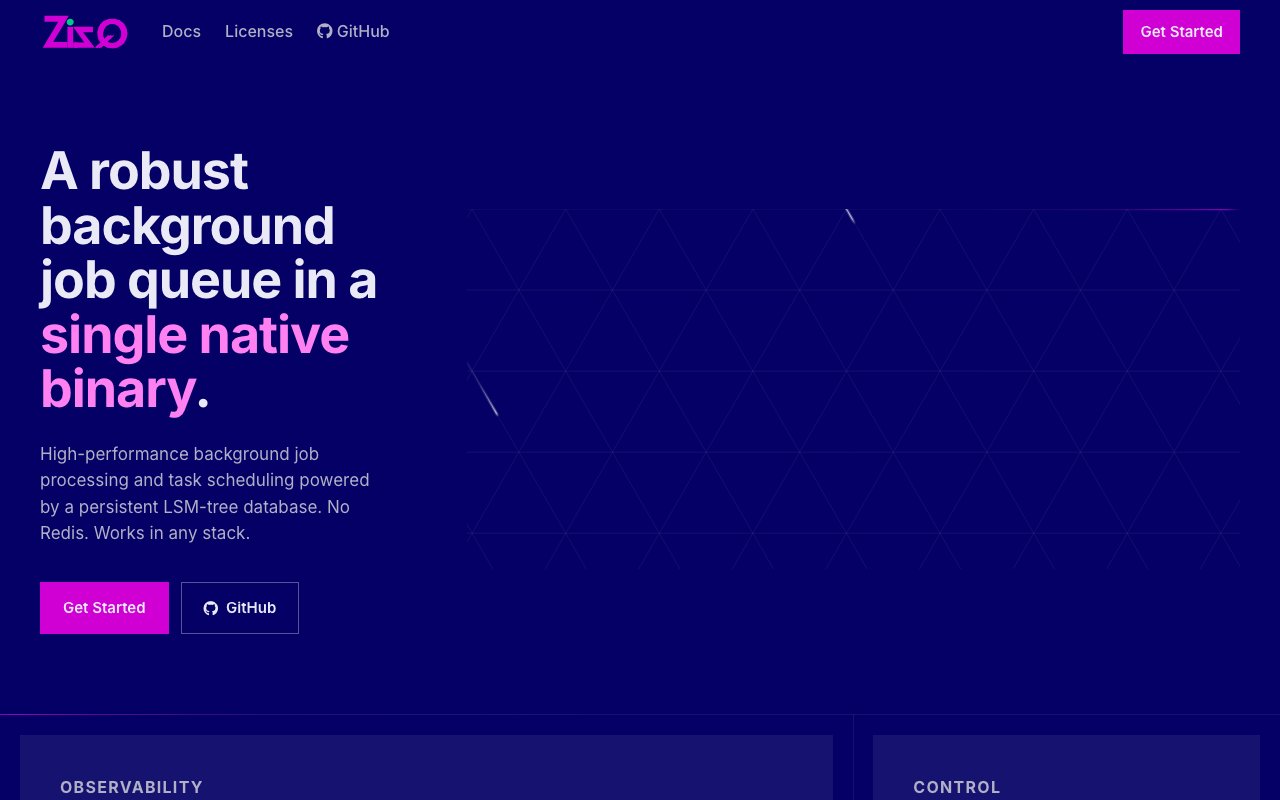
Zizq is a background job queue packaged as a single native binary. It handles the bread and butter work of queuing tasks, retrying failures, scheduling cron jobs, and distributing work across workers, all without requiring Redis, Postgres, or any external database. It ships its own durable storage built on an LSM tree transactional database, so everything you need lives in one process. Jobs survive crashes, disconnects, and restarts. If the process goes down unexpectedly, nothing is lost. When it comes back up, your jobs are still there waiting to be processed.
The appeal is simplicity. Most job queues lean on Redis for persistence and pub sub, which means your infrastructure now has another service to manage, monitor, back up, and worry about when it fails at 3am. Zizq removes that dependency entirely. You download a binary, run it, and your queue is up. No Docker compose files with Redis containers. No managed Redis instance eating into your cloud bill. No Redis connection strings to configure across environments. The built in database handles durability, and the single binary approach means deployment is as simple as copying a file and running it. This is particularly valuable for small teams and solo developers who do not want to maintain infrastructure that exists only to support their actual infrastructure.
Communication happens over an HTTP/2 API, which makes Zizq language agnostic in a meaningful way. Your workers can be written in Ruby, Node.js, Rust, Python, Go, or anything else that speaks HTTP. Official client libraries exist for Ruby, Node.js, and Rust, which cover the most common use cases, but you can also hit the API directly from any language with an HTTP client. This fits polyglot architectures where different services are written in different languages but all need to share a job queue. You might enqueue a job from a Ruby on Rails application and have it processed by a Python worker. The queue does not care. It just passes messages over HTTP.
For observability, Zizq includes a terminal UI called zizq top that shows queue depth, worker activity, and job status in real time. You can filter and search jobs using jq style expressions, which is familiar if you have ever worked with JSON on the command line. Once you find the jobs you need, you can move them, re prioritize them, re schedule them, or delete them entirely without leaving the terminal. These operations happen atomically via PATCH requests to the API. The free tier limits the terminal UI to displaying ten jobs at a time, while the Pro tier removes that cap. For debugging stuck jobs or draining a queue before a deploy, this kind of introspection is invaluable. You do not need to connect to a separate Redis CLI or log into a web dashboard. Everything happens from the command line alongside your other dev tools.
Feature wise Zizq covers the checklist you would expect from a production job queue. Prioritized FIFO queues let urgent jobs jump ahead of less critical work. Configurable exponential backoff and retry limits handle transient failures gracefully, so a temporary network blip does not crash your entire processing pipeline. A built in dead letter queue catches jobs that fail permanently so you can debug them later. Batch processing lets you fold and merge enqueues for efficiency when you have many small jobs. Unique jobs prevent duplicates from being enqueued by enforcing scoped uniqueness. Cron scheduling runs jobs on a timezone aware schedule with second level precision, which matters for applications that span multiple timezones and need exact timing. All job delivery is guaranteed, so once something enters the queue, it will be processed or land in the dead letter queue. Nothing silently disappears.
Pricing follows a freemium model with a generous free tier. You can run Zizq for free forever with unlimited instances in development and staging environments, unlimited workers, unlimited queues and throughput, job scheduling, priorities, backoff policies, retention configuration, cross language job processing, and introspection. The only limitations on free are the ten job display cap in zizq top and the absence of some advanced features. Community support is included. The Pro plan costs $819 per year for one production instance, with renewals dropping to $709 per year. Pro unlocks batched jobs, unique jobs, cron scheduling, mutual TLS authentication for secure communication, full job display in the terminal UI, and dedicated support alongside community support. Most deployments need only one production instance even for high throughput use cases, so the price covers your entire production environment rather than scaling per worker or per queue.
The code is source available on GitHub, which means you can inspect it, understand exactly what it does, and modify it for your own needs, though the license restricts redistribution. The company behind Zizq is registered in Australia with ABN 64 066 739 074, which is a good sign for longevity and accountability. For teams tired of babysitting Redis, debugging connection pool issues, or setting up Redis Sentinel for high availability, Zizq offers a clean alternative. You trade the large ecosystem and community of something like Sidekiq for a simpler deployment story and dramatically lower operational burden. If simplicity and reliability matter more to you than plugin ecosystems, this is worth a look.
Key Features
- Single-binary deployment with no dependencies
- Built-in LSM-tree durable storage
- Language-agnostic HTTP/2 API
- Real-time terminal UI for observability
- Prioritized queues and configurable retries
- Timezone-aware cron scheduling
Pros & Cons
What we like
- No Redis or external database required
- Jobs persist across crashes and restarts
- Works with any language that speaks HTTP
- Free tier covers core queue functionality
Room for improvement
- Smaller community compared to established queues like Sidekiq
- Pro features like cron require an annual license
- Source-available but not fully open source
- Newer product with less battle-tested history
Frequently Asked Questions
What is Zizq?
Is Zizq free?
What languages does Zizq work with?
Does Zizq persist jobs across restarts?
Best For
Featured in
Alternatives to Zizq

Kevin Gabeci
Solo developer building web apps, cozy browser games, and AI creator toolkits.

SoloDevStack
A solo developer blog built on head-to-head tool comparisons, 580+ posts deep.

Codedex
A gamified, story-driven platform that teaches Python, web dev, and more like an RPG quest

Vibe Built
Building real apps with agentic AI. What worked, what broke, what shipped.
Reviews (0)
Badge builder
Add Zizq to your website
Choose a badge style and size, preview it here, then copy the generated HTML. Badge images are self-contained SVGs and do not require an external script.

<a href="https://toolindex.net/tools/zizq?ref=badge" target="_blank" rel="noopener">
  <img src="https://toolindex.net/badge/zizq/medium.svg" alt="Zizq - Listed on Tool Index" width="180" height="50" />
</a>How to use the badge
- 1. Pick the style, size, and theme that fit your layout.
- 2. Copy the generated HTML from the code block.
- 3. Paste it into your footer, homepage, or press page.
Standard badge available
The standard listing badge is available now. Score and circle badges are limited to tools currently ranked in the top 10 of a category.
Badge clicks return visitors to this profile with a referral tag so the source remains identifiable.
Related Tools
Kevin Gabeci
Solo developer building web apps, cozy browser games, and AI creator toolkits.

Coolify
Self-hostable, open source alternative to Heroku and Netlify

Warp
The modern terminal reimagined with AI and collaboration

Bolt.new
Prompt-to-deployed full-stack app inside the browser
Work on Zizq? Request listing access or correction