
Ackd
AI-assisted job application tracker with MCP integration for agent-powered job search
Gallery
About Ackd
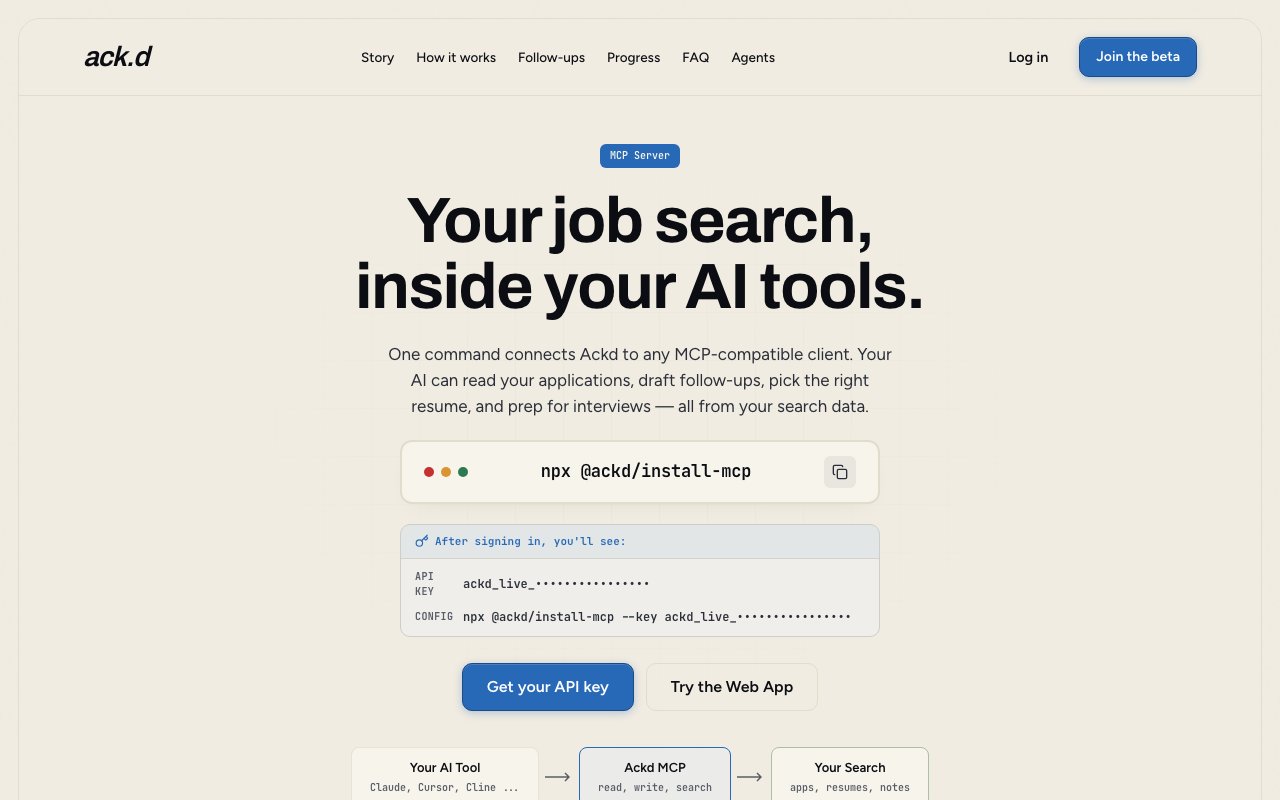
Ackd is a job application tracker that doubles as a Model Context Protocol server, which means AI agents can connect to it and actually help manage your job search instead of just chatting about it. You track applications, resumes, contacts, and interviews in one workspace, and any MCP compatible agent can read that data, draft follow up emails, generate company briefings, or prep you for interviews. It's built for tech job seekers who are already using AI tools and want those tools to work with real, structured data rather than context you paste into a chat window every time.
The underlying problem is that job searching produces a lot of moving parts. You apply to dozens of companies, each at different stages, with different resume versions and different contacts. Spreadsheets handle this until they don't, usually right when you need to remember which version of your resume you sent to which company three weeks ago. Most dedicated trackers are passive databases that just store what you put in. They don't help you act on the information. Ackd takes a different approach by exposing your application data through an API that agents can query and update. If you're using Claude, GPT, or any other MCP capable assistant, it can pull your latest applications, see which ones need follow up, and generate the actual messages rather than generic templates.
The workflow covers the full application lifecycle. You create applications and log the job description, the source where you found it, and any notes about the role. You attach the specific resume and cover letter you sent, which matters when you're tailoring materials for different positions. You record contacts at the company, whether recruiters, hiring managers, or referrals. You track stage changes as you move through their process, from application to phone screen to onsite to offer. You set reminders for follow ups and note outcomes. Every application builds a timeline showing exactly what happened and when, which becomes invaluable when you're juggling multiple processes and can't remember if you already sent that thank you email.
When you connect an agent, it sees all of this context and can act on it. The agent skill playbook in the documentation walks through what's possible. Agents can generate tailored cover letters based on your resume and the job description. They can audit your materials for consistency across applications, catching cases where you mentioned different things to different companies. They can draft follow up messages that reference specific details from your timeline. They can generate company briefings before interviews, pulling together what you know about the role and the people you've talked to. The MCP interface means these aren't one-off prompts; the agent has persistent access to your search state.
Analytics are built in and actually useful. You can see which job sources are producing interviews, not just applications. You can compare how different resume versions perform, which tells you whether your tailored approach is worth the time. You can identify where applications tend to stall, whether that's at the initial screen or further along in the process. This kind of visibility helps you adjust your approach based on what's working rather than intuition. If LinkedIn applications are going nowhere while referrals are landing interviews, the data shows it. If your three page resume converts worse than your one page version, you'll know.
Authentication happens through API keys, which you generate in the platform and configure in your AI agent. The MCP server runs on Streamable HTTP at api.ackd.app/mcp, so agents make standard authenticated requests to read and write data. For developers who want to build custom integrations or connect agents beyond the standard MCP setup, there's an OpenAPI specification available. The documentation is solid for a beta product, with setup guides, a tool reference for every available agent capability, and a skill playbook that walks through practical use cases.
Privacy is handled explicitly. Your data is private and non indexed, meaning Ackd doesn't share it with third parties or use it for training models. For job seekers dealing with sensitive career information, including current employment status and compensation discussions, knowing that an AI assistant won't leak application details to a model training pipeline matters. The platform keeps your job search data separate from the training data economy that most AI tools participate in.
Pricing is currently free during the beta period with full feature access including the MCP integration. There's no announced paid tier yet, though the depth of features suggests monetization is coming. If you want to try agent assisted job searching without committing to a subscription, the beta window is the right time to experiment and see whether the workflow fits how you search.
Who should use Ackd? Tech job seekers who are already comfortable with AI tools and want those tools to work smarter. If you're the type who pastes context into ChatGPT before asking for help, Ackd replaces that manual step with a persistent data layer the agent can access directly. It's also useful for anyone who wants more structure than a spreadsheet without the overhead of a full career management platform. The agent features are the differentiator, but the tracker itself is solid even if you never connect an AI. The MCP angle is a bet on where job searching is headed, and if that bet is right, Ackd is one of the early tools positioned to benefit.
Key Features
- Application tracking with stage history
- Resume and cover letter version management
- Contact and reminder system with follow up drafting
- MCP server for AI agent integration
- Source and resume analytics
- Company briefing and interview prep tools
Pros & Cons
What we like
- MCP integration lets AI agents read and update job search data
- Free during beta with full feature access
- Private data handling with no indexing or training use
- Works with or without AI features enabled
Room for improvement
- Focused on tech job seekers specifically
- Beta product so features may change
- Future pricing not yet announced
- Requires API key setup for agent features
Frequently Asked Questions
What is Ackd?
Is Ackd free?
What is the MCP integration?
Is my job search data private?
Best For
Featured in
Alternatives to Ackd

Stack AI
No-code platform for building and deploying enterprise AI agents and workflows on a visual canvas

Almanac
A hosted, source-cited wiki that turns your files into context your AI agents can use

Demi AI
Demi helps busy professionals eliminate repetitive admin work across their favorite tools.
Vapi
Build voice AI agents that take and place phone calls
Reviews (0)
Badge builder
Add Ackd to your website
Choose a badge style and size, preview it here, then copy the generated HTML. Badge images are self-contained SVGs and do not require an external script.

<a href="https://toolindex.net/tools/ackd?ref=badge" target="_blank" rel="noopener">
  <img src="https://toolindex.net/badge/ackd/medium.svg" alt="Ackd - Listed on Tool Index" width="180" height="50" />
</a>How to use the badge
- 1. Pick the style, size, and theme that fit your layout.
- 2. Copy the generated HTML from the code block.
- 3. Paste it into your footer, homepage, or press page.
Standard badge available
The standard listing badge is available now. Score and circle badges are limited to tools currently ranked in the top 10 of a category.
Badge clicks return visitors to this profile with a referral tag so the source remains identifiable.
Related Tools

OpenBenchmarks
Public, externally validated benchmarks that help agents pick SaaS APIs
Almanac
A hosted, source-cited wiki that turns your files into context your AI agents can use

Wizard
Self-extending Rust terminal AI agent that works with any model

Chariot
Elastic cloud infrastructure for deploying and scaling AI agent fleets with persistent storage
Work on Ackd? Request listing access or correction