
Archron
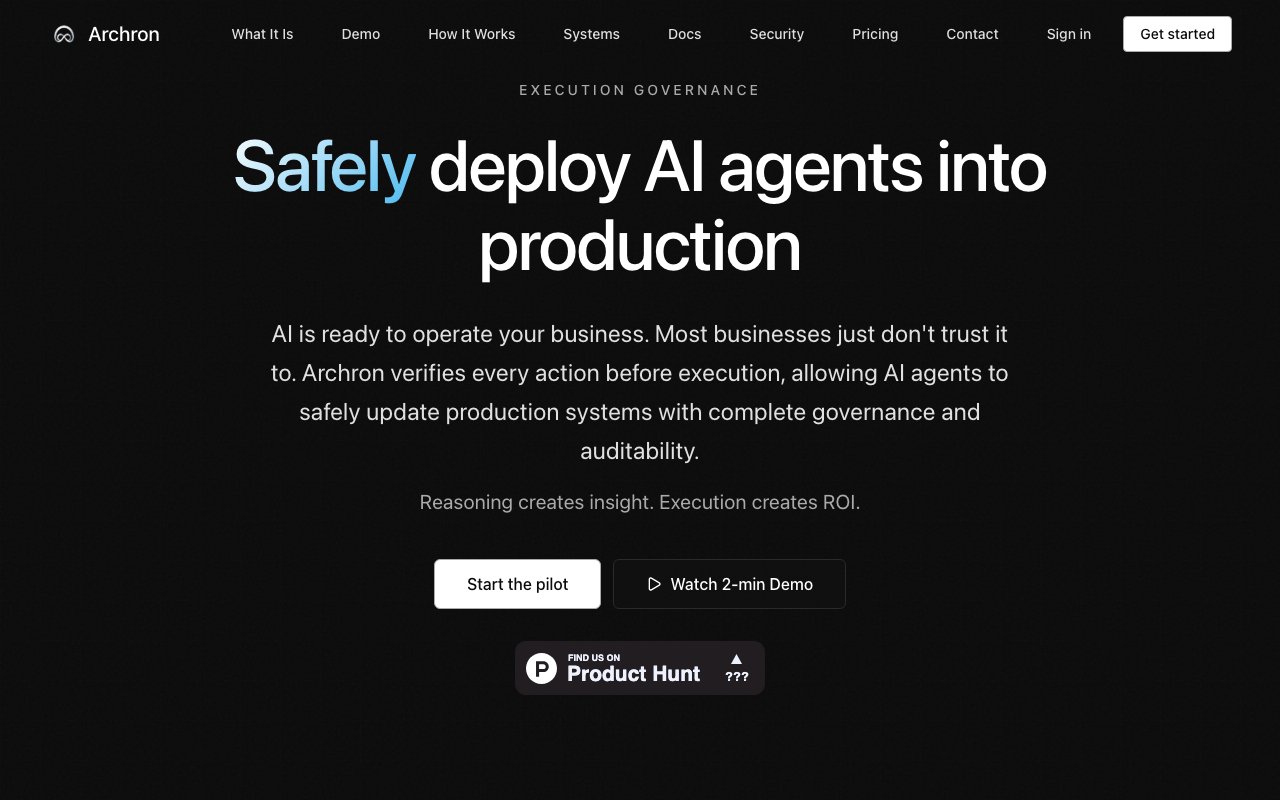
AI execution governance that verifies every agent action before it touches your CRM
Gallery
About Archron
Archron is an execution governance platform that sits between AI agents and the business systems they write to. When an agent wants to update a Salesforce record, create a HubSpot contact, or make any change to production data, Archron intercepts the request, validates it against the schema, checks user permissions, applies business rules, and only then lets the write through. If something looks wrong or ambiguous, it stops and asks for clarification rather than letting the agent guess. The result is that every agent action is verified before it touches real data, which is the kind of control layer enterprises need before they'll deploy AI agents against production CRMs.
The core problem is trust at scale. Companies are excited about AI agents handling repetitive CRM work, updating opportunity stages, logging activities, cleaning up duplicate records, enriching contacts. But they're also terrified of what happens when an agent makes a mistake in production. A bad update could overwrite contact information, delete records, or violate business rules that took years to encode. A confused agent might merge the wrong accounts or change a deal value that triggers downstream calculations. Without a verification layer, the only options are to not use agents at all or to accept the risk and hope for the best. Archron offers a third path where agents can act but every action is checked first, and nothing slips through without meeting the rules.
Permission enforcement happens through per-user OAuth. When a user connects their CRM account, the agent inherits that user's exact permissions. If a sales rep can only edit their own leads, an agent working on that rep's behalf can't touch anyone else's records. If a manager has read access to all accounts but write access only to their team's, the agent inherits the same boundaries. This isn't a separate permission system layered on top; it's the same access control the organization already uses, which makes compliance and security reviews significantly easier. The agent operates within existing boundaries instead of requiring IT to configure new ones.
The audit trail is append-only and hash-chained, meaning it's tamper-evident. Every action the agent attempts, whether approved or rejected, gets logged with enough context to reconstruct what happened and why. The record includes the user, the agent, the exact request, the rule that applied, and the outcome. For regulated industries or any company that might face questions about how their AI systems behave, this kind of record is increasingly necessary. If an auditor asks why a particular record changed, you can trace the change back through the verification chain. If something goes wrong, you have the forensic evidence to understand exactly what happened.
What separates Archron from basic validation is the clarification loop. If an agent submits a request that doesn't quite match the schema, say a field value that isn't in the allowed set, Archron doesn't just reject it. It prompts the agent to refine the request, giving it a chance to correct the mistake. This makes agents more useful because they can recover from minor errors instead of failing outright, but it also keeps them safe because the corrected request still goes through full validation. The agent gets to learn and adapt, but never at the cost of data integrity. This is different from systems that simply block bad requests; Archron makes agents smarter while keeping them accountable.
Currently, Archron works with MCP-compatible agents including Claude, Grok, and ChatGPT, and it exposes an HTTP API for custom agent frameworks that don't use the MCP standard. Live integrations cover Salesforce and HubSpot, including sandbox environments where you can test agent behavior before going to production. ERP systems, support tools, and internal systems are on the roadmap. The platform doesn't store your business data itself; it holds governance rules and audit evidence while the actual records stay in the connected systems. Your CRM data never passes through Archron's servers beyond the metadata needed for verification.
Pricing starts at $999 per month for the pilot program. That includes one agent connected to one business system with unlimited users and unlimited operations. There are no per-action fees, which matters if you're planning high-volume automation where thousands of agent actions happen daily. Larger deployments with multiple agents and systems move to custom pricing. The pilot is positioned for teams that want to test agent governance on a real system without signing an enterprise contract upfront. You can prove the concept works before committing to a broader rollout.
Who should use Archron? IT and operations teams at companies that want to deploy AI agents into production but need accountability built in from the start. If your CRM data is business-critical, if you face compliance requirements around data changes, or if you simply don't trust an agent to act without supervision, Archron provides the checkpoint layer that makes deployment possible. It's not a replacement for the agent itself; it's the verification layer that makes the agent safe to use. For organizations that have been holding off on agent automation because of governance concerns, this is the product category that addresses those concerns directly.
Key Features
- Pre-execution action verification
- Per-user OAuth permission enforcement
- Append-only hash-chained audit trail
- Clarification prompts for ambiguous requests
- Salesforce and HubSpot integration
- HTTP API for custom agents
Pros & Cons
What we like
- Stops bad agent actions before they touch production data
- Audit trail is tamper-evident and hash-chained
- Flat monthly pricing with no per-action fees
- Works with popular MCP agents like Claude and ChatGPT
Room for improvement
- Limited to Salesforce and HubSpot for now
- $999 per month entry price is steep for small teams
- Requires MCP-compatible agent or custom API work
- ERP and support tool integrations are not yet available
Frequently Asked Questions
What is Archron?
Which AI agents does Archron support?
How much does Archron cost?
What business systems does Archron integrate with?
Best For
Featured in
Alternatives to Archron

Stack AI
No-code platform for building and deploying enterprise AI agents and workflows on a visual canvas
Almanac
A hosted, source-cited wiki that turns your files into context your AI agents can use

Demi AI
Demi helps busy professionals eliminate repetitive admin work across their favorite tools.
Vapi
Build voice AI agents that take and place phone calls
Reviews (0)
Badge builder
Add Archron to your website
Choose a badge style and size, preview it here, then copy the generated HTML. Badge images are self-contained SVGs and do not require an external script.

<a href="https://toolindex.net/tools/archron?ref=badge" target="_blank" rel="noopener">
  <img src="https://toolindex.net/badge/archron/medium.svg" alt="Archron - Listed on Tool Index" width="180" height="50" />
</a>How to use the badge
- 1. Pick the style, size, and theme that fit your layout.
- 2. Copy the generated HTML from the code block.
- 3. Paste it into your footer, homepage, or press page.
Standard badge available
The standard listing badge is available now. Score and circle badges are limited to tools currently ranked in the top 10 of a category.
Badge clicks return visitors to this profile with a referral tag so the source remains identifiable.
Related Tools

OpenBenchmarks
Public, externally validated benchmarks that help agents pick SaaS APIs
Almanac
A hosted, source-cited wiki that turns your files into context your AI agents can use

Wizard
Self-extending Rust terminal AI agent that works with any model

Chariot
Elastic cloud infrastructure for deploying and scaling AI agent fleets with persistent storage
Work on Archron? Request listing access or correction