
Aristra
AI operating system with persistent memory, proactive agents, and connected tools in one place
Gallery
About Aristra
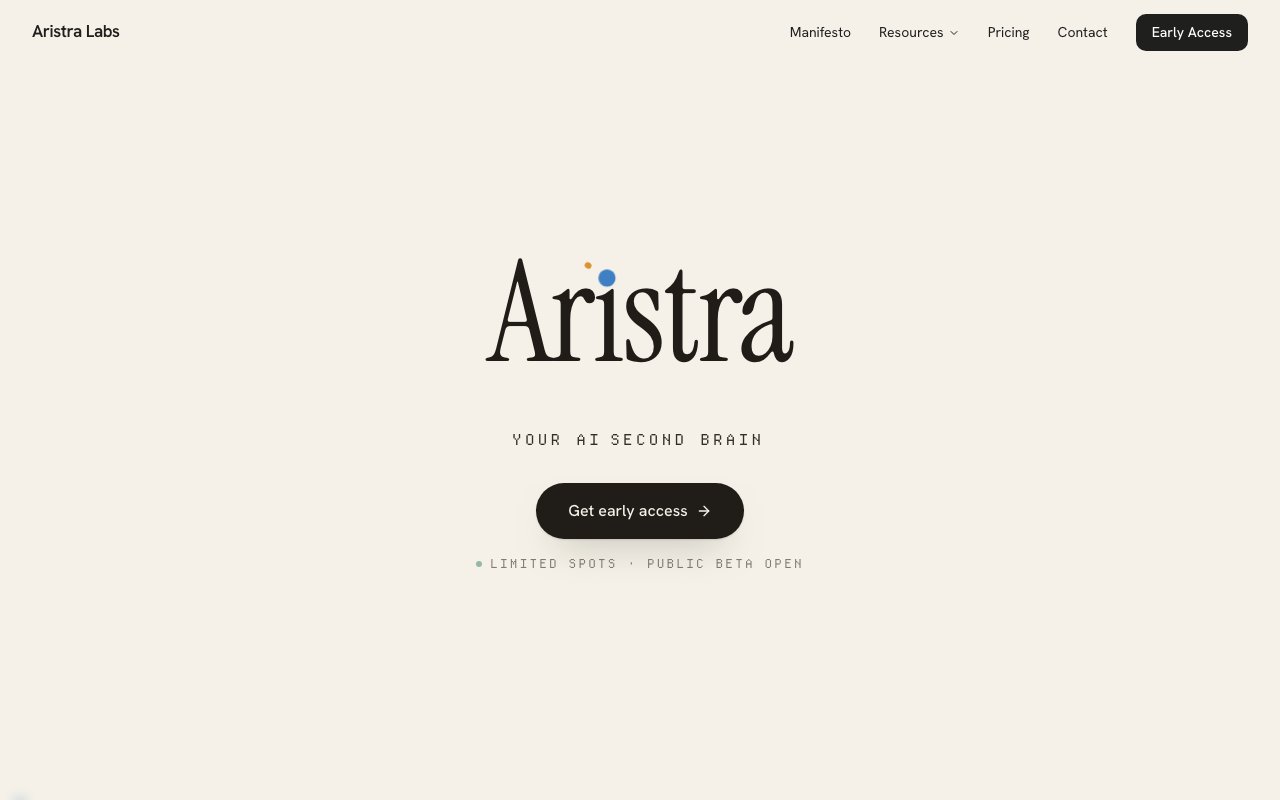
Aristra positions itself as an operating system for your work, combining a persistent memory layer, proactive background agents, and document tools in a single platform. Instead of bouncing between a chat assistant, a task manager, and a notes app, you get a unified workspace where context follows you and automated agents handle recurring jobs on your behalf. The pitch is that AI assistants become genuinely useful only when they remember who you are, what you're working on, and what matters to you. Aristra is built around that premise, and everything in the product flows from it.
The memory system is the foundation, and it works differently from most AI tools. Most AI assistants forget everything between sessions, so you repeat yourself constantly. Every conversation starts from zero. You explain your role, your projects, your preferences, and then you do it again tomorrow. Aristra flips that by letting you approve what it remembers, review stored context at any time, and edit or delete anything. Nothing is retained automatically. You decide what sticks and what doesn't. That control matters when you're feeding the system sensitive work data, client information, or strategic context you wouldn't want leaking into a training set. The memory is yours, stored under your account, and you can wipe it any time you want. If you ever need to audit what the system knows about you, it's all visible in one place.
Built on top of that memory are proactive agents. These aren't just chatbots waiting for prompts. They run in the background on schedules you set, handling things like daily briefings, follow-ups on pending items, and drafting messages while you're away. You configure triggers and timing, then let the agents work autonomously. When they act, each agent logs exactly what it did, so you can audit the work before anything goes out. That audit trail is critical for anyone who wants automation but doesn't want to lose visibility. If an agent drafts an email, you review it before sending. If it surfaces a task, you decide whether to act on it. The agents can chain together, so one might check your calendar, another might pull unread emails, and a third might synthesize both into a morning summary.
On the writing side, Aristra Compose lets you draft documents with AI assistance while keeping tracked changes visible. Suggestions show up inline, and you accept or reject each one individually. It's closer to a collaborative editor than a black-box rewrite tool. You can see exactly what the AI proposed and decide piece by piece what to keep. That granularity is useful when you want help but don't want to lose your voice or miss errors the model introduces. The tracked-changes model also means you have a record of what was suggested versus what you wrote, which is helpful if you ever need to explain a document's evolution.
Integrations connect through MCP, the Model Context Protocol, with current support for Gmail, Google Calendar, Notion, GitHub, and Linear. Slack is on the roadmap. These connections let agents pull real data from your tools, so a morning briefing can include your calendar, open GitHub issues, and Notion tasks without you copying anything. The MCP approach means new integrations can be added without rebuilding the core system, and it opens the door to third-party tools plugging in over time. You can access the system from a web dashboard, a Chrome extension, Telegram, or MCP clients like Claude Desktop. That flexibility means you can interact wherever you already work rather than switching to yet another app.
Aristra is in public beta, which means features are still evolving and the team is actively responding to user feedback. The free tier gives you 100 credits per month and 5 GB of storage, enough to try the core features and see whether the memory model fits your workflow. Credits are consumed by AI actions, so heavier users will hit the ceiling faster. The Plus plan at 29 dollars a month bumps that to 3,000 credits and unlocks custom agents and the browser extension. Pro at 99 dollars a month adds 10,000 credits and 100 GB of storage for heavier users or teams. No credit card is required to start, so you can test drive the product before committing.
The bet here is that persistent memory changes how you interact with AI tools. Context is the bottleneck in most assistant interactions. You spend half your time bringing the model up to speed. Aristra is trying to eliminate that overhead by building memory into the core architecture rather than bolting it on as an afterthought. If you're tired of re-explaining context to every assistant you use, this is the product trying to be the one that actually remembers. Whether it delivers depends on how well the memory layer captures what matters to your specific work, but the design is pointed in the right direction. For knowledge workers juggling multiple projects, clients, and tools, the promise of a system that retains context and acts on it proactively is compelling enough to be worth a trial.
Key Features
- User-controlled persistent memory
- Background proactive agents
- AI document editing with tracked changes
- MCP integrations for Gmail and Notion
- Chrome extension and Telegram access
- Audit logs for agent actions
Pros & Cons
What we like
- Memory persists across sessions without automatic retention
- Agents run proactively, not just when prompted
- Integrates with common work tools via MCP
- Accessible from browser, extension, or Telegram
Room for improvement
- Still in public beta with evolving features
- Slack integration not yet available
- Credit-based pricing can run out on heavy use
- Depends on quality of connected tool integrations
Frequently Asked Questions
What is Aristra?
Is Aristra free?
Who is Aristra for?
How does the memory system work?
Best For
Featured in
Alternatives to Aristra

Stack AI
No-code platform for building and deploying enterprise AI agents and workflows on a visual canvas
Almanac
A hosted, source-cited wiki that turns your files into context your AI agents can use

Demi AI
Demi helps busy professionals eliminate repetitive admin work across their favorite tools.
Vapi
Build voice AI agents that take and place phone calls
Reviews (0)
Badge builder
Add Aristra to your website
Choose a badge style and size, preview it here, then copy the generated HTML. Badge images are self-contained SVGs and do not require an external script.

<a href="https://toolindex.net/tools/aristra?ref=badge" target="_blank" rel="noopener">
  <img src="https://toolindex.net/badge/aristra/medium.svg" alt="Aristra - Listed on Tool Index" width="180" height="50" />
</a>How to use the badge
- 1. Pick the style, size, and theme that fit your layout.
- 2. Copy the generated HTML from the code block.
- 3. Paste it into your footer, homepage, or press page.
Standard badge available
The standard listing badge is available now. Score and circle badges are limited to tools currently ranked in the top 10 of a category.
Badge clicks return visitors to this profile with a referral tag so the source remains identifiable.
Related Tools

OpenBenchmarks
Public, externally validated benchmarks that help agents pick SaaS APIs
Almanac
A hosted, source-cited wiki that turns your files into context your AI agents can use

Wizard
Self-extending Rust terminal AI agent that works with any model

Chariot
Elastic cloud infrastructure for deploying and scaling AI agent fleets with persistent storage
Work on Aristra? Request listing access or correction