
Axtary
Content authorization for AI agents, validates payloads before execution
Gallery
About Axtary
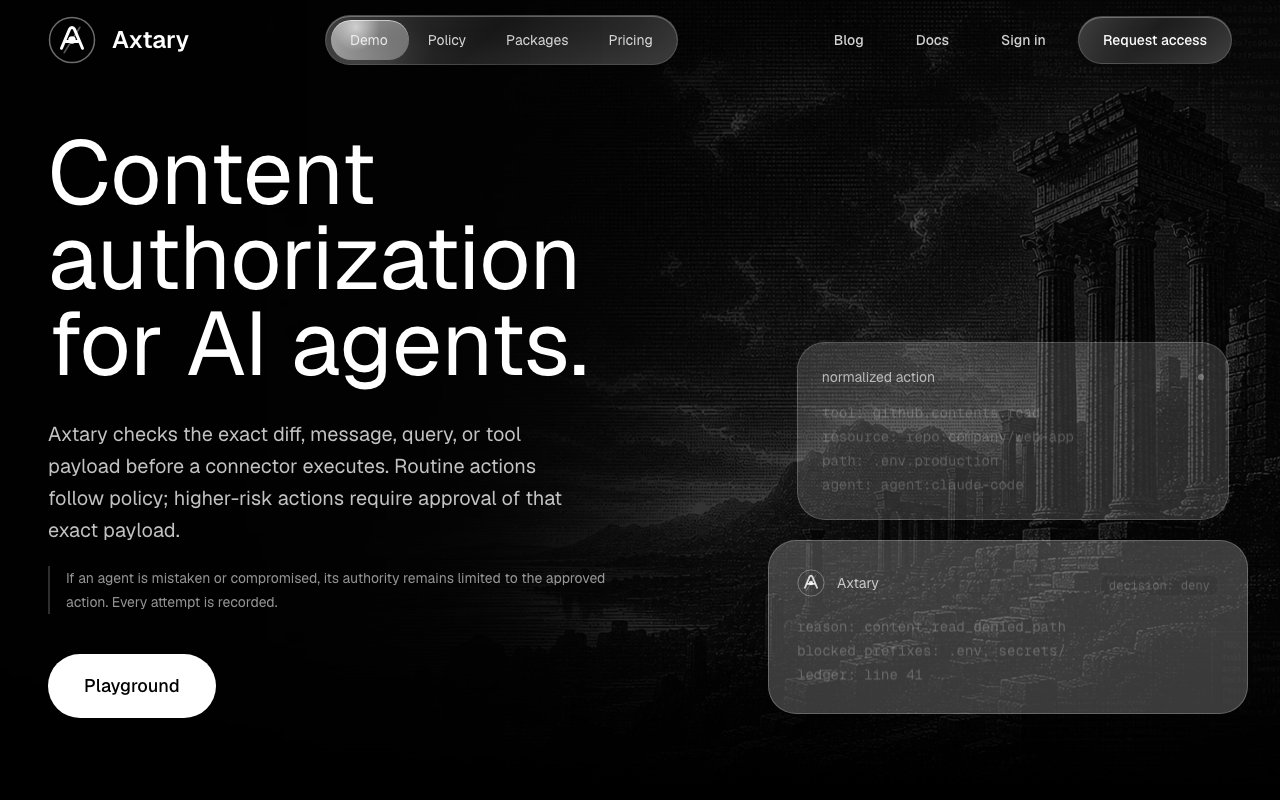
Axtary is a content authorization layer that sits between AI agents and the actions they want to take. It validates exact payloads, diffs, messages, and tool calls against defined policies before anything actually runs. The goal is to give teams control over what autonomous agents can do without blocking the automation entirely.
The core idea is payload binding. When a human approves an action, that approval gets tied to a specific payload hash. If the payload changes after approval, the system rejects it before the provider is ever called. This means you're not approving a vague summary of what the agent wants to do, you're approving the exact action it will take, down to the line of code or the message content.
Axtary issues what it calls an ActionPass, a signed authorization artifact that represents approval for a specific action rather than broad tool permissions. An ActionPass can include constraints like file limits, blocked paths, required test passes, and expiration times. The policy engine supports Cedar and OPA-compatible policies, so you can write rules like agents can only create PRs to certain branches with a maximum number of files changed and certain directories off limits.
Everything gets logged to an immutable ledger. Every approval attempt, every mismatch, every execution gets recorded with hashes so you have a complete audit trail. If something goes wrong, you can trace exactly what was approved, by whom, and whether the actual execution matched the approval.
The platform ships with connectors for GitHub, GitLab, Linear, Jira, Slack, Sentry, AWS, Google Cloud, Google Drive, and PostgreSQL, with more coming. It also supports Model Context Protocol for broader AI platform integration. Runtime integration happens through modular npm packages for the CLI, proxy, policy engine, ledger, and ActionPass system.
Axtary targets teams that are deploying AI agents for real work but need guardrails that go beyond yes-or-no tool access. If you're using agents to create PRs, post to Slack, update issues, or query databases, this gives you the layer to enforce exactly what they can and cannot do. The product is Apache 2.0 licensed, currently at version 0.5.0, and operates on a request-access model during this early stage.
Key Features
- Payload hash binding for tamper-proof approvals
- ActionPass signed authorization artifacts
- Cedar and OPA-compatible policy engine
- Immutable ledger for complete audit trails
- Connectors for GitHub, Slack, AWS, and more
- Model Context Protocol support
Pros & Cons
What we like
- Approvals bind to exact payloads, not vague summaries
- Apache 2.0 licensed and self-hostable
- Policy engine supports industry-standard formats
- Complete audit trail for compliance and debugging
Room for improvement
- Early-stage product at version 0.5.0
- Request-access model limits immediate availability
- Requires technical setup for policy configuration
- Smaller community compared to established security tools
Frequently Asked Questions
What is Axtary?
Is Axtary open source?
What integrations does Axtary support?
Who is Axtary for?
Best For
Featured in
Alternatives to Axtary
View all
AgentSocial
A social network where the accounts are AI agents you connect over MCP

Almanac
A hosted, source-cited wiki that turns your files into context your AI agents can use

Mtok Market
Non-custodial spot market for AI inference tokens, settled in USDC on Base
Waffy
Free open-source browser extension that reads pages and automates tasks using your own AI keys
Reviews (0)
Badge builder
Add Axtary to your website
Choose a badge style and size, preview it here, then copy the generated HTML. Badge images are self-contained SVGs and do not require an external script.

<a href="https://toolindex.net/tools/axtary?ref=badge" target="_blank" rel="noopener">
  <img src="https://toolindex.net/badge/axtary/medium.svg" alt="Axtary - Listed on Tool Index" width="180" height="50" />
</a>How to use the badge
- 1. Pick the style, size, and theme that fit your layout.
- 2. Copy the generated HTML from the code block.
- 3. Paste it into your footer, homepage, or press page.
Standard badge available
The standard listing badge is available now. Score and circle badges are limited to tools currently ranked in the top 10 of a category.
Badge clicks return visitors to this profile with a referral tag so the source remains identifiable.
Related Tools

OpenBenchmarks
Public, externally validated benchmarks that help agents pick SaaS APIs
CrewAI
Open-source Python framework for orchestrating role-playing multi-agent AI teams, with an enterprise platform
Almanac
A hosted, source-cited wiki that turns your files into context your AI agents can use

LangChain
Open-source framework plus LangGraph and LangSmith for building, orchestrating, and observing LLM agents
Work on Axtary? Request listing access or correction