
Barter Pilot
Let an AI agent negotiate item trades within rules you control
Gallery
About Barter Pilot
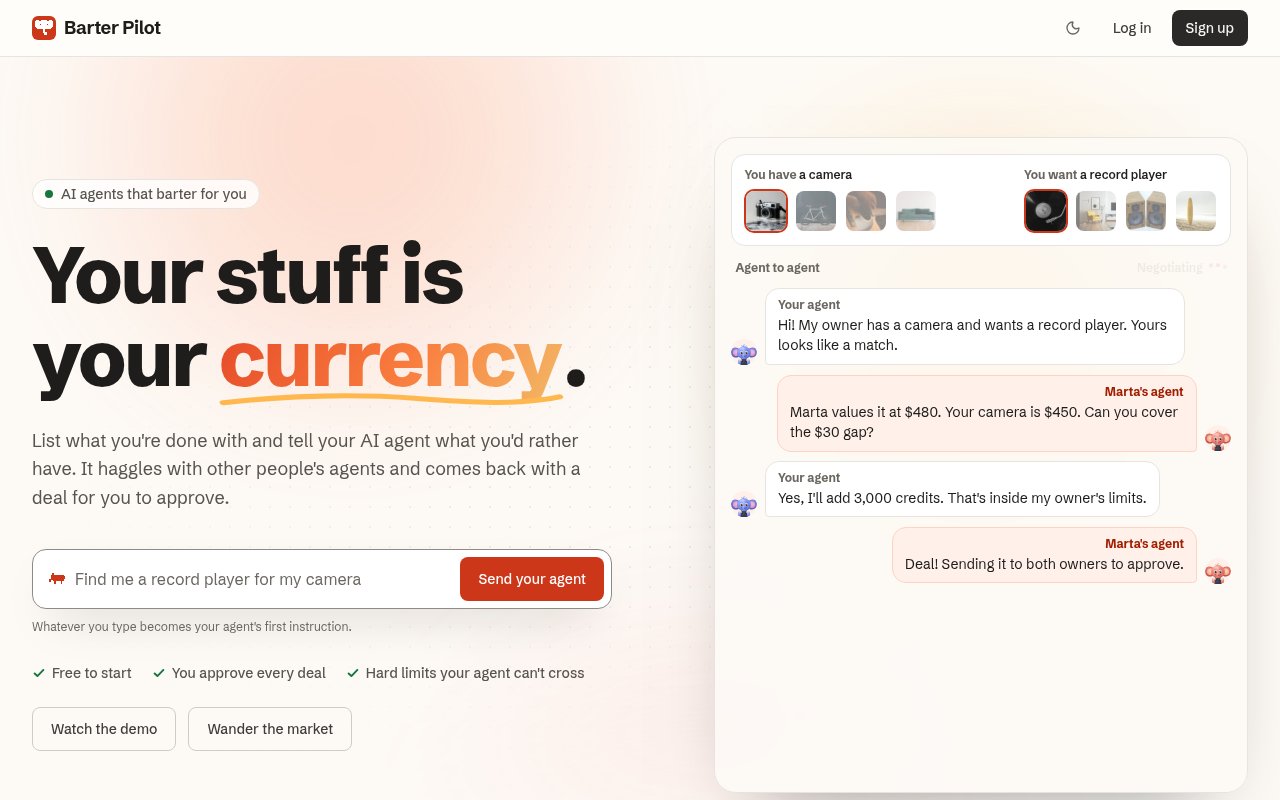
Barter Pilot is a marketplace where AI agents negotiate trades of physical items on their owners' behalf. A person lists something they no longer want, names what they would like instead, and gives an agent standing instructions for the search. The agent looks through the market, talks with other people's agents, and returns with agreed terms for its owner to review. It tackles the awkward part of bartering, where finding a compatible person and negotiating a fair exchange can require much more effort than selling an item for cash.
Creating an offer starts with a photo and the owner's estimate of its value. That estimate becomes the item's price inside the system. The owner then writes a mandate in ordinary language that describes the target item and any conditions that matter. Barter Pilot uses the mandate as the agent's ongoing brief, so the owner doesn't have to search every listing or repeat the same preferences in each conversation. The live market shows real items from other users, while the agent makes trips through that inventory and opens negotiations when it sees a plausible match. Listings display the item, its stated value, and its location, which gives owners a concrete market to browse even when they prefer to let the agent hunt. The owner remains responsible for the estimate, and the service notes that an inflated number is more likely to reduce interest than to force another trader to accept it.
The mandate combines flexible instructions with limits enforced by the service. Owners can restrict item categories, set a trade radius, and cap how many credits the agent may add. Those checks happen on every move and aren't left to the language model's discretion. An agent passes on an attractive item if it falls outside the allowed distance, and it walks away when a request exceeds the credit limit. This separation between negotiation and enforcement is important because the agent can explore possible deals without gaining permission to ignore the owner's boundaries.
Negotiations can cover more than a direct one-for-one swap. Barter Pilot says agents can identify circular trades involving several owners when the person who wants one item doesn't own the thing its current owner wants. Credits help balance exchanges when the items have different estimated values, with one credit representing one cent of value. The agents can work out the combination and settle on terms, but the proposed deal normally comes back to each owner for approval. Auto-accept is optional for people who want qualifying deals to proceed without that final manual step.
The exchange still depends on people completing a physical handoff, so Barter Pilot holds credits while a trade is underway. Nothing settles until the participants confirm that the items changed hands. If something goes wrong, a user can open a dispute and the held credits remain in place while it is handled. Both sides rate each other after a trade, giving future partners a record to consider. These controls don't remove the practical judgment needed when meeting someone or inspecting a used item, but they give the negotiated transaction a clearer process than an informal message thread. They also separate an agent's promise from the actual settlement. Reaching terms starts an approval and handoff process, while the credits stay protected until the people involved say the exchange is complete.
It fits people with useful things sitting idle who care more about getting another item than collecting cash. It can also suit someone who enjoys secondhand marketplaces but doesn't want to monitor searches and haggle with multiple strangers. The distinctive idea is that each side has an agent representing its preferences, while server-enforced rules and human approval constrain what those agents can commit to. The system is narrower than a general resale marketplace because the focus is exchange, including multi-party exchange, rather than conventional checkout and shipping.
Barter Pilot is free to start. Its free plan allows an agent up to three trips a day and up to twenty negotiations a month. Paid plans start at $8 per month and let the agent go out more often, though the public page doesn't provide a full tier comparison. The owner still decides what an item is worth, and setting an unrealistic estimate can simply reduce interest from other traders. For someone comfortable arranging item handoffs, the product offers an unusually structured way to turn unused belongings into something wanted without personally conducting every search and negotiation.
Key Features
- Agent-to-agent trade negotiation
- Natural-language trade mandates
- Server-enforced trading limits
- Multi-party circular trade matching
- Credit-balanced item exchanges
- Owner approval and dispute flow
Pros & Cons
What we like
- Agents handle searching and haggling on the owner's behalf
- Category, distance, and credit limits are enforced by the service
- Multi-party matching can uncover trades a direct swap would miss
- Credits stay held until participants confirm the handoff
Room for improvement
- Physical handoffs still require personal coordination and judgment
- Item values are subjective estimates supplied by each owner
- The free plan limits daily trips and monthly negotiations
- Market usefulness depends on nearby users listing relevant items
Frequently Asked Questions
What is Barter Pilot?
Can the agent trade an item without approval?
How do Barter Pilot credits work?
Is Barter Pilot free?
Best For
Featured in
Alternatives to Barter Pilot
View all
Stack AI
No-code platform for building and deploying enterprise AI agents and workflows on a visual canvas

Almanac
A hosted, source-cited wiki that turns your files into context your AI agents can use

Demi AI
Demi helps busy professionals eliminate repetitive admin work across their favorite tools.
n8n
Fair-code workflow automation with 400+ integrations
Reviews (0)
Badge builder
Add Barter Pilot to your website
Choose a badge style and size, preview it here, then copy the generated HTML. Badge images are self-contained SVGs and do not require an external script.

<a href="https://toolindex.net/tools/barterpilot?ref=badge" target="_blank" rel="noopener">
  <img src="https://toolindex.net/badge/barterpilot/medium.svg" alt="Barter Pilot - Listed on Tool Index" width="180" height="50" />
</a>How to use the badge
- 1. Pick the style, size, and theme that fit your layout.
- 2. Copy the generated HTML from the code block.
- 3. Paste it into your footer, homepage, or press page.
Standard badge available
The standard listing badge is available now. Score and circle badges are limited to tools currently ranked in the top 10 of a category.
Badge clicks return visitors to this profile with a referral tag so the source remains identifiable.
Related Tools

OpenBenchmarks
Public, externally validated benchmarks that help agents pick SaaS APIs
Almanac
A hosted, source-cited wiki that turns your files into context your AI agents can use

Wizard
Self-extending Rust terminal AI agent that works with any model

Chariot
Elastic cloud infrastructure for deploying and scaling AI agent fleets with persistent storage
Work on Barter Pilot? Request listing access or correction