
BayStacker
Run transmission diagnosis, repair work, verification, and invoicing on one case
Gallery
About BayStacker
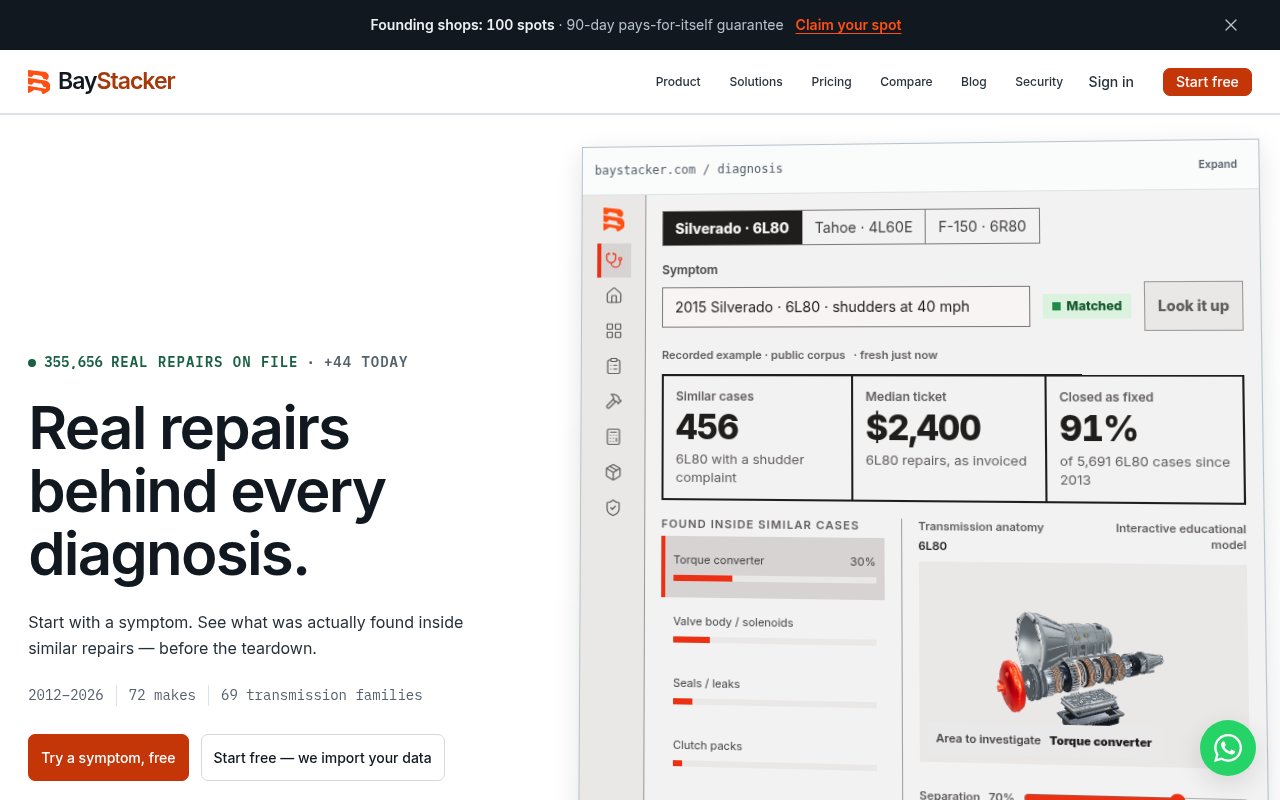
BayStacker is diagnosis first shop software built specifically for transmission and powertrain work. It gives a repair one case that begins with the customer's complaint and continues through diagnosis, parts, the build, verification, invoicing, and reporting. The focus is not simply producing an estimate or moving a ticket across a board. It is keeping the evidence for a diagnosis attached to the operational work that follows, so a comeback can reopen the original record instead of becoming a disconnected second job. That structure is intended to help shops find where rework began and stop incomplete repairs from looking finished. Historical repair examples can help a technician see what was found in similar cases, but the product explicitly presents that history as supporting material rather than a replacement for diagnosis.
A case starts with the reported symptom, operating conditions, a decoded VIN, fault codes, and initial findings. BayStacker's Analysis A ranks a likely cause against the transmission family and the shop's own closed cases, shows the inputs behind that hypothesis, and identifies evidence that is still missing. Analysis cannot run until the VIN is decoded, which prevents a hypothesis from being ranked against the wrong family. The proposed conclusion remains a draft until a person confirms it. An evidence ladder records observations such as scan results, road tests, fluid checks, and pan photos, keeping confidence and completeness separate so a confident but thin case is still visibly incomplete.
Once work begins, the same case feeds the shop floor. A work order board shows each open repair, its current phase, time in that phase, and the condition holding it up. Parts requests distinguish requested, allocated, and installed quantities and retain the purchase order, vendor, landed cost, and charge treatment. A blocking part changes the repair's state rather than relying on someone to remember the delay. The build sheet records the failure mode, component work, torque values, fluid, and hours against plan. Unit and core records stay open until a vendor credit actually lands, which makes outstanding core value visible instead of treating a shipment as recovered money.
Verification is an operational gate rather than an optional note at the end. A diagnosis managed job cannot be invoiced, delivered, or closed until the required road test and code recheck pass or the gate is explicitly waived. Supplements also wait for approval before the build continues. After verification, the Full OS edition can create an invoice and send a focused estimate approval link to the customer. BayStacker records what the customer owes and what was paid, but it does not process card payments, so the shop continues using its existing terminal, cash, or check workflow. Reports cover repair verification, QC bottlenecks, work in progress, comebacks, repeated steps, aging cores, and purchase orders awaiting action. Unknown costs remain visibly incomplete on an invoice instead of being rendered as zero.
The system fits transmission rebuilders, R and R operations, powertrain specialists, and multi-role shops where reception, diagnosis, parts, builders, inspectors, accounting, and drivers need different views of the same job. It is narrower than a general auto repair platform, and that is a meaningful buying criterion. A shop mainly seeking tire sales, a labor guide, broad marketing, or integrated payment processing will need other systems around it. Existing history can come in through CSV, with a dry run shown before anything is written. Access is scoped by shop, location, role, and assignment, with PostgreSQL row level security enforcing the boundaries. The database is hosted in the European Union, and the vendor states that it is not SOC 2 certified. Support is included with each plan and advertises a one business day weekday response.
BayStacker charges by location rather than by user or vehicle. The Intelligence plan costs $149 per location each month for intake, guided diagnosis, evidence, and case history. Full OS costs $499 per location each month and adds work orders, invoices, and the operational path from a diagnosis case. Both plans include 1,000 analysis runs per month and begin with a seven day trial that requires a card. Creating an account alone does not start a subscription. A limited founding shop offer advertises Full OS at $99 per location each month with setup, history import, priority support, and a 90 day refund guarantee, but buyers should confirm availability before relying on that promotional price. Plans can be changed or cancelled from billing, and records can be exported if a shop leaves.
Key Features
- Evidence-backed diagnosis cases
- Repair phase and hold tracking
- Parts, build, and core records
- Verification-gated repair invoicing
- Transmission rework reporting
- Role and location access controls
Pros & Cons
What we like
- Keeps diagnosis and repair work on one record
- Shows missing evidence before a conclusion is confirmed
- Makes blocked work and aging cores visible
- Charges by location instead of user count
Room for improvement
- Focused on transmission and powertrain shops
- Card payments must be processed elsewhere
- Work orders and invoices require Full OS
- The vendor is not SOC 2 certified
Frequently Asked Questions
What is BayStacker?
How does BayStacker's diagnosis workflow work?
How much does BayStacker cost?
Does BayStacker replace a general shop system?
Best For
Featured in
Alternatives to BayStacker

CalendHub
Smart scheduling and calendar management for teams
Kevin Gabeci Toolkits
Seven AI toolkits for writing books, making music, cutting video, and building agents.

Eased Into AI
Learn AI from zero. No jargon, no hype, just steps that work.

Fix It Gently
Calm, plain-English fixes for everyday tech problems.
Reviews (0)
Badge builder
Add BayStacker to your website
Choose a badge style and size, preview it here, then copy the generated HTML. Badge images are self-contained SVGs and do not require an external script.

<a href="https://toolindex.net/tools/baystacker?ref=badge" target="_blank" rel="noopener">
  <img src="https://toolindex.net/badge/baystacker/medium.svg" alt="BayStacker - Listed on Tool Index" width="180" height="50" />
</a>How to use the badge
- 1. Pick the style, size, and theme that fit your layout.
- 2. Copy the generated HTML from the code block.
- 3. Paste it into your footer, homepage, or press page.
Standard badge available
The standard listing badge is available now. Score and circle badges are limited to tools currently ranked in the top 10 of a category.
Badge clicks return visitors to this profile with a referral tag so the source remains identifiable.
Related Tools

Confluence
Atlassian's long-running team wiki that anchors many enterprise knowledge stacks
Asana
Project management for teams that live in projects, tasks and dependencies
Kevin Gabeci Toolkits
Seven AI toolkits for writing books, making music, cutting video, and building agents.

Logseq
An open-source outliner notes app where every bullet is a first-class block
Work on BayStacker? Request listing access or correction