
Brickroad
Infrastructure for sourcing, evaluating, and licensing data for AI systems
Gallery
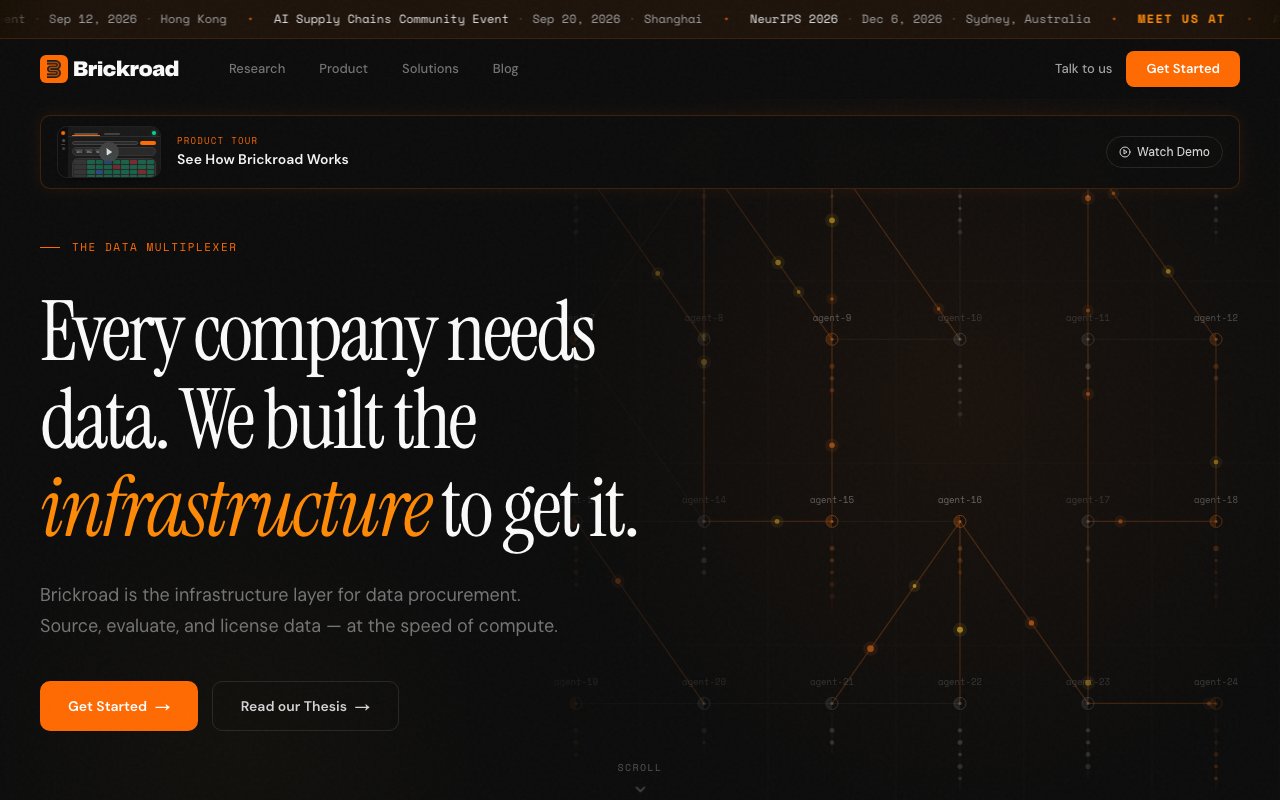
About Brickroad
Brickroad is an infrastructure platform for data procurement in AI. Teams building models and agent systems eventually run into the data problem, where the datasets they need sit scattered across hundreds of vendors and catalogs, each with its own contract, its own format, and its own sales cycle. Buying data at any real scale means weeks of discovery calls, legal review, and integration work, repeated for every new source. Brickroad's pitch is to automate that whole lifecycle. It discovers and ranks sources from a network of more than 1.5 million datasets, evaluates whether a dataset will actually improve your system before you pay for it, and executes the licensing, so a purchase that used to take weeks of back and forth can close in minutes.
The core of the system is what the company calls the multiplexer protocol. Procurement is normally an n times m problem, with every buyer negotiating bilaterally with every seller and the legal and technical overhead of each deal repeated from scratch. Brickroad collapses that into n plus m by having buyers and sellers each integrate once with the protocol, which then handles matching, evaluation, and transaction mechanics between them. The company says transactions complete in under 180 seconds at an estimated per-deal cost of around seven cents. Numbers like that only matter when software rather than people is doing the buying, and that's the real bet here, that agentic AI systems will procure their own data at runtime and will need rails built for machine speed.
The platform splits into three enterprise products. Atlas handles data value estimation, helping teams work out what a dataset is worth to their specific models before committing budget. Wayfinder covers runtime data access, giving systems a way to pull licensed data across multiple vendors and catalogs while they run. Horizon is the market intelligence layer, tracking what's available across the network and what it's worth. The three names split cleanly along the buying journey, deciding what data is worth, getting it into running systems, and watching the market itself. A sandbox evaluation step sits in the middle of the buying flow, so you can test a dataset's utility against your own workload before purchase rather than discovering after the invoice that it didn't move your metrics.
The other half of the network is the supply side. Data vendors onboard through a supplier wizard that walks them through packaging their data for the network, a checklist-style flow for describing what they have and how it can be licensed. That's how the catalog grows beyond the big-name providers. If your company is sitting on proprietary data with commercial value, the wizard is the front door for turning it into a listed, licensable asset that buyers and their agents can discover and evaluate without you running a sales motion yourself.
The obvious audience is AI labs and research teams with real data budgets, along with companies building agent-based systems that need data access at runtime rather than as a one-time training purchase. Data providers looking for distribution are the other half of the market. For them the pitch is reach without a sales team, since a listed catalog becomes discoverable to every buyer on the network and to the agents buying on their behalf. It's worth noting that the team publishes actual research, with peer-reviewed work at NeurIPS 2025 and CVPR 2026, which is more technical grounding than most infrastructure startups in this space can point to.
What makes Brickroad different from a data marketplace is that it isn't trying to be the storefront. Marketplaces list datasets and leave the evaluation, negotiation, and integration to you. Brickroad treats those steps as the product, automating the judgment calls about value and the mechanics of the deal itself. Whether that positioning holds depends on how many suppliers join the network, since a procurement layer is only as useful as what it can procure, but the two-sided design with a low-friction supplier onboarding path is clearly aimed at that problem.
Access is enterprise-shaped. The site points to a pricing page but no rates are disclosed, the three products are described as being in an onboarding phase, and the path in runs through the founders directly. This isn't a tool you sign up for on a Saturday afternoon, it's infrastructure you evaluate with a budget and a data strategy behind you. For teams already spending seriously on data and compute, and for vendors with data worth selling, it's an early but credible entry in a category that barely existed a year ago.
Key Features
- Network of 1.5 million plus datasets
- Multiplexer protocol for unified deal-making
- Sandbox data evaluation before purchase
- Atlas data value estimation
- Wayfinder runtime data access
- Supplier wizard for data vendors
Pros & Cons
What we like
- Automates the full data procurement lifecycle instead of just listing datasets
- Sandbox evaluation lets you test data utility before paying
- Team publishes peer-reviewed research behind the approach
- Serves both data buyers and data suppliers
Room for improvement
- Pricing isn't published, access runs through the sales team
- Products are early and still described as onboarding
- Built for organizations with data budgets, not solo builders
- Value depends on how many suppliers join the network
Frequently Asked Questions
What is Brickroad?
Is Brickroad free?
Who is Brickroad for?
How is Brickroad different from a data marketplace?
Best For
Featured in
Alternatives to Brickroad

Apatero AI
The creator studio for AI image, video, audio, 3D, and avatars, now at apatero.ai.

SoloDevStack
A solo developer blog built on head-to-head tool comparisons, 580+ posts deep.
Apatero Studio
Creator studio for AI image, video, audio, 3D, and avatars. Every model worth using, in one workspace.

Melodex
Turn your idea into an AI-generated music video
Reviews (0)
Badge builder
Add Brickroad to your website
Choose a badge style and size, preview it here, then copy the generated HTML. Badge images are self-contained SVGs and do not require an external script.

<a href="https://toolindex.net/tools/brickroad?ref=badge" target="_blank" rel="noopener">
  <img src="https://toolindex.net/badge/brickroad/medium.svg" alt="Brickroad - Listed on Tool Index" width="180" height="50" />
</a>How to use the badge
- 1. Pick the style, size, and theme that fit your layout.
- 2. Copy the generated HTML from the code block.
- 3. Paste it into your footer, homepage, or press page.
Standard badge available
The standard listing badge is available now. Score and circle badges are limited to tools currently ranked in the top 10 of a category.
Badge clicks return visitors to this profile with a referral tag so the source remains identifiable.
Related Tools
Apatero AI
The creator studio for AI image, video, audio, 3D, and avatars, now at apatero.ai.
Kevin Gabeci Toolkits
Seven AI toolkits for writing books, making music, cutting video, and building agents.

Warp
The modern terminal reimagined with AI and collaboration

Bolt.new
Prompt-to-deployed full-stack app inside the browser
Work on Brickroad? Request listing access or correction