
Brief
A news reader that condenses the day's coverage into short, sourced briefs
Gallery
About Brief
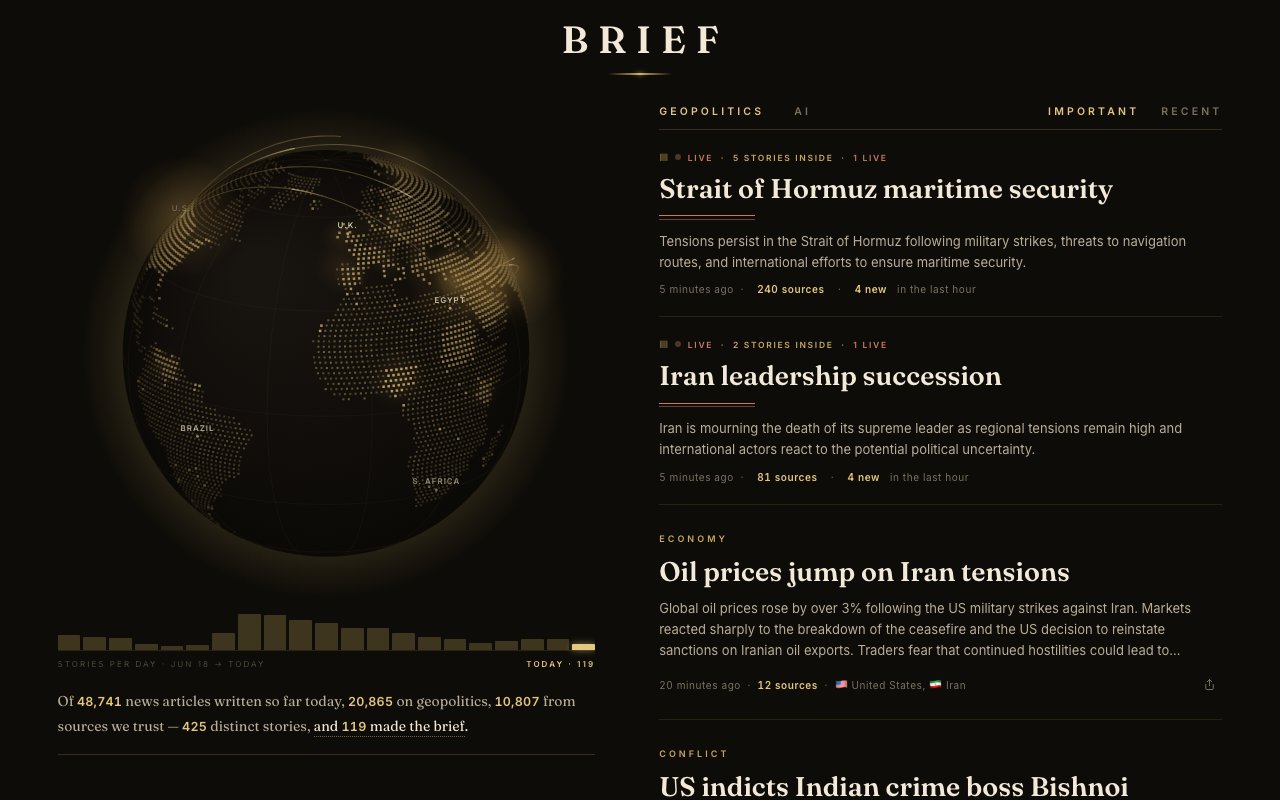
Brief is a news reader that takes the daily flood of reporting and condenses it into short, sourced briefs you can actually keep up with. Instead of a wall of headlines pulled from a hundred different outlets, it groups the coverage into story clusters, writes a tight summary of what is happening in each one, and shows you how many outlets are covering it so you can gauge how big a story really is before you spend any time on it. The whole design points at a single goal, turning an overwhelming stream into a short list of things worth knowing, without ever hiding where any of it came from.
The problem it goes after is news fatigue, the specific kind that comes from abundance rather than scarcity. Any major event now generates hundreds of near-identical articles across BBC, Reuters, CNN, Al Jazeera, and dozens of regional and national outlets, and reading five of them usually tells you almost nothing the first one didn't. Brief collapses that duplication into one clear cluster per story, so you read the shape of an event once instead of the same handful of facts rewritten by every desk on the planet. What you are left with is the substance of the day rather than its raw volume.
The reading experience is built around live story tracking. Each cluster carries a timestamp, a running count of how many outlets are covering it, and a flag when a story is still developing, so you can tell at a glance what is fresh and what has already settled into the record. A single geopolitics event might show coverage drawn from hundreds of sources at once, with a short brief up top and the original articles linked underneath whenever you want to go deeper on any one of them. Nothing is a dead end, since every summary doubles as a jumping-off point into the primary reporting behind it.
Coverage spans geopolitics, active conflicts, diplomacy, the economy, and technology, and stories carry geographic tags so you can follow a particular region or thread over time rather than losing it in the churn. Because the full source list stays visible on every story, you can see the spread of who is reporting something, notice when a claim is coming from only a couple of outlets versus the entire press corps, and decide for yourself how much weight to give it. That transparency is doing quiet work, since the number of sources on a story reads as a rough confidence signal you can act on.
It fits anyone who needs to stay genuinely informed without living inside a feed all day. That means researchers, analysts, policy people, journalists tracking a beat, and generally curious readers who want the substance of the day without opening twenty tabs and cross-checking them by hand. If you have ever landed on a news homepage and immediately felt behind, overwhelmed by the sheer volume and unsure what actually mattered, this is aimed squarely at that feeling. It rewards a quick scan, which is how most people really consume news in the gaps between everything else they have to do.
What sets it apart is the emphasis on clustering and source transparency rather than yet another infinite timeline. Plenty of apps aggregate headlines and call it a day, leaving you to do the deduplication in your own head while quietly deciding for you which single version of a story you get to see. Brief's whole angle is the opposite, condensing many articles into one brief per story while always keeping the underlying spread of coverage in view, so the summary stays anchored to real reporting you can click through and verify instead of a take you have to accept on faith. The structure is the product, not a wrapper around one opinionated feed.
In practice it behaves less like a social feed and more like a briefing you check and close. Because the stories are clustered and finite rather than infinitely scrolling, there is a natural stopping point once you have read through the day's clusters, which is the opposite of an app engineered to keep you swiping forever. The linked outlets do the heavy lifting on detail, so Brief can stay short without pretending to be the last word, and you decide for yourself when a headline is worth the full article and when the two-line brief was all you actually needed. For readers who have tried to quit doomscrolling and failed, that shape matters nearly as much as the summaries themselves.
Access looks free and open. There is no signup wall standing between you and the day's briefs, so you can start reading immediately and treat it as a lightweight morning scan or a running check-in through the day. For anyone building a habit around staying current, the pitch is simple, less time spent reading and more of the actual picture, with the receipts one tap away whenever you want them. It leans toward breadth and speed over long-form depth, which is exactly the trade most people want when they are trying to catch up rather than settle in for a single deep read.
Key Features
- Story clustering across many outlets
- Live developing-story tracking
- Per-story source counts
- Linked original articles
- Geographic and topic tags
- Condensed brief summaries
Pros & Cons
What we like
- Collapses duplicate coverage into one brief per story
- Source counts show how widely a story is covered
- Links straight to the original reporting
- No signup wall to start reading
Room for improvement
- Built for breadth, not long-form depth
- Thin public detail on its curation method
- No obvious personalization or saved topics
- Newer product with a small footprint
Frequently Asked Questions
What is Brief?
Is Brief free?
Who is Brief for?
How is Brief different from a normal news app?
Best For
Featured in
Alternatives to Brief

CalendHub
Smart scheduling and calendar management for teams

Confluence
Atlassian's long-running team wiki that anchors many enterprise knowledge stacks

Calculator.Free
200+ free online calculators for money, health, math and everyday questions

Reassign
A visual day planner that lays your whole day on a 24-hour circular dial
Reviews (12)
Recommended without reservation
Brief solves a real problem for me without making a fuss about it. What stands out is how it handles live developing-story tracking. It slotted into my routine without much fuss. No regrets so far.
Worth a look
Started using Brief casually, now it is pinned in my dock. The source counts show how widely a story is covered is more useful than I expected. It does what it says, which is rarer than it should be. Mostly using it for jumping from a summary to primary reporting.
Recommended without reservation
Hadn't planned on switching, but Brief was hard to ignore. It just works, day after day, without surprises. Glad I made the switch.
Finally something that fits
Started using Brief casually, now it is pinned in my dock. The condensed brief summaries is more useful than I expected. Recommending it to people in a similar spot.
Solid daily driver
Tried Brief on a side project first, then rolled it out everywhere. Their take on links straight to the original reporting is genuinely good. It handles the boring parts so I can focus on the work that matters. Recommending it to people in a similar spot.
Finally something that fits
Have been running Brief for a while, here is where I land. Their take on condensed brief summaries is genuinely good. Setup was painless and I was productive the same day. It fits well for jumping from a summary to primary reporting. Recommending it to people in a similar spot.
It just works
Tried Brief on a side project first, then rolled it out everywhere. What stands out is how little babysitting it needs. Hard to imagine going back to my old setup.
Recommended without reservation
Three months of Brief later, here is what holds up. Their take on source counts show how widely a story is covered is genuinely good. Mostly using it for tracking a developing geopolitical event. Hard to imagine going back to my old setup.
Recommended without reservation
Found Brief on a Show HN thread and I am glad I clicked. Their take on condensed brief summaries is genuinely good. The core workflow is smooth once you are set up. Mostly using it for tracking a developing geopolitical event. It earns its place in my stack.
Recommended without reservation
Hadn't planned on switching, but Brief was hard to ignore. The story clustering across many outlets is more useful than I expected. Mostly using it for jumping from a summary to primary reporting. It earns its place in my stack.
Recommended without reservation
Have been running Brief for a while, here is where I land. Their take on condensed brief summaries is genuinely good. Performance has been steady even when I lean on it hard. Mostly using it for scanning the day's major stories in one pass. Glad I made the switch.
Pulled its weight from week one
Brief has quietly become part of my daily flow. Setup was painless and I was productive the same day. Glad I made the switch.
Badge builder
Add Brief to your website
Choose a badge style and size, preview it here, then copy the generated HTML. Badge images are self-contained SVGs and do not require an external script.

<a href="https://toolindex.net/tools/briefnews?ref=badge" target="_blank" rel="noopener">
  <img src="https://toolindex.net/badge/briefnews/medium.svg" alt="Brief - Listed on Tool Index" width="180" height="50" />
</a>How to use the badge
- 1. Pick the style, size, and theme that fit your layout.
- 2. Copy the generated HTML from the code block.
- 3. Paste it into your footer, homepage, or press page.
Standard badge available
The standard listing badge is available now. Score and circle badges are limited to tools currently ranked in the top 10 of a category.
Badge clicks return visitors to this profile with a referral tag so the source remains identifiable.
Related Tools
Confluence
Atlassian's long-running team wiki that anchors many enterprise knowledge stacks
Asana
Project management for teams that live in projects, tasks and dependencies
Kevin Gabeci Toolkits
Seven AI toolkits for writing books, making music, cutting video, and building agents.

Logseq
An open-source outliner notes app where every bullet is a first-class block
Work on Brief? Request listing access or correction