Kibu
Vertical software for disability service providers covering compliance, documentation, and programming
Gallery
About Kibu
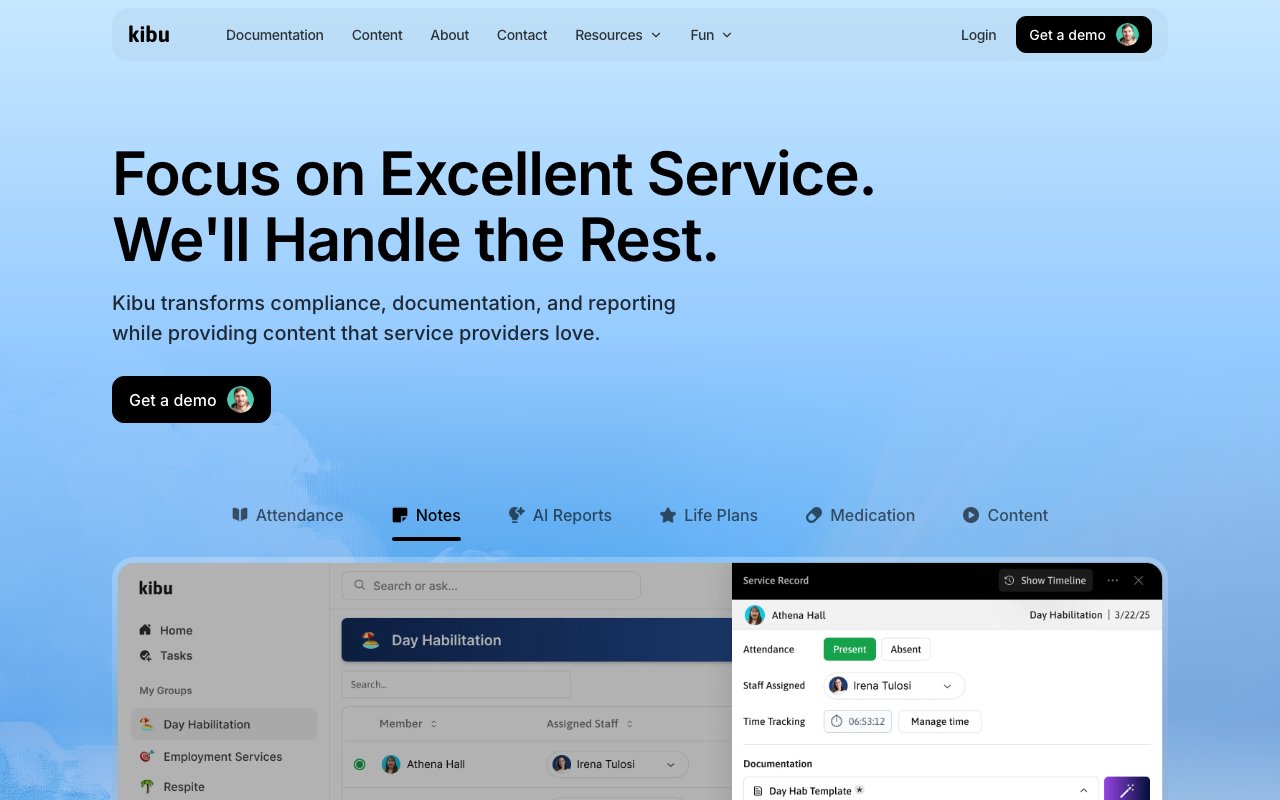
Kibu is a software platform designed specifically for organizations that provide services to people with intellectual and developmental disabilities. It combines documentation tools, compliance tracking, and educational content into a single system built around the workflows these providers actually follow. Instead of adapting generic software to a specialized field and hoping the customizations hold together, Kibu starts from the operational reality of IDD service delivery and builds outward from there. That focus matters because the compliance requirements, documentation standards, and day-to-day workflows in this sector don't map cleanly onto tools designed for general healthcare or social services.
The problem it addresses is the administrative burden that comes with running a disability services program while staying compliant with Medicaid, HIPAA, and a patchwork of state-specific regulations. Staff need to track attendance, manage individual service goals, log medication administration, and produce documentation that satisfies auditors. Doing this across disconnected spreadsheets, paper forms, and general-purpose software creates gaps, and audits expose those gaps in ways that can threaten funding and accreditation. Direct support professionals often spend more time on paperwork than on the people they're supposed to be supporting, which burns them out and reduces the quality of care. Kibu consolidates these tasks and uses AI-assisted note generation to reduce the time staff spend documenting while keeping the output compliant and complete.
At the core is a documentation system that handles case notes, attendance, goal tracking, and medication logs. The AI component, which Kibu describes as a magic pen feature, helps staff write compliant notes faster by suggesting language and structure that meets regulatory standards. This isn't about replacing human judgment but about reducing the cognitive load of remembering what documentation needs to say and how it needs to be formatted. Compliance reporting is built in, so organizations can pull audit-ready records without assembling them manually from multiple systems. The platform reports a 99.2% compliance rate within two months of implementation, which suggests the tooling aligns closely with what regulators actually require.
Beyond the administrative core, Kibu includes scheduling for appointments and transportation, task assignment and tracking for staff, and member record management. These operational features mean the platform can serve as the primary system of record for a provider organization rather than one tool among many. Custom dashboard configurations let different roles see what's relevant to them without wading through features they don't use. Built-in translation support addresses the reality that many direct support professionals and the people they serve speak languages other than English as their primary language.
The platform also offers a library of over 600 on-demand training classes covering life skills, job development, yoga, cooking, and staff education. These can be paired with tracking to monitor member progress automatically. For organizations that run day programs, community participation services, or residential settings, this content layer means they don't need to source and manage training materials separately. The educational content isn't an afterthought bolted onto an administrative system; it's integrated in a way that lets providers use it as part of their service delivery rather than just compliance paperwork.
Kibu serves IDD and HCBS providers ranging from small local programs to large multi-site networks. Organizations like The ARC, YMCA affiliates, and Chimes already use it, which signals that the platform can handle the complexity of larger operations while remaining accessible to smaller programs without dedicated IT staff. The platform is mobile-ready, which matters for direct support professionals who work in community settings or residential homes rather than sitting at a desk all day.
Kibu operates on a subscription model, with pricing based on program size and feature needs. Interested organizations can request a demo or submit a formal RFP. There's no self-serve free tier, which reflects the enterprise nature of the buyer and the implementation support typically required to get a new documentation system running smoothly. The sales process is consultative, aimed at understanding an organization's specific compliance environment and service model before proposing a configuration.
Key Features
- Attendance and medication tracking
- AI-assisted service notes with translation
- Automated compliance reporting and dashboards
- Member records, appointments, and transport management
- Library of habilitative and recreational classes
- Lesson plan creation and progress tracking
Pros & Cons
What we like
- Built specifically for the IDD care vertical, not a generic CRM
- Combines compliance tooling with ready-made programming content
- Strong reported compliance gains within two months
Room for improvement
- No public pricing, you have to book a demo
- Only relevant to disability service providers
- Young company with a single seed round behind it
- AI service notes still need staff review for accuracy
Frequently Asked Questions
Who is Kibu actually built for?
How much does Kibu cost?
How does the compliance side work?
What is the content library and why does it matter?
Are the AI-written service notes reliable?
Best For
Featured in
Alternatives to Kibu

Notion
All-in-one workspace for notes, docs, and collaboration

Airtable
Spreadsheet-database hybrid with linked records, multiple views, automations, and an interface designer for internal apps.
monday.com
A flexible work OS built around colorful, spreadsheet-like boards

ClickUp
One workspace that tries to absorb every other project tool you use
Our take
Tool Index Editorial · Jun 2026· 4.2/5
Kibu is a clean example of vertical software done right. It understands that disability service providers are drowning in compliance documentation and gives them a single system that handles the paperwork and ships a deep library of life-skills and recreational programming on top. The reported 99.2 percent compliance within two months and a client list that includes The Arc and the YMCA suggest it delivers on the core promise.
The caveats are the usual ones for a young, focused vendor. Pricing is demo-only so you can't budget without a sales call, it's an early-stage company with a single seed round behind it, and the AI service notes still need a human to check them before they hit a compliance record. None of that undercuts the value for the right buyer. If you run an IDD program, Kibu is built for you in a way generic CRMs never will be. If you don't, it's simply not for you.
Editorial opinion from the Tool Index team, written from the public product pages. Not a user review.
Reviews (6)
It just works
Kibu isn't perfect but it's the best I've used in this category. Where it really wins is built specifically for the IDD care vertical, not a generic CRM. Found it works best for program directors delivering structured life-skills curriculum. Still recommending it to people in similar setups.
Pros
- Built specifically for the IDD care vertical, not a generic CRM
- Strong reported compliance gains within two months
Quietly excellent
Honest take: Kibu delivers most of what the marketing promises. Honestly impressed by how built specifically for the IDD care vertical, not a generic CRM. Got real value out of member records, appointments, and transport management. It fits well for frontline staff logging medication and transport in one system. Not perfect: AI service notes still need staff review for accuracy. Easy yes for anyone weighing the same trade-offs.
Cons
- Young company with a single seed round behind it
- AI service notes still need staff review for accuracy
Kibu is fine, here's the real take
Got Kibu on the recommendation of someone I trust. The biggest win has been strong reported compliance gains within two months.
Pros
- Built specifically for the IDD care vertical, not a generic CRM
- Strong reported compliance gains within two months
Onboarded the team in a day
The pitch for Kibu sounded too good to be true. Mostly true. The biggest win has been built specifically for the IDD care vertical, not a generic CRM. The library of habilitative and recreational classes is more useful than I expected. Would buy again without thinking twice.
The kind of tool you forget you're paying for
Came to Kibu after frustration with what I had before. Genuine strength: strong reported compliance gains within two months. Library of habilitative and recreational classes works the way you'd hope. It fits well for day programs documenting attendance and service notes for IDD members. It would be a 5 if not for AI service notes still need staff review for accuracy. Still recommending it to people in similar setups.
Cons
- No public pricing, you have to book a demo
- AI service notes still need staff review for accuracy
The kind of tool you forget you're paying for
Took a few weeks for Kibu to click, then it stuck. Genuine strength: strong reported compliance gains within two months. Mostly using it for disability agencies automating state compliance reporting. Sticking with Kibu.
Badge builder
Add Kibu to your website
Choose a badge style and size, preview it here, then copy the generated HTML. Badge images are self-contained SVGs and do not require an external script.

<a href="https://toolindex.net/tools/kibu?ref=badge" target="_blank" rel="noopener">
  <img src="https://toolindex.net/badge/kibu/medium.svg" alt="Kibu - Listed on Tool Index" width="180" height="50" />
</a>How to use the badge
- 1. Pick the style, size, and theme that fit your layout.
- 2. Copy the generated HTML from the code block.
- 3. Paste it into your footer, homepage, or press page.
Score badge available
Kibu qualifies for the score and circle badges based on its current top-10 positionin Productivity.
Badge clicks return visitors to this profile with a referral tag so the source remains identifiable.
Related Tools

Confluence
Atlassian's long-running team wiki that anchors many enterprise knowledge stacks
Asana
Project management for teams that live in projects, tasks and dependencies
Kevin Gabeci Toolkits
Seven AI toolkits for writing books, making music, cutting video, and building agents.

Logseq
An open-source outliner notes app where every bullet is a first-class block
Work on Kibu? Request listing access or correction