
Cochat
AI research assistant that verifies citations against 200M academic papers before you publish
Gallery
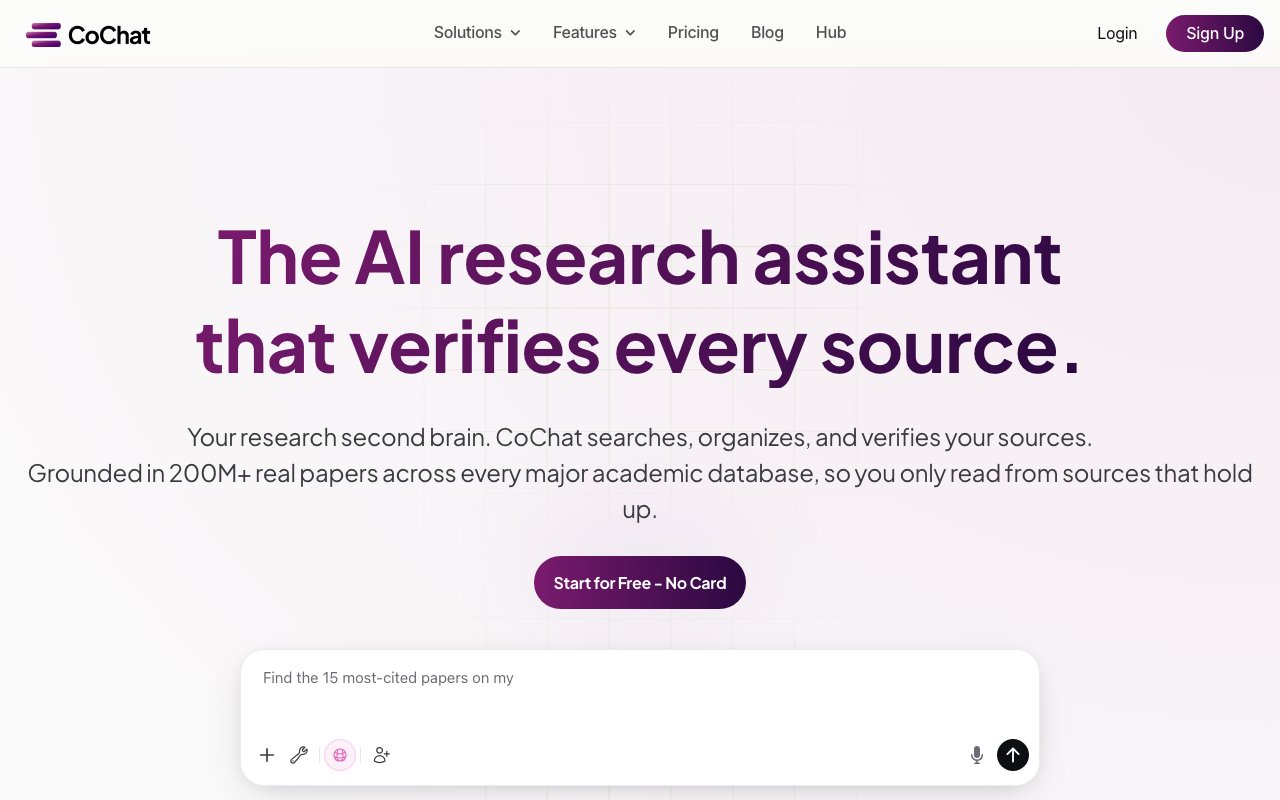
About Cochat
Cochat is a research assistant workspace that tackles one of the most persistent problems in academic writing: fabricated and misquoted citations. It searches across more than two hundred million papers from ArXiv, PubMed, Semantic Scholar, Crossref, OpenAlex, Europe PMC, and CORE, then verifies every recommended citation against the actual source before you use it. The platform is built on Open WebUI, an open source project with over 130,000 GitHub stars and 230 million downloads, which gives it a foundation that has been tested at scale. If you have ever had a language model confidently cite a paper that does not exist, or worse, published a manuscript only to have a reviewer flag a hallucinated reference, this is the product trying to prevent that from happening.
The core workflow centers on verification before insertion. You pose a research question, and Cochat retrieves relevant papers with real bibliographic data attached. It can run your query through Claude, GPT, and Gemini simultaneously, displaying the answers side by side so you can cross-reference them and spot inconsistencies between models. Anything unverified gets flagged before it ends up in your manuscript. The system checks every recommended citation against the actual paper, not just the metadata, so you know the source says what the AI claims it says. According to research cited on the site, one in four citations in published work misrepresents its source, based on a 2015 meta-analysis by Jergas and Baethge. Catching those errors during drafting costs far less than catching them during peer review or after publication.
Beyond citation checking, the workspace supports the rest of the research process from start to finish. You can organize literature reviews, generate comparison tables, create flashcards for studying, build diagrams, and assemble slide decks. The file management system lets you upload documents, capture notes, and attach Google Drive files directly into your workspace. Everything you create exports with source verification intact, which matters when you are handing a bibliography to a journal editor or a thesis committee that will check your references. The emphasis throughout is on traceability rather than just generation speed.
Collaboration is built into the platform at the workspace level. You can invite advisors, co-authors, and study groups into shared workspaces where everyone can see sources and outputs in real time. Model switching within threads means one person can ask Claude while another queries Gemini, and the conversation stays coherent. Conversations are searchable and exportable, so nothing gets buried in a chat history that someone forgets to save. This makes it practical for lab groups, dissertation committees, and multi-author papers where different people are responsible for different sections but everyone needs access to the same source material.
The automation layer adds scheduled agents that can monitor publications in your field without requiring you to check manually. You can set up agents to flag when a paper you cited gets updated or retracted, generate weekly reading summaries of new work in your area, and trigger reviews or workflows via webhooks. For researchers who need to stay current in fast-moving fields, this turns the platform into an always-on literature scanner rather than a tool you open only when you are actively writing. The three automations available on the starter tier and unlimited automations on pro make this accessible at different levels of usage.
Cochat integrates with over two hundred external services including Google Drive, Notion, GitHub, Zapier, HubSpot, Atlassian, Supabase, Figma, and various learning management systems. This breadth means you can pull in documents from wherever you already store them and push outputs wherever you need them to go. The platform is used at more than a hundred universities including Princeton, Columbia, Cambridge, Florida State, University of Michigan, and NYU according to the site. It is aimed at students and researchers who need to move fast but cannot afford to publish bad citations, and the university presence suggests it has found traction in exactly that audience.
Pricing is freemium with a clear escalation path. The free tier gives you unlimited messages with basic models, three file uploads per day, and ten citation verifications. Starter at nine dollars per month bumps that to five times the usage, twenty daily uploads, a hundred verifications, and three active automations. Pro at nineteen per month removes the limits entirely with unlimited file uploads, unlimited citation verifications, and unlimited automations. No credit card is required to start, and the platform does not train on user data. For anyone writing a thesis, submitting to journals, or just trying to build a literature review without manually checking every reference, the verification layer alone makes it worth trying on the free tier to see if it catches problems you would have missed.
Key Features
- Citation verification across 200M papers
- Multi-model querying with Claude, GPT, and Gemini
- Real-time collaboration for research teams
- Publication monitoring with retraction alerts
- 200+ integrations including Drive and Notion
- Literature review and flashcard tools
Pros & Cons
What we like
- Catches fabricated citations before publication
- Cross-references answers across multiple AI models
- Free tier available with no credit card required
- Does not train on user research data
Room for improvement
- Free tier limits verifications to ten per day
- Focused on academic research, less useful elsewhere
- Relies on indexed databases, so very new papers may lag
- Built on Open WebUI, so some features overlap with the base project
Frequently Asked Questions
What is Cochat?
Is Cochat free?
What databases does Cochat search?
Who is Cochat for?
Best For
Featured in
Alternatives to Cochat

Apatero AI
The creator studio for AI image, video, audio, 3D, and avatars, now at apatero.ai.

SoloDevStack
A solo developer blog built on head-to-head tool comparisons, 580+ posts deep.
Apatero Studio
Creator studio for AI image, video, audio, 3D, and avatars. Every model worth using, in one workspace.

Melodex
Turn your idea into an AI-generated music video
Reviews (0)
Badge builder
Add Cochat to your website
Choose a badge style and size, preview it here, then copy the generated HTML. Badge images are self-contained SVGs and do not require an external script.

<a href="https://toolindex.net/tools/cochat?ref=badge" target="_blank" rel="noopener">
  <img src="https://toolindex.net/badge/cochat/medium.svg" alt="Cochat - Listed on Tool Index" width="180" height="50" />
</a>How to use the badge
- 1. Pick the style, size, and theme that fit your layout.
- 2. Copy the generated HTML from the code block.
- 3. Paste it into your footer, homepage, or press page.
Standard badge available
The standard listing badge is available now. Score and circle badges are limited to tools currently ranked in the top 10 of a category.
Badge clicks return visitors to this profile with a referral tag so the source remains identifiable.
Related Tools
Apatero AI
The creator studio for AI image, video, audio, 3D, and avatars, now at apatero.ai.
Kevin Gabeci Toolkits
Seven AI toolkits for writing books, making music, cutting video, and building agents.

Warp
The modern terminal reimagined with AI and collaboration

Bolt.new
Prompt-to-deployed full-stack app inside the browser
Work on Cochat? Request listing access or correction