
ConferenceFindr
Search business conferences and trade shows by industry, place, date, price, and size
Gallery
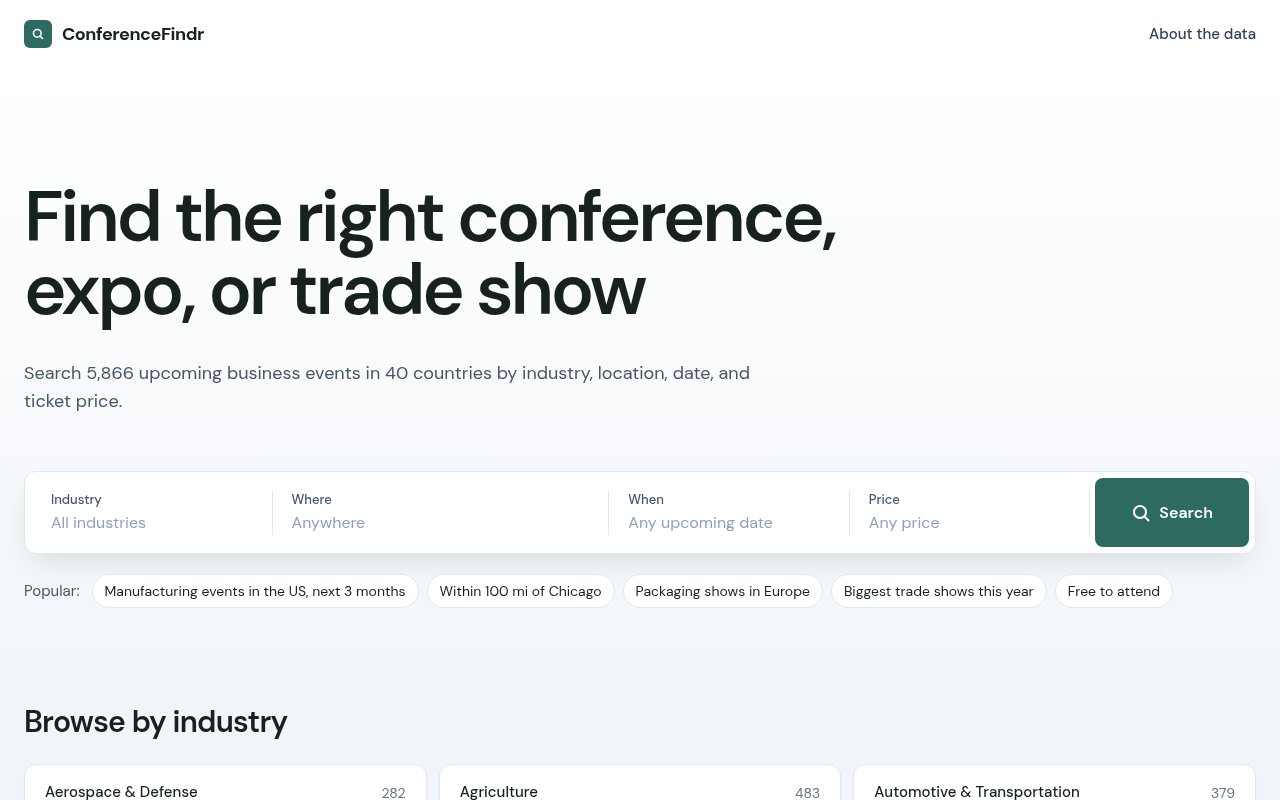
About ConferenceFindr
ConferenceFindr is a searchable directory for finding business conferences, expos, and trade shows without working through a pile of organizer sites and scattered event calendars. Its homepage currently indexes more than 5,800 upcoming events across 40 countries. A visitor can narrow that catalog by industry, location, date, and ticket price, then follow the official event link when something looks relevant. The focus is practical business discovery rather than academic calls for papers, so it fits people looking for customers, suppliers, partners, professional education, or a useful industry gathering.
The search experience combines a keyword box with structured filters. Industry choices span areas such as manufacturing, healthcare, technology, finance, construction, energy, retail, agriculture, marketing, and supply chain. Location controls let someone search anywhere, choose places, or look near a location. Time filters help constrain the calendar, while price filters can isolate free events or published passes under specific spending limits. Attendance bands make it possible to distinguish a smaller meeting from a major exhibition. Result counts update around the selected criteria, and results can be sorted, which makes the directory useful for both broad exploration and a fairly specific brief.
Each result carries more than a title and date. Listings can show the event format, venue, city, a concise summary, the audience it serves, organizer, approximate attendance or exhibitor numbers, the year it began, published pricing, and relevant industry labels. Some entries identify hybrid attendance, separate an expo pass from a full pass, or preserve expired price tiers beside the current rate. The individual event page links out to the organizer's official site and can state when dates, venue, or prices were last checked. Missing information is marked as not published or unknown instead of being filled with a confident guess.
That structure is especially helpful for teams planning a trade show calendar. A sales or partnerships lead can compare gatherings where likely buyers will be present. Procurement teams can look for supplier exhibitions in a particular region. Marketers can find industry events that fit a travel window and budget, while an individual attendee can start with free events or a distance based search. Because the catalog covers multiple countries and many industries in one interface, it also helps with early research when someone knows the market they care about but not the names of its major shows.
Price information gets more care than it does in a typical event list. The search can filter against the cheapest published pass, whether that is a full registration or an expo only option, and events without a published price are left out of those filtered results. An event record may distinguish a free exhibit hall pass from paid conference access, display a current deadline based tier, and retain earlier rates as expired for context. Notes can explain which audience or membership rate is being shown. That makes quick budget screening possible while reminding the reader that two displayed prices may cover different levels of access.
ConferenceFindr is unusually open about how the catalog is assembled and where its limits are. Its data page says events are discovered through web searches by industry and location. Upcoming events are checked for updates at least weekly, while searches for new events happen roughly monthly. Attendance and exhibitor figures are approximate and generally come from numbers reported by organizers. Dates and venues can change, so the site repeatedly tells readers to confirm details on the official event website before booking travel. That caution matters because the directory is a research starting point, not the ticket seller or final authority for an event.
The strongest reason to use it is the combination of breadth and decision friendly detail. Many calendars stop at topic, city, and date. ConferenceFindr brings audience, scale, organizer, published pass prices, and direct source links into the same comparison flow. It also publishes an MCP endpoint that can be added to ChatGPT or Claude as a custom connector for event research inside those tools. Its limitations follow from the source material. Many organizers don't publish attendance, founding year, or pricing, and a weekly check can't eliminate every late change. The site also concentrates on business and industry events, so researchers seeking academic conferences may need a different database. Access appears free, with no account requirement or paid plan shown on the public site, which makes it easy to search before committing budget or travel time.
Key Features
- Keyword and structured event search
- Industry, date, and location filters
- Ticket price and attendance filters
- Audience and organizer details
- ChatGPT and Claude MCP connector
- Direct official event links
Pros & Cons
What we like
- Covers thousands of business events across many industries
- Combines budget, timing, location, and scale filters
- Marks unknown details instead of presenting guesses
- Links every listing back to an official source
Room for improvement
- Many events lack published size or price data
- Event changes can occur between weekly checks
- Academic conferences are not the main focus
- It doesn't sell tickets or confirm availability
Frequently Asked Questions
What is ConferenceFindr?
Is ConferenceFindr free?
How current is the event information?
What details can I compare?
Best For
Featured in
Alternatives to ConferenceFindr
View all
CalendHub
Smart scheduling and calendar management for teams
Kevin Gabeci Toolkits
Seven AI toolkits for writing books, making music, cutting video, and building agents.

Eased Into AI
Learn AI from zero. No jargon, no hype, just steps that work.

Fix It Gently
Calm, plain-English fixes for everyday tech problems.
Reviews (0)
Badge builder
Add ConferenceFindr to your website
Choose a badge style and size, preview it here, then copy the generated HTML. Badge images are self-contained SVGs and do not require an external script.

<a href="https://toolindex.net/tools/conferencefindr?ref=badge" target="_blank" rel="noopener">
  <img src="https://toolindex.net/badge/conferencefindr/medium.svg" alt="ConferenceFindr - Listed on Tool Index" width="180" height="50" />
</a>How to use the badge
- 1. Pick the style, size, and theme that fit your layout.
- 2. Copy the generated HTML from the code block.
- 3. Paste it into your footer, homepage, or press page.
Standard badge available
The standard listing badge is available now. Score and circle badges are limited to tools currently ranked in the top 10 of a category.
Badge clicks return visitors to this profile with a referral tag so the source remains identifiable.
Related Tools

Confluence
Atlassian's long-running team wiki that anchors many enterprise knowledge stacks
Asana
Project management for teams that live in projects, tasks and dependencies
Kevin Gabeci Toolkits
Seven AI toolkits for writing books, making music, cutting video, and building agents.

Logseq
An open-source outliner notes app where every bullet is a first-class block
Work on ConferenceFindr? Request listing access or correction