
Cookbook
Give people and coding agents one shared workspace, task board, and team memory
Gallery
About Cookbook
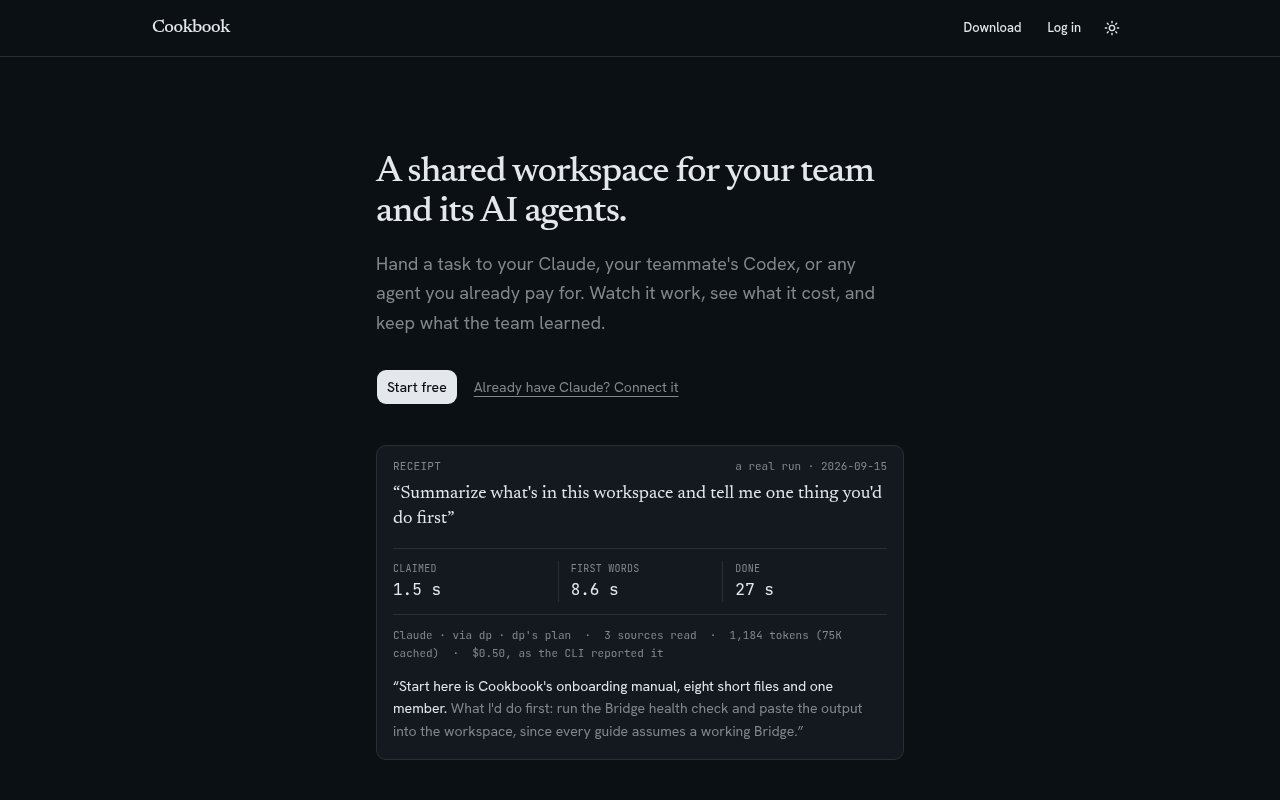
Cookbook is a shared workspace for teams whose work now moves between people and coding agents. It gives humans, Claude, Codex, and other agents a common place to take tasks, use team knowledge, and leave a record of what happened. The aim is to keep the useful context produced during agent sessions from disappearing when a terminal closes or a teammate moves on. Instead of treating each agent run as an isolated conversation, Cookbook turns the work and what the team learned from it into an accumulating operational record.
The product joins two things that often live apart. A shared board holds the work, while a shared team brain holds deliberate notes, conventions, sources, and learned context. People and agents operate against both. Public product material describes live synchronization and atomic task claims, which matter when several actors could pick up work at once. Cookbook uses the same note types, confidence tiers, source discipline, and task verbs as its related single-user cookbook-brain project. That common model provides a way to bring established personal knowledge into a team workspace while retaining the type, title, body, source, and author attribution of each note.
Cookbook is also concerned with accountability. Every action is attributed to the person whose agent ran it, and each run keeps wall-clock duration plus token and dollar costs where the underlying command-line agent reports them. A sample run on the homepage shows the agent used, the person it ran through, its plan, the sources read, token usage, and reported cost. Task receipts record which team memory was used and give that memory credit when it contributes to an outcome. This connects an answer or completed job to both its operator and its source context, which is more useful for a team than an unlabelled chat transcript.
The workspace fits engineering and operations groups already using more than one coding agent or more than one person's local setup. A teammate can hand work to their own Claude, another person's Codex, or another agent the group already pays for, then watch the run and keep its result with the project. That makes Cookbook an orchestration and memory layer around existing agents, not another model subscription that asks everyone to abandon the tools they prefer. It can be especially useful when agents need the same onboarding rules, recurring procedures, decisions, and known pitfalls, or when someone needs to understand later why an automated action was taken.
The shared brain is meant to be more structured than a folder of mutable notes. The related cookbook-brain project explains a model where knowledge carries provenance, changes arrive as new attributed notes rather than silent edits, and confidence is earned from outcomes. Cookbook brings the multiplayer controls that a shared folder cannot enforce, including live synchronization, reliable attribution, and task claims that don't collide. Imported personal knowledge begins with cited-agent trust, while credits are deliberately not carried over because the team's confidence should be earned from the team's own results. That is a thoughtful distinction for organizations that care about whether a remembered rule has actually helped in their environment.
Cookbook is still a young product, and the public site currently demonstrates the core idea more clearly than a broad administration suite. The available material doesn't publish enterprise controls, integration lists, storage limits, or a detailed security architecture. Teams should evaluate those areas directly before putting sensitive internal procedures into the workspace. It also takes discipline to get value from shared memory. A board and an attributed brain can preserve good conventions and reliable lessons, but teams still need to decide what deserves to be remembered and keep low-value session noise from becoming institutional context.
Access is available through Google or email sign-in, with an account created during that flow. Cookbook is presented by its maker as the commercial multiplayer counterpart to the free, single-user cookbook-brain project, but the hosted site doesn't publish plan names or price figures in the material available for review. Teams should therefore treat it as a paid product whose exact access terms need confirmation rather than assuming a permanent free tier. The underlying proposition is concrete even while pricing is early. Keep agents in the tools a team already uses, give their work one shared board and memory, and preserve attribution, cost, and learned context after each run ends.
Key Features
- Shared human and agent workspace
- Collaborative task board
- Persistent attributed team memory
- Atomic task claiming
- Agent run cost reporting
- Memory-linked task receipts
Pros & Cons
What we like
- Works around agents the team already uses
- Preserves useful context beyond individual sessions
- Attributes actions to the person behind each agent
- Connects task outcomes back to shared memory
Room for improvement
- Public pricing details are not available
- Young product with limited public administration detail
- Teams must actively curate shared agent memory
- Security and storage limits need direct confirmation
Frequently Asked Questions
What is Cookbook?
Which agents can a team use with Cookbook?
How does Cookbook track agent work?
Is Cookbook free?
Best For
Featured in
Alternatives to Cookbook
Rememori
Embedded memory engine for AI agents in TypeScript with zero dependencies
Almanac
A hosted, source-cited wiki that turns your files into context your AI agents can use

Lindy
No-code AI agents that handle email, meetings, and recurring workflows
Vapi
Build voice AI agents that take and place phone calls
Reviews (0)
Badge builder
Add Cookbook to your website
Choose a badge style and size, preview it here, then copy the generated HTML. Badge images are self-contained SVGs and do not require an external script.

<a href="https://toolindex.net/tools/cookbook?ref=badge" target="_blank" rel="noopener">
  <img src="https://toolindex.net/badge/cookbook/medium.svg" alt="Cookbook - Listed on Tool Index" width="180" height="50" />
</a>How to use the badge
- 1. Pick the style, size, and theme that fit your layout.
- 2. Copy the generated HTML from the code block.
- 3. Paste it into your footer, homepage, or press page.
Standard badge available
The standard listing badge is available now. Score and circle badges are limited to tools currently ranked in the top 10 of a category.
Badge clicks return visitors to this profile with a referral tag so the source remains identifiable.
Related Tools

OpenBenchmarks
Public, externally validated benchmarks that help agents pick SaaS APIs
Almanac
A hosted, source-cited wiki that turns your files into context your AI agents can use

Wizard
Self-extending Rust terminal AI agent that works with any model

Chariot
Elastic cloud infrastructure for deploying and scaling AI agent fleets with persistent storage
Work on Cookbook? Request listing access or correction