
Court Rules
Search source-linked court rules, filing requirements, holidays, and enforcement data
Gallery
About Court Rules
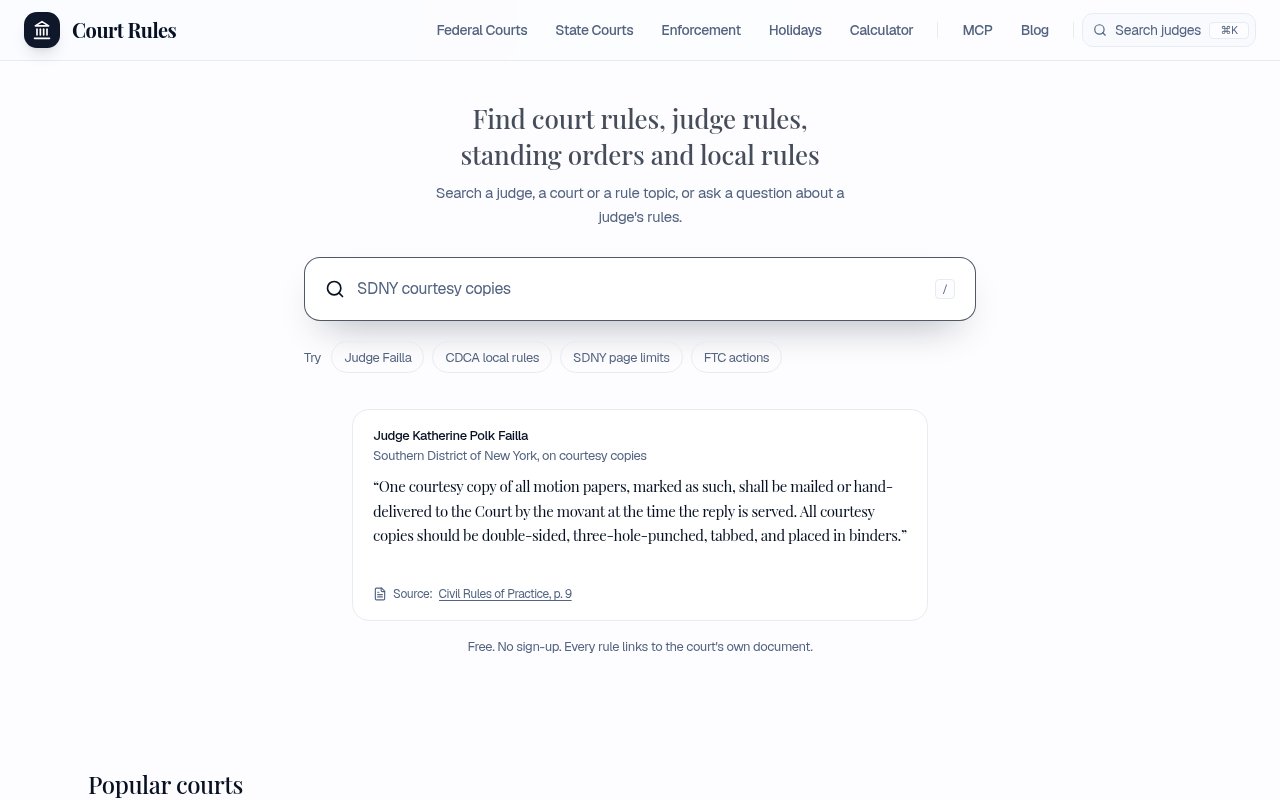
Court Rules is a legal research service that organizes judge specific filing requirements, local court rules, court holidays, and privacy enforcement actions. The public website lets a user search for a judge, court, rule topic, or company without signing up. Instead of leaving a rule buried in a standing order or practice document, the service turns it into a structured entry for questions such as page limits, courtesy copies, filing format, pre-motion procedures, discovery disputes, sealing, and electronic filing. Every rule links back to the court document and the relevant page so a legal professional can confirm it before acting.
The main value is speed without removing the source trail. Federal district court coverage is organized by circuit, and state resources are organized by jurisdiction. Users can browse a particular court, open an individual judge's practices, or compare the same topic across courts and judges. The homepage also includes calculators for filing deadlines, federal deadlines, business days, and court days, along with closure calendars. Court Rules explicitly says it isn’t legal advice and tells users to confirm information with the court's own source, which is an important boundary for any filing workflow.
Privacy enforcement data forms a second part of the product. The tracker structures actions from sources such as the FTC, HHS, state attorneys general, and other privacy regulators. Records can include the organization, fine amount, violation types, cited laws, remedies, risk level, and a link to the official government material. The service says sources are checked daily and new enforcement events generally appear within 24 to 48 hours of an official announcement. This gives compliance teams a searchable view of regulatory activity alongside the court procedure material, though the two collections serve different day to day needs.
For software teams, the same data is available through a REST API and an MCP server. The API covers judge rules, enforcement events, court and judge directories, deadline and formatting data, and filing compliance checks. A compliance check can take an uploaded PDF, classify the document type, count pages and words, and return a status for the applicable rules with source citations. MCP makes the data available to compatible AI clients, including Claude Desktop, Cursor, VS Code, Windsurf, and Codex CLI. Programmatic access requires an account and API key even though the public research website doesn’t require a login.
This combination makes Court Rules useful to litigators, paralegals, docketing staff, legal operations teams, compliance professionals, and legal technology developers. A litigation team can look up a judge's page limit and courtesy copy practice before filing. A docketing professional can count court days and review holiday closures. A compliance team can monitor enforcement activity and trace an event to the government announcement. A product team can embed source linked rule data or pre-filing checks in an editor. The site is strongest when the user needs a procedural requirement with a citation, not case law research, docket retrieval, or a prediction about how a judge will decide a dispute.
The service describes a continuous collection process that checks covered court sites for changes to standing orders and individual practices. Rules are organized around drafting, filing, chambers contact, and related legal workflows rather than presented as one long extracted document. The API page says compliance critical material receives human review before publication and that changes are logged with timestamps and before and after differences. Even with those controls, court practices can change, coverage varies, and the original court document remains authoritative. Users should treat the structured result as a faster route to verification rather than a substitute for it.
The public website is free for individual users with no paywall or login. API access follows a freemium model. The Developer plan costs zero dollars per month, includes all courts and judges, and is limited to 10 requests per minute with community support. Startup and Scale plans use custom pricing for production limits, commercial licensing, priority support, unlimited requests, custom service terms, and other higher volume needs. That split keeps ordinary research open while charging organizations that integrate the data into products. Buyers evaluating the API can start with the free plan, but they will need to contact the company for a firm production price.
Key Features
- Source linked judge rules
- Court deadline calculators
- Privacy enforcement tracker
- Filing compliance checks
- REST API access
- MCP server integration
Pros & Cons
What we like
- Links every rule back to its court source
- Keeps the public research website free
- Combines procedural rules with practical calculators
- Supports product integrations through API and MCP
Room for improvement
- Users must still verify rules before filing
- Programmatic access requires an account
- Production API prices require a custom quote
- Coverage depends on the courts and judges collected
Frequently Asked Questions
What is Court Rules?
Is Court Rules free?
Can Court Rules check a filing?
How can developers access the data?
Best For
Featured in
Alternatives to Court Rules

CalendHub
Smart scheduling and calendar management for teams

Kevin Gabeci
Solo developer building web apps, cozy browser games, and AI creator toolkits.
SoloDevStack
A solo developer blog built on head-to-head tool comparisons, 580+ posts deep.

Vibe Built
Building real apps with agentic AI. What worked, what broke, what shipped.
Reviews (0)
Badge builder
Add Court Rules to your website
Choose a badge style and size, preview it here, then copy the generated HTML. Badge images are self-contained SVGs and do not require an external script.

<a href="https://toolindex.net/tools/court-rules?ref=badge" target="_blank" rel="noopener">
  <img src="https://toolindex.net/badge/court-rules/medium.svg" alt="Court Rules - Listed on Tool Index" width="180" height="50" />
</a>How to use the badge
- 1. Pick the style, size, and theme that fit your layout.
- 2. Copy the generated HTML from the code block.
- 3. Paste it into your footer, homepage, or press page.
Standard badge available
The standard listing badge is available now. Score and circle badges are limited to tools currently ranked in the top 10 of a category.
Badge clicks return visitors to this profile with a referral tag so the source remains identifiable.
Related Tools
Kevin Gabeci
Solo developer building web apps, cozy browser games, and AI creator toolkits.

Coolify
Self-hostable, open source alternative to Heroku and Netlify

Confluence
Atlassian's long-running team wiki that anchors many enterprise knowledge stacks
Asana
Project management for teams that live in projects, tasks and dependencies
Work on Court Rules? Request listing access or correction