
Deepmark
Search your bookmarks by what's inside them, not just the title
Gallery
About Deepmark
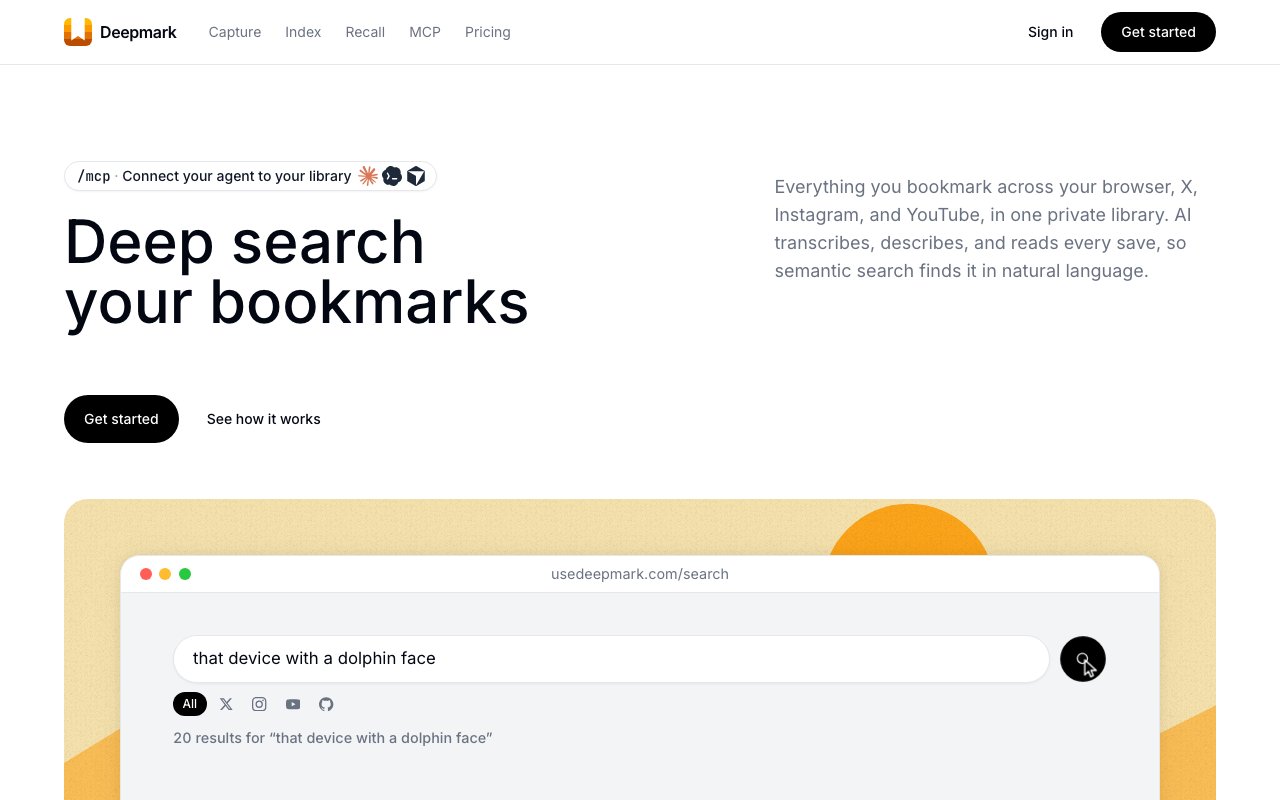
Deepmark is a bookmark manager built around one observation, that the things you save are almost never findable by their titles. A YouTube video called something vague, a thread on X with an unhelpful first line, an Instagram save with no text at all. Deepmark pulls your bookmarks from the browser, X, Instagram, and YouTube into one private library, then uses AI to index what each saved item actually contains so you can search for the idea you remember rather than the title you don't. The saving habit most people already have stops being a write-only archive and starts behaving like a real personal search engine.
Capture happens through a Chrome extension that syncs automatically. From there the indexing gets unusually thorough. Audio in a saved video gets transcribed. Text visible in video frames gets extracted. Page content gets read in full. Images get visual descriptions written for them, and every item picks up an AI-generated summary and tags. That means a cooking video you saved months ago is findable by an ingredient the host only ever said out loud, and a screenshot is findable by the words that appear inside it. None of this asks anything extra of you at save time. You bookmark the way you always have, and the indexing happens on Deepmark's side, which is the part that makes the habit sustainable. Tools that demand tagging discipline at the moment of saving tend to collapse within a month, and Deepmark's bet is that the machine should do that work after the fact instead.
Search runs as hybrid semantic and keyword matching across every one of those layers, so a loose conceptual query and an exact phrase both work. It also crosses languages, with support for around 99 of them, and the site is explicit that an English query can surface a foreign-language transcript. If you save content from creators who don't post in your language, that's a quietly significant feature that most bookmark tools don't even attempt. The hybrid approach matters in practice too. Pure semantic search is great until you need one exact product name, and pure keyword search fails the moment you remember the concept but not the wording, so running both against every indexed layer covers the way memory actually works.
The sources it consolidates are the ones where saves actually pile up. Browser bookmarks are the obvious one, but Deepmark also brings in your X bookmarks, your Instagram saves, and your YouTube Watch Later and Liked lists. Anyone who has tried to relocate a half-remembered tweet through X's own search will understand why pulling those into a properly indexed library is the real selling point here. Each platform treats its bookmark feature as an afterthought, and none of them can see what you saved on the others. Deepmark's library is private and unified, one place to ask a question of everything you've ever thought was worth keeping.
The feature that points at where this is going is MCP support. Deepmark works as an MCP server, which means AI agents and assistants like Claude, Cursor, and ChatGPT can connect to your library and search it as a tool. Your bookmarks stop being a graveyard of good intentions and become a personal knowledge base your AI tools can actually draw on when you ask them questions. For people building workflows around AI assistants, that turns years of casual saving into usable context. Ask your assistant to pull up that pricing strategy thread you saved last spring and it can actually go find it, transcript, summary, and all, instead of guessing from its training data.
It fits researchers, heavy social media users, and anyone whose saved-for-later piles have outgrown their memory. If you bookmark ten things a week and find maybe one of them again, you're the target. It's equally aimed at AI power users who want their accumulated links available to their agents rather than locked in four separate platforms' half-hearted bookmark screens. Content curators who save in several languages get a version of this that simply doesn't exist elsewhere, since the cross-language index makes the whole library searchable from one query box in whatever language comes to mind first.
Pricing is a single plan with everything included, no tiers and no feature gates. It costs $7 a month billed yearly at $84, or $10 a month if you'd rather pay monthly, and you can cancel anytime. There's no free tier, which is a real consideration, but the flat structure at least means you're never wondering which features your plan actually covers. For a tool whose value compounds as the library grows, the honest question is simply whether your bookmark habit is worth seven dollars a month to finally search properly.
Key Features
- Multi-source capture from browser, X, Instagram, YouTube
- Audio transcription of saved videos
- Text extraction from video frames and images
- AI summaries and automatic tagging
- Hybrid semantic and keyword search
- MCP server for AI agent access
Pros & Cons
What we like
- Searches the actual content of saves, not just titles
- Consolidates four platforms' bookmarks in one library
- Cross-language search across roughly 99 languages
- Single flat plan with every feature included
Room for improvement
- No free tier to try before paying
- Capture depends on a Chrome extension
- Covers four sources, other platforms are out of scope
- Younger product without a long track record
Frequently Asked Questions
What is Deepmark?
Is Deepmark free?
How is Deepmark different from a normal bookmark manager?
Can AI assistants use my Deepmark library?
Best For
Featured in
Alternatives to Deepmark

CalendHub
Smart scheduling and calendar management for teams
Kevin Gabeci Toolkits
Seven AI toolkits for writing books, making music, cutting video, and building agents.

Eased Into AI
Learn AI from zero. No jargon, no hype, just steps that work.

Fix It Gently
Calm, plain-English fixes for everyday tech problems.
Reviews (0)
Badge builder
Add Deepmark to your website
Choose a badge style and size, preview it here, then copy the generated HTML. Badge images are self-contained SVGs and do not require an external script.

<a href="https://toolindex.net/tools/deepmark?ref=badge" target="_blank" rel="noopener">
  <img src="https://toolindex.net/badge/deepmark/medium.svg" alt="Deepmark - Listed on Tool Index" width="180" height="50" />
</a>How to use the badge
- 1. Pick the style, size, and theme that fit your layout.
- 2. Copy the generated HTML from the code block.
- 3. Paste it into your footer, homepage, or press page.
Standard badge available
The standard listing badge is available now. Score and circle badges are limited to tools currently ranked in the top 10 of a category.
Badge clicks return visitors to this profile with a referral tag so the source remains identifiable.
Related Tools

Confluence
Atlassian's long-running team wiki that anchors many enterprise knowledge stacks
Asana
Project management for teams that live in projects, tasks and dependencies
Kevin Gabeci Toolkits
Seven AI toolkits for writing books, making music, cutting video, and building agents.

Logseq
An open-source outliner notes app where every bullet is a first-class block
Work on Deepmark? Request listing access or correction