
DomeSOC
Autonomous SOC that grades every AI claim against evidence before it reaches an analyst
Gallery
About DomeSOC
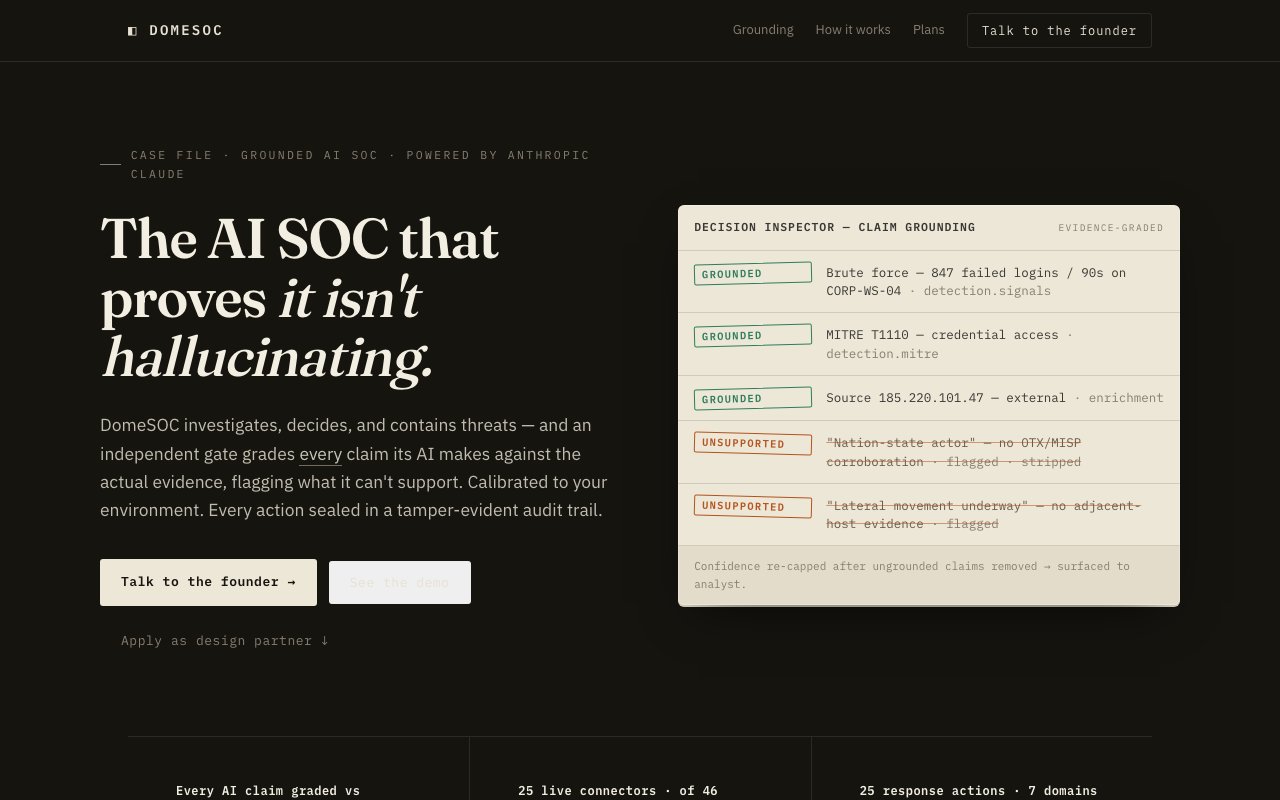
DomeSOC is an autonomous security operations centre that investigates detections with a team of AI agents and then audits its own conclusions before any of them reach a human. The site leads with the line "The AI SOC that proves it isn't hallucinating", which tells you what the product is really arguing about. The claim isn't that AI can triage alerts, since plenty of vendors say that already. It's that an AI SOC is worth nothing unless every statement it makes traces back to actual evidence, so DomeSOC builds the verification step into the pipeline instead of trusting the model to behave.
The problem is familiar to anyone who has staffed a security team. Detections arrive faster than analysts can work them, so most alerts get a glance and a guess, and the real incident hides in the pile. The first wave of AI triage tools promised to absorb that volume, and some of them do, but a language model that confidently asserts an IP was beaconing when nothing in the logs says so is worse than no answer at all. A wrong answer delivered with confidence gets acted on. In security, acting on a fabricated conclusion means either containing a healthy production box or waving through a real intrusion.
The investigation itself runs as a small team working a detection in parallel rather than one model doing everything. A Threat Hunter maps observed behaviour to TTPs and a kill-chain stage. An Intel Analyst handles attribution and IOC reputation, but only where MISP, OTX, or VirusTotal actually confirm it. A Forensics specialist works out blast radius and what evidence needs preserving first. Then there's a Skeptic, a devil's advocate whose entire job is to argue the strongest benign or alternative explanation, which is a deliberate structural counterweight to models that agree with themselves. An Advisor weighs all of them, folds in what the system knows about your environment, and produces one recommendation.
Sitting after that is the grounding gate, and it's the piece the whole product rests on. Every claim any agent makes gets graded against the underlying evidence by an independent verifier, and comes back either grounded or unsupported. Unsupported claims are flagged and stripped before you ever read them. The gate is built to recognise honest rebuttals too, so an agent saying "no evidence of beaconing" isn't penalised for reporting an absence. Every flagged claim is recorded per component and stays queryable, which means the hallucination rate becomes a number you can look up rather than a promise in a sales deck.
Two other mechanisms compound with use. Per-tenant calibration learns what normal looks like in your environment specifically, tracking what your analysts dismissed as false positives and down-weighting the reputation of entities that keep turning out benign, with the false-positive profile measured only on reviewed alerts from your own tenant. Separately, every decision and its evidence chain is hash-chained and sealed to S3 Object-Lock in compliance mode, producing write-once evidence that an auditor can verify independently of DomeSOC. If you work anywhere that has to prove why a containment action happened six months after the fact, that's the feature that matters.
It connects through tooling you already own. The site lists 25 live connectors and is pointed about what live means, noting that it's "wired to a real path, not a logo on a grid". The set spans endpoint and detection with CrowdStrike, SentinelOne, and Microsoft Defender, identity with Okta and Entra ID, network with Palo Alto and Fortinet, cloud with AWS and GCP, SIEM with Splunk, Microsoft Sentinel, Elastic, and QRadar, email with Proofpoint and Mimecast, messaging and ticketing with Slack, Teams, Jira, ServiceNow, and PagerDuty, and threat intel with OTX, VirusTotal, AbuseIPDB, and MISP. The target buyer is a security team that already has the stack and is losing to the queue, not one starting from nothing.
Pricing is paid from the first tier and reflects three levels of autonomy. Supervised runs $1,000 a month for up to 500 detections, where the AI recommends and humans approve. Autonomous is $2,500 a month and contains threats above a confidence threshold you set, with per-action granularity over what it's allowed to touch. Full Autonomous is $15,000 a month for autonomous containment across every action under your policy, and the site describes that tier as still in validation with design partners. The team is recruiting design partners with 60-day trials for the first few, there's a signup at app.domesoc.com, the approach is patent pending on a filed US provisional, and the published contact is founder@domesoc.com.
Key Features
- Independent grounding gate on every AI claim
- Five-agent parallel investigation team
- Built-in skeptic agent arguing the benign case
- Per-tenant false-positive calibration
- Hash-chained audit trail sealed to S3 Object-Lock
- 25 live security and intel connectors
Pros & Cons
What we like
- Verifies and strips unsupported AI claims instead of asking you to trust the model
- Hallucination rate is measured per component and queryable, not just promised
- Tamper-evident evidence chain suits regulated environments and post-incident audits
- Autonomy is tiered with per-action control rather than all or nothing
Room for improvement
- No free tier, and entry pricing starts at $1,000 a month
- Full Autonomous tier is still in validation with design partners
- Value depends on already running a supported detection and SIEM stack
- Early product, so there's little independent track record to check yet
Frequently Asked Questions
What is DomeSOC?
How does DomeSOC avoid hallucinated findings?
Is DomeSOC free?
What does DomeSOC connect to?
Best For
Featured in
Alternatives to DomeSOC

1Password
Password and secrets manager for individuals, families, and developer teams with strong CLI and SSH agent support.
Clerk
Drop-in authentication and user management for modern apps

Tailscale
WireGuard-based mesh VPN that connects your devices, servers, and cloud resources into one private network in minutes.

BackPedal
UK bike theft protection that sends recovery agents after your stolen bike
Reviews (13)
Solid daily driver
Have been running DomeSOC for a while, here is where I land. Where it really wins is 25 live security and intel connectors. It earns its place in my stack.
Two months in, no regrets
Came to DomeSOC after getting frustrated with what I had before. The independent grounding gate on every ai claim is more useful than I expected. It earns its place in my stack.
Recommended without reservation
DomeSOC solves a real problem for me without making a fuss about it. Where it really wins is hallucination rate is measured per component and queryable, not just promised. The core workflow is smooth once you are set up. Hard to imagine going back to my old setup.
Exactly what I needed
Three months of DomeSOC later, here is what holds up. The five-agent parallel investigation team is more useful than I expected. Mostly using it for clearing a detection queue a small security team can't keep up with.
Finally something that fits
Started using DomeSOC casually, now it is pinned in my dock. The built-in skeptic agent arguing the benign case is more useful than I expected. It handles the boring parts so I can focus on the work that matters. It fits well for cutting false positives by calibrating to one environment's normal. Glad I made the switch.
Genuinely impressed
DomeSOC solves a real problem for me without making a fuss about it. Where it really wins is hash-chained audit trail sealed to s3 object-lock.
Pulled its weight from week one
Picked DomeSOC for the price, stayed for the quality. It just works, day after day, without surprises. It earns its place in my stack.
Two months in, no regrets
DomeSOC has quietly become part of my daily flow. Got real value out of autonomy is tiered with per-action control rather than all or nothing. Found it works best for cutting false positives by calibrating to one environment's normal.
Recommended without reservation
Hadn't planned on switching, but DomeSOC was hard to ignore. The per-tenant false-positive calibration is more useful than I expected. Found it works best for automating containment with per-action limits a policy team can approve. Recommending it to people in a similar spot.
Solid daily driver
Came to DomeSOC after getting frustrated with what I had before. Their take on hallucination rate is measured per component and queryable, not just promised is genuinely good. Hard to imagine going back to my old setup.
Good, with a few caveats
Came to DomeSOC after getting frustrated with what I had before. Support actually answered when I had a question, which surprised me. Performance has been steady even when I lean on it hard. It would be a five if not for full autonomous tier is still in validation with design partners.
Exactly what I needed
Hadn't planned on switching, but DomeSOC was hard to ignore. Got real value out of autonomy is tiered with per-action control rather than all or nothing. The interface stays out of my way, which I appreciate. Found it works best for clearing a detection queue a small security team can't keep up with.
Does the job, a few gripes
DomeSOC solves a real problem for me without making a fuss about it. Got real value out of built-in skeptic agent arguing the benign case. Found it works best for automating containment with per-action limits a policy team can approve. My only gripe is value depends on already running a supported detection and siem stack. Would sign up again without thinking twice.
Badge builder
Add DomeSOC to your website
Choose a badge style and size, preview it here, then copy the generated HTML. Badge images are self-contained SVGs and do not require an external script.

<a href="https://toolindex.net/tools/domesoc?ref=badge" target="_blank" rel="noopener">
  <img src="https://toolindex.net/badge/domesoc/medium.svg" alt="DomeSOC - Listed on Tool Index" width="180" height="50" />
</a>How to use the badge
- 1. Pick the style, size, and theme that fit your layout.
- 2. Copy the generated HTML from the code block.
- 3. Paste it into your footer, homepage, or press page.
Score badge available
DomeSOC qualifies for the score and circle badges based on its current top-10 positionin Security.
Badge clicks return visitors to this profile with a referral tag so the source remains identifiable.
Related Tools
Clerk
Drop-in authentication and user management for modern apps
Reel
Forensic evidence capture for regulated Kubernetes, plus a free open-source VEX hub

HeimWall
Menu bar app that catches secrets and PII before you paste them into AI coding tools

Clay Seal
A control plane that checks and records every action an AI agent takes
Work on DomeSOC? Request listing access or correction