
Fathom Analytics
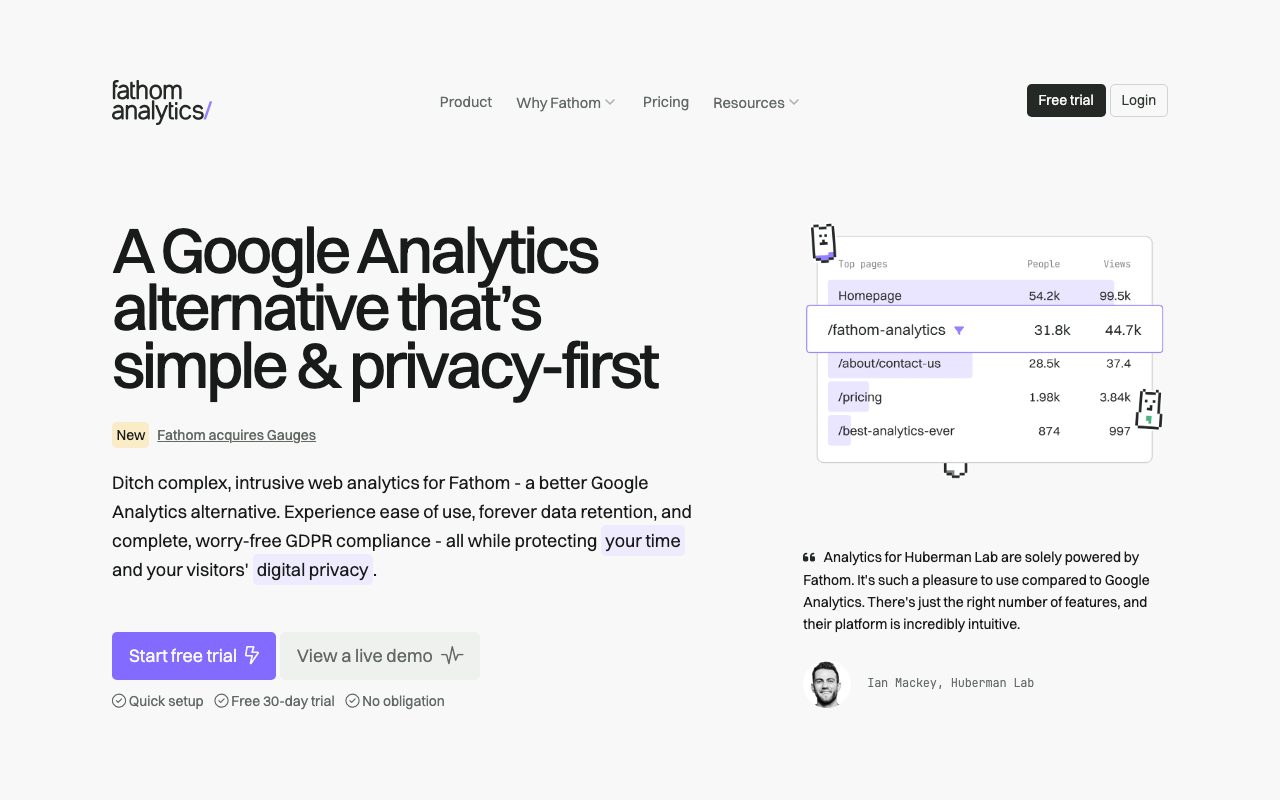
Privacy-first website analytics that show real traffic, sources, and conversions on a single page without cookie banners.
Gallery
About Fathom Analytics
Fathom Analytics is the privacy-first answer to Google Analytics. Founded by Paul Jarvis and Jack Ellis in 2018, it stays small on purpose. The whole product fits on a single dashboard.
If you've ever opened GA4 and felt your eyes glaze over, Fathom Analytics is the antidote. It shows traffic, sources, and conversions without drowning you in dimensions.
What Fathom Analytics actually does
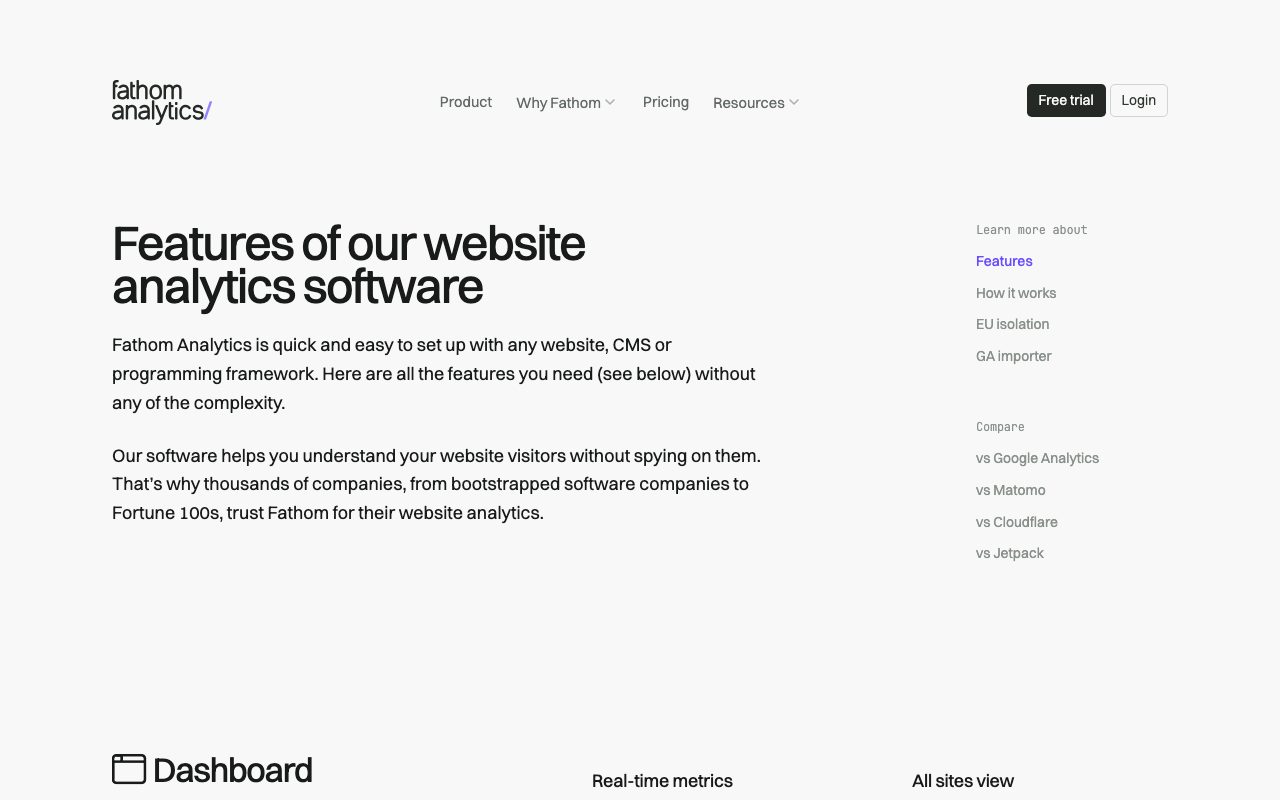
You drop a tiny tracking script on your site. Fathom Analytics counts pageviews, sessions, sources, and goals. It does not set cookies. It does not collect personal data. That's the whole privacy claim.
The dashboard is one page. You see real-time visitors, top pages, top referrers, and conversion goals. Filter by date, country, or campaign tag. That's it.
Who Fathom Analytics is for
Marketing site owners who want clean numbers without a cookie banner. EU-facing businesses navigating GDPR. Indie hackers who don't need funnel analysis. Privacy-minded creators who don't want Google in their stack.
It's also great for agencies running many client sites. The multi-site model means one subscription covers everything. Public dashboards make client reporting trivial.
Fathom Analytics pricing breakdown
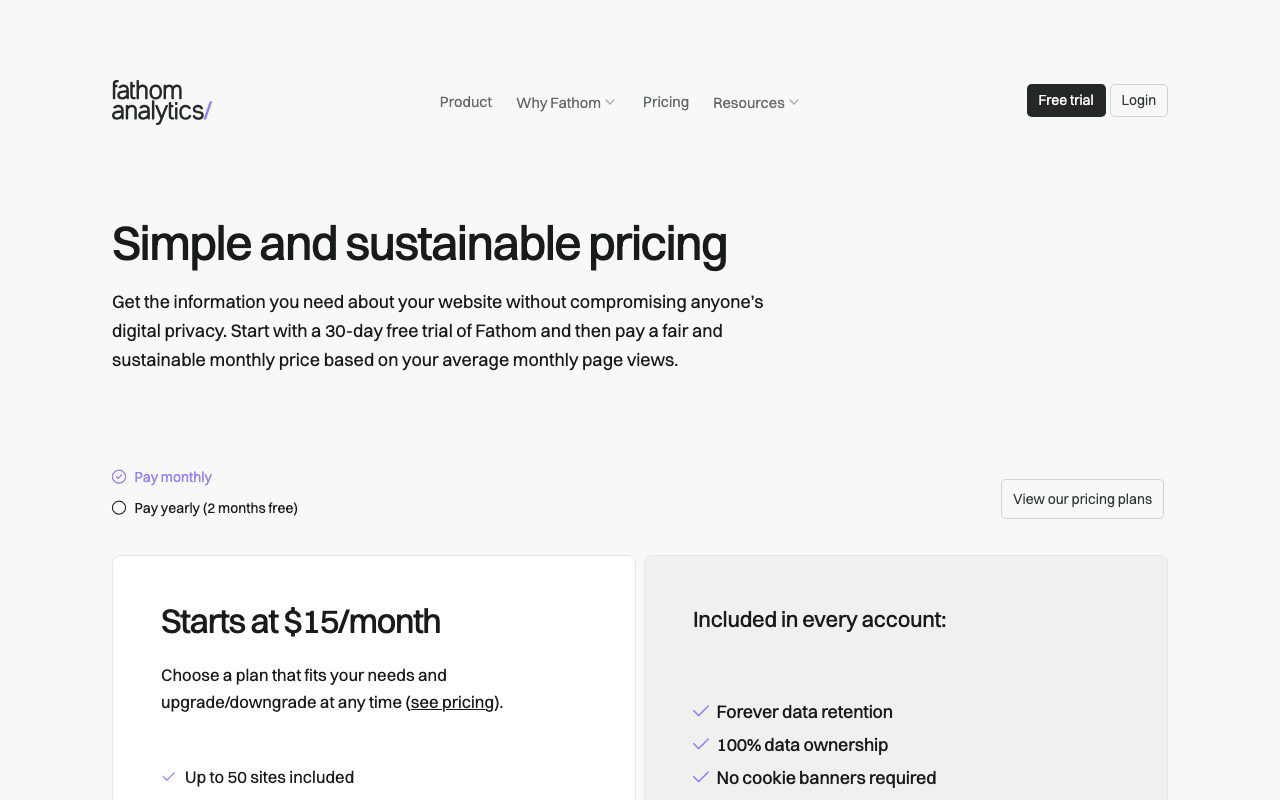
Plans start at $15 per month for up to 100,000 monthly pageviews. The next tier goes up from there. All paid plans support unlimited sites under one subscription.
There's no free plan. There is a 30-day trial. Fathom Analytics doesn't pretend to be free because the product isn't ad-supported.
That pricing model is the whole point. They're paid by you, not by selling your visitor data to advertisers. Honest tradeoff.
Standout Fathom Analytics features
The single-page dashboard is the whole UX. You can read it in fifteen seconds and act on what you see. GA4's six-tab maze can't say the same.
Goals and event tracking work without setup gymnastics. Click a button on Fathom Analytics, paste an event into your code, watch conversions roll in. The setup is the kind of thing GA4 should be.
Public dashboards turn analytics into a marketing artifact. Plenty of indie hackers post their Fathom Analytics page to show real traffic numbers. Transparency that GA4 can't match.
Honest tradeoffs
Fathom Analytics is less granular than full product analytics tools. There's no funnel analysis, no cohort retention, no session replay. If you need that, you need Mixpanel or Amplitude or PostHog.
It's also paid from day one. Indie hackers building on a free tier sometimes pick Plausible or self-hosted Umami instead. Fathom Analytics is the polished commercial pick.
And the small team means slower feature releases. New capabilities ship at a steady but unhurried pace. That's a feature, not a bug, but worth knowing.
Fathom Analytics is the right tool when "how many people visited my site" is the actual question. It refuses to be more.
Fathom Analytics vs the alternatives
The closest peer is Plausible Analytics. Both are privacy-first, single-page, EU-friendly. Plausible is open-source and slightly cheaper. Fathom Analytics has stronger goal tracking and public dashboards.
Simple Analytics is another close peer. They all overlap heavily and you can't really go wrong picking any of them.
Against Google Analytics, Fathom Analytics is the lifestyle pick. You give up depth and gain peace of mind.
For real product analytics, PostHog is the move. Different tool for a different question.
See best website analytics, Fathom Analytics alternatives, and Fathom vs Plausible.
Bottom line on Fathom Analytics
Fathom Analytics is the cleanest analytics tool for marketing sites. Privacy compliant, fast to read, and refreshingly simple. The $15 starting price is fair for what you get.
If you've been wrestling with GA4 and you'd like to stop, switch to Fathom Analytics this weekend. You won't go back.
Fathom Analytics setup
Setup takes ten minutes. Add the tracking script to your site, verify the install, watch real-time traffic appear. No data layer, no consent banner gymnastics, no warm-up period.
Goal tracking takes another five minutes. Click the button on Fathom Analytics, paste a small script tag where the conversion happens, watch goals roll in. The setup is roughly what GA4 should be.
Email reports configure in two clicks. Daily, weekly, or monthly summaries land in your inbox automatically. Plenty of indie hackers run their analytics review entirely through email.
Fathom Analytics privacy specifics
Fathom Analytics doesn't set cookies. The tracking script generates anonymous session identifiers from a hashed IP plus user agent, rotated daily. That avoids creating persistent identifiers.
No personal data is collected. No IP addresses stored. No behavioral profiles. The compliance posture is genuinely strong against GDPR, CCPA, PECR, and similar regulations.
Their hosting choices reinforce the privacy stance. EU isolation is available for European traffic to keep data inside the bloc.
Fathom Analytics common questions
"Is Fathom Analytics enough for SEO?" For tracking traffic and goals, yes. For deep keyword research and ranking, pair it with Google Search Console.
"Does it support events?" Yes. Goal tracking covers most event use cases. The simple model is intentional.
"Can I track multiple sites?" Yes. All paid plans include unlimited sites under one subscription.
"What about funnels and cohorts?" Not built in. Fathom Analytics is intentionally simpler. Use PostHog or Amplitude for those.
Final word on Fathom Analytics
Fathom Analytics earns its $15 per month. The privacy posture is real. The dashboard is honest. The feature set is intentionally narrow.
If you've been wrestling with GA4's complexity and you'd like to stop, Fathom Analytics is the off-ramp. Most users feel relief within the first week of switching.
It's also the right tool for client work. Public dashboards, multi-site billing, and clean UI all add up to a tool agencies can recommend without apology.
Fathom Analytics for client work
Agencies running client websites benefit from Fathom Analytics's multi-site model. One subscription covers unlimited sites. Each client gets a separate site with isolated dashboards.
Public dashboards turn analytics into a deliverable. Send the client a URL. They see their numbers. No GA4 onboarding, no Google account requirements, no permission gymnastics.
Email reports automate the monthly traffic update. Configure once, recipients get clean summaries every month. One less Slack message to send.
The privacy posture matters for client work too. EU clients especially appreciate not having to add cookie banners or consent management platforms.
Fathom Analytics for solo creators
Bloggers, indie hackers, and creators run Fathom Analytics on personal sites. The dashboard answers "how much traffic does my site get this week" in three seconds. That's all most solo creators need.
Goals track newsletter signups, RSS subscriptions, course purchases, or product clicks. The simple model fits creator workflows naturally.
Public dashboards work for "build in public" creators sharing their numbers. Transparency that GA4 makes nearly impossible.
Fathom Analytics ecosystem
Integrations cover Webflow, WordPress, Ghost, Substack, Squarespace, and most modern static site generators. Setup is a single tracking script in nearly all cases.
The API lets you pull data programmatically. Build custom dashboards, embed numbers in internal tools, or pipe metrics into Slack.
Fathom Analytics doesn't have a huge plugin ecosystem because the core product is intentionally minimal. That's the design choice, not a gap.
Fathom versus Plausible specifically
Both are privacy-first, cookie-free, single-page dashboards. The differences are subtle.
Plausible is open source and self-hostable. Fathom Analytics is closed source but founder-owned and committed to remaining independent.
Plausible's pricing is slightly cheaper at small scale. Fathom Analytics's goal tracking is slightly stronger and the public dashboard option is more polished.
Either works. Most teams pick one and move on. The functional overlap is huge.
Fathom Analytics long-term value
The product has been steady since 2018. Founder-owned, privacy-committed, focused. The roadmap is incremental rather than revolutionary.
That stability is a feature for users who want their analytics to keep working without surprise changes. Fathom Analytics from 2020 still works. Fathom Analytics from today will probably still work in 2028.
The simple dashboard model means there's nothing to relearn when the team ships updates. Improvements add small refinements, not new mental models.
For users who outgrow Fathom Analytics, the migration path is straightforward. PostHog, Amplitude, or Mixpanel all import similar event data. Or pair Fathom Analytics with one of those for funnels and cohorts while keeping Fathom for traffic.
Most marketing sites don't outgrow Fathom Analytics. The simple needs (how many visitors, where from, what converted) cover most use cases indefinitely.
Fathom Analytics for SaaS founders
SaaS founders use Fathom Analytics for marketing site traffic and product conversions. The simple model fits the early-stage need.
Goals track signups, trial starts, and upgrade events. Funnel analysis isn't built in but the goal pattern covers most early-stage needs.
Public dashboards work for "build in public" SaaS founders sharing their numbers. Transparency that builds trust.
For deeper product analytics, pair Fathom Analytics with PostHog or Amplitude. Different tools for different questions about your business.
Tutorial / Demo
Key Features
- Single-page privacy-first dashboard
- No cookies and no personal data collected
- Goals and event tracking with filters
- Email reports and public dashboards
- Multiple sites under one subscription
- Lightweight tracking script
Pros & Cons
What we like
- Compliant by default, no cookie banners needed
- Genuinely fast to read and act on
- Independently owned with a clear privacy stance
Room for improvement
- Less granular than full product analytics tools
- No funnel, retention, or cohort analysis built in
Frequently Asked Questions
How much does Fathom cost?
Fathom vs Plausible vs Google Analytics?
Do I need a cookie banner with Fathom?
Does Fathom track conversions?
Can I self-host Fathom?
Best For
Featured in
Tags
Alternatives to Fathom Analytics
View all
Plausible
Privacy-friendly Google Analytics alternative
Notionlytics
Page-view analytics and reader feedback widgets for public Notion pages

Simple Analytics
Cookieless, GDPR-friendly web analytics that needs no consent banner

Simple Analytics
Privacy-friendly web analytics with a clean dashboard, event tracking, and a strong stance against personal data collection.
Our take
Tool Index Editorial · May 2026· 4.6/5
What Fathom Analytics is really selling — beyond the marketing copy — is privacy-first website analytics that show real traffic, sources, and conversions on a single page without cookie banners.
Worth highlighting: Compliant by default, no cookie banners needed, Genuinely fast to read and act on, and Independently owned with a clear privacy stance. What to watch for: Less granular than full product analytics tools and No funnel, retention, or cohort analysis built in.
Bottom line: pick Fathom Analytics when you need marketing site analytics without GA complexity; look elsewhere if less granular than full product analytics tools would be a dealbreaker.
Editorial opinion from the Tool Index team, written from the public product pages. Not a user review.
Reviews (3)
Solid but with caveats
Took a few weeks for Fathom Analytics to click, then it stuck. Where it really wins is genuinely fast to read and act on. No cookies and no personal data collected works the way you'd hope. Honest gripe: less granular than full product analytics tools. Decent value once you accept the rough edges.
Cons
- Less granular than full product analytics tools
- No funnel, retention, or cohort analysis built in
Wanted to love it, couldn't
Started using Fathom Analytics casually, now it's pinned in my dock. Honestly impressed by how independently owned with a clear privacy stance. Their take on goals and event tracking with filters is solid. It fits well for marketing site analytics without GA complexity. Probably better for someone with different needs.
Pros
- Genuinely fast to read and act on
- Independently owned with a clear privacy stance
- Compliant by default, no cookie banners needed
Honest take after three months
Skeptical at first because Fathom Analytics looked too simple. It's not. What stands out is how genuinely fast to read and act on. Main use case: marketing site analytics without GA complexity. That said, less granular than full product analytics tools is a real gripe.
Pros
- Compliant by default, no cookie banners needed
- Independently owned with a clear privacy stance
- Genuinely fast to read and act on
Cons
- No funnel, retention, or cohort analysis built in
Badge builder
Add Fathom Analytics to your website
Choose a badge style and size, preview it here, then copy the generated HTML. Badge images are self-contained SVGs and do not require an external script.

<a href="https://toolindex.net/tools/fathom-analytics?ref=badge" target="_blank" rel="noopener">
  <img src="https://toolindex.net/badge/fathom-analytics/medium.svg" alt="Fathom Analytics - Listed on Tool Index" width="180" height="50" />
</a>How to use the badge
- 1. Pick the style, size, and theme that fit your layout.
- 2. Copy the generated HTML from the code block.
- 3. Paste it into your footer, homepage, or press page.
Standard badge available
The standard listing badge is available now. Score and circle badges are limited to tools currently ranked in the top 10 of a category.
Badge clicks return visitors to this profile with a referral tag so the source remains identifiable.
Related Tools

Sleep Suivour
Track your sleep, improve your rest
Notionlytics
Page-view analytics and reader feedback widgets for public Notion pages
Mixpanel
Product analytics tool for tracking user events, funnels, retention, and cohorts to understand how people use your app.
Simple Analytics
Privacy-friendly web analytics with a clean dashboard, event tracking, and a strong stance against personal data collection.
Work on Fathom Analytics? Request listing access or correction