
Forge Tools
Practical engineering and workshop calculators with visible methods and units
Gallery
About Forge Tools
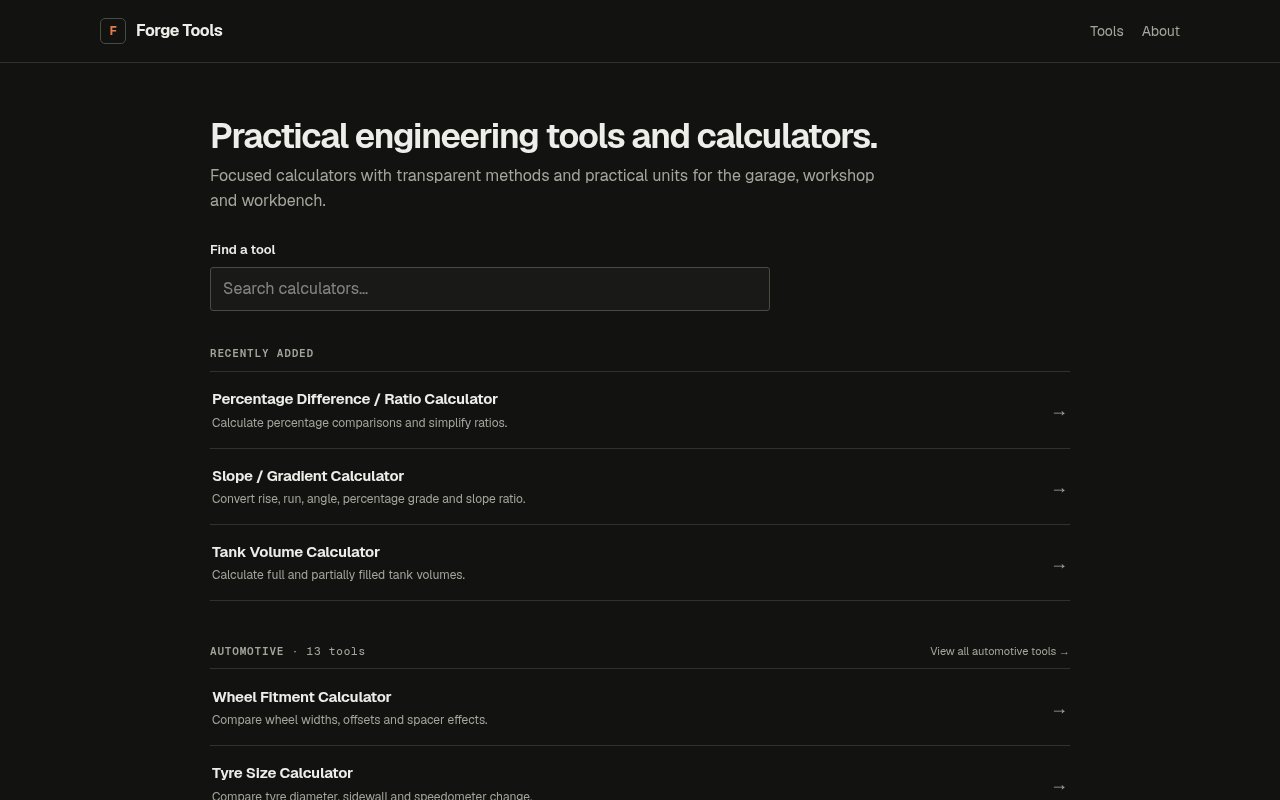
Forge Tools is a free collection of focused calculators for engineering, automotive, electrical, fabrication, machining, radio frequency, 3D printing, and general workshop work. It replaces scattered formulas and one-off spreadsheet cells with small web tools that are quick to open and clear about the inputs they expect. The collection is meant for the garage, workbench, and job site as much as for a desk. It doesn't ask visitors to create an account or set up a project before getting an answer, and the interface is designed to remain usable on a phone. That low-friction format makes sense for measurements taken beside a vehicle, machine, electrical run, or unfinished part, where a large design application would add more setup than value.
The directory currently contains 66 calculators organized into eight technical areas. Automotive covers wheel fitment, tyre sizes, drivetrain ratios, engine geometry, brakes, and fuel calculations. Electrical and RF cover subjects such as voltage drop, Ohm's law, battery runtime, conductor resistance, antenna length, path loss, and Fresnel clearance. Mechanical and fabrication add beam, shaft, spring, bearing, hydraulic, belt, material weight, hole pattern, bend, weld, and tube calculations. Machining, 3D printing, and general geometry round out a broad set of everyday shop references. The directory shows how many tools sit in each discipline, which makes its scope easy to judge before opening an individual calculator.
Each calculator narrows the screen to the variables relevant to one problem. A wheel fitment comparison takes old and new width, offset, and spacer thickness, then reports inner clearance, outer position, and effective offset. The battery runtime tool applies voltage, capacity, usable depth of discharge, efficiency, reserve, and load to show nominal energy, usable energy, and a theoretical runtime. The speeds and feeds tool can work from cutting speed, spindle RPM, or feed rate, supports metric and imperial units, and returns RPM, feed, surface speed, and chip load. Its material presets provide conservative starting values for general-purpose carbide tooling. This pattern makes the result easier to inspect than a single opaque number because intermediate quantities and the units attached to them remain visible.
Transparency is one of the useful details. Tool pages state the method behind the calculation and include assumptions or limitations near the result. The wheel calculator explains how width is converted and how a spacer changes effective offset. It also tells the user to check tyres, brakes, suspension movement, and bodywork clearance before fitting anything. Battery runtime warns that chemistry, temperature, age, voltage sag, discharge rate, inverter losses, and management system limits can change real performance. Machining presets are described as conservative starting estimates, with reminders that tool geometry, rigidity, cooling, workholding, and manufacturer guidance still matter. These notes help a user understand where a quick estimate ends and practical verification begins.
The collection fits makers, technicians, students, mechanics, machinists, fabricators, radio enthusiasts, and engineers who need a fast check during planning or hands-on work. Search on the home page helps find a calculator by task, while the full directory supports browsing by category and sorting. Its value is strongest when someone knows the physical question but doesn't want to retrieve and rearrange the formula manually. The consistent page design also lowers the learning cost of moving from an automotive problem to an electrical or fabrication one. It can make a calculation easier to communicate because the inputs, output units, method, and caveats appear together on one page.
Forge Tools is best viewed as a reference bench, not a simulation package or engineering sign-off system. Its calculators solve individual problems, and many outputs are ideal or theoretical estimates that still need judgement, measurement, and applicable safety guidance. The tools don't combine into a saved vehicle, machine, assembly, or job, so related results have to be carried between pages by the user. There are no accounts, saved projects, team workspaces, or paid upgrades presented on the site. Every calculator is available directly in the browser for free. That simple access model, combined with visible formulas and discipline-specific units, makes the site a useful bookmark for quick checks without pretending that a browser result replaces manufacturer data or a qualified design review.
Key Features
- Sixty-six focused calculators
- Eight technical tool categories
- Searchable calculator directory
- Metric and imperial units
- Visible calculation methods
- Assumption and limitation notes
Pros & Cons
What we like
- Covers a broad range of workshop disciplines
- Explains formulas and limits beside results
- Works without accounts or setup
- Keeps individual calculators quick to understand
Room for improvement
- Many outputs remain theoretical estimates
- Doesn't replace manufacturer or safety guidance
- No accounts for saving related calculations
- Individual tools aren't connected into project workflows
Frequently Asked Questions
What is Forge Tools?
Is Forge Tools free?
Does Forge Tools explain its calculations?
Who is Forge Tools for?
Best For
Featured in
Alternatives to Forge Tools

CalendHub
Smart scheduling and calendar management for teams
Kevin Gabeci Toolkits
Seven AI toolkits for writing books, making music, cutting video, and building agents.

Eased Into AI
Learn AI from zero. No jargon, no hype, just steps that work.

Fix It Gently
Calm, plain-English fixes for everyday tech problems.
Our take
Tool Index Editorial · Oct 2026· 4.0/5
Forge Tools is a free collection of focused calculators for automotive, electrical, RF, mechanical, fabrication, machining, and 3D printing work. We found the visible methods, units, assumptions, and cautions more valuable than the raw count of tools. The pages are quick to use on a phone and don't demand an account before answering a workshop question.
This is a reference bench, not an engineering approval system. Many outputs are theoretical and still require measurements, manufacturer data, safety guidance, and professional judgment. There are also no saved projects or connected calculations, so users must carry values between tools themselves. For quick checks with understandable math, it earns a strong recommendation.
Editorial opinion from the Tool Index team, written from the public product pages. Not a user review.
Reviews (0)
Badge builder
Add Forge Tools to your website
Choose a badge style and size, preview it here, then copy the generated HTML. Badge images are self-contained SVGs and do not require an external script.

<a href="https://toolindex.net/tools/forge-tools?ref=badge" target="_blank" rel="noopener">
  <img src="https://toolindex.net/badge/forge-tools/medium.svg" alt="Forge Tools - Listed on Tool Index" width="180" height="50" />
</a>How to use the badge
- 1. Pick the style, size, and theme that fit your layout.
- 2. Copy the generated HTML from the code block.
- 3. Paste it into your footer, homepage, or press page.
Standard badge available
The standard listing badge is available now. Score and circle badges are limited to tools currently ranked in the top 10 of a category.
Badge clicks return visitors to this profile with a referral tag so the source remains identifiable.
Related Tools

Confluence
Atlassian's long-running team wiki that anchors many enterprise knowledge stacks
Asana
Project management for teams that live in projects, tasks and dependencies
Kevin Gabeci Toolkits
Seven AI toolkits for writing books, making music, cutting video, and building agents.

Logseq
An open-source outliner notes app where every bullet is a first-class block
Work on Forge Tools? Request listing access or correction