
Fountain
Open-source API that gives your app a sandboxed computer a coding agent can work in
Gallery
About Fountain
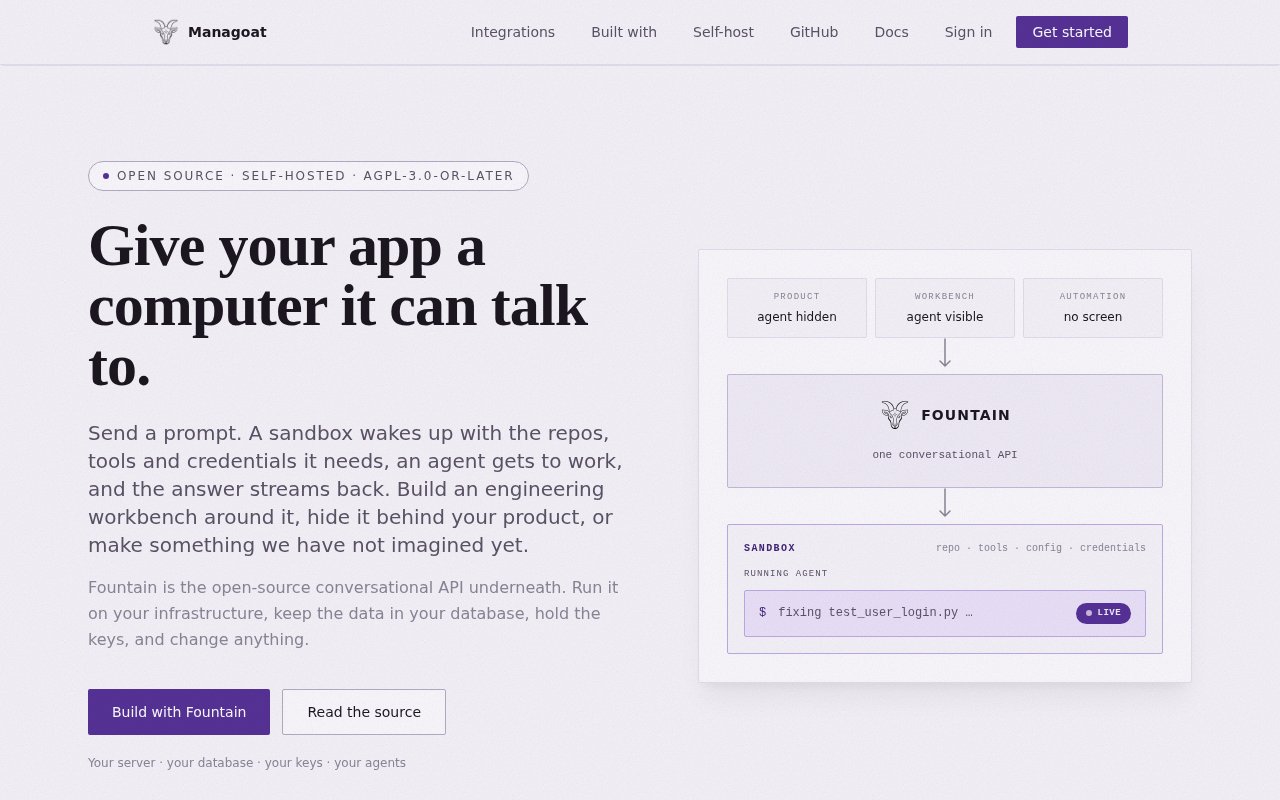
Fountain is an open-source backend that turns coding agents into an API. Your application sends a prompt to an HTTP endpoint, a sandboxed machine wakes up with the right repositories cloned, packages installed, and credentials in place, an agent such as Claude Code, Codex, or Gemini CLI does the work, and the answer streams back. The site's one-line version is that it gives your app a computer it can talk to, and the follow-up prompt lands on the same machine with its state intact. The tagline on the launch page is an OSS API to give your app a computer it can talk to, and that's the accurate framing, an API rather than a chat product.
The problem it solves is the plumbing around agents rather than the agents themselves. Running an agent once on a laptop is easy. Running it on demand for many users, each with their own repos and secrets, on isolated machines that don't leak state between customers, with the conversation resumable later and the bill under control, is a lot of infrastructure that has nothing to do with your product. Fountain packages that into a service you can self-host or use hosted, and exposes it through the same kinds of interfaces you'd expect from any backend.
It's organised around four primitives. An Environment is the template for a machine, its dependencies, networking, and base setup. A Vault holds secrets, which are merged in at launch with the Vault taking precedence over anything in the environment. An Agent is a template naming the model, the runtime, and the environment it runs in. A Conversation is a single agent run on a provisioned machine, with a transcript and file state that persist across turns. Between messages a machine parks, keeping its disk while costing nothing and using no concurrency, so a follow-up prompt picks up where the last one stopped without cloning and installing everything again. The separation matters for reuse. One Environment can back many Agents, one Vault can serve many Environments, and a Conversation is the only piece that's specific to a single run.
The surface area is wide. There's a REST API with Swagger docs, SDKs for TypeScript, Python, Elixir, and Swift, a CLI installable through Homebrew, and a web dashboard for operators. OpenAI-compatible endpoints let existing chat clients talk to it, webhooks report events, AG-UI streams agent activity to a front end, and editor plugins connect over ACP. It also publishes llms.txt and a skill endpoint so agentic IDEs can learn the API on their own. Supported runtimes include Claude Code, Codex, Gemini CLI, and opencode, and users bring their own model credentials, so the provider bills them directly and Fountain adds no markup on tokens. The CLI and the operator dashboard cover the administrative side, while the SDKs are for the product code that calls it.
It's for developers building products or internal workbenches on top of coding agents, and for infrastructure teams automating engineering tasks like fixing tests or opening pull requests. If you've been shelling out to an agent CLI from a web service and worrying about isolation, secrets, and what happens when two requests land at once, this is the layer that's missing. It's also a fit for teams that want the hosted convenience now with the option of moving in-house later, since the engine is the same. It's less suited to someone who only wants a chat window, since the value is in the API surface and the isolation rather than an interface.
What sets it apart is that the whole thing is open. The server is licensed AGPL-3.0-or-later, the CLI and SDKs are Apache-2.0, and the enterprise directory covering credits and Stripe billing is under the Elastic License 2.0, free to run yourself but not to resell as a hosted service. Self-hosting is a Docker Compose setup with Postgres 16 or newer, or plain Kubernetes manifests with no operators or CRDs, and it needs a sandbox provider token to do anything. The trade-off is operational. You own email, master key backups, upgrades, and the sandbox provider choice, feature flags like teammate communications and the OpenAI-compatible API are yours to configure, and the project is young, with a small star count and a long open issue list on GitHub. The repository shows a long commit history for a young project, which suggests steady work, but the 14 stars at the time of writing mean you'll be an early adopter.
Access is open source, with a hosted version called Managoat from the same maintainer, BinaryBourbon. Managoat charges $0.25 per active agent hour, billing only while prompts are in flight, with a $5 starter credit that needs no card and expires after 14 days, and credit packs at $10, $25, and $100. Neither site publishes a contact email, so support runs through GitHub issues and the docs, and the low-risk way to evaluate it is the starter credit before committing to a self-hosted deployment. Managoat bills agent time rather than tokens, so a parked machine costs nothing on the hosted plan either.
Key Features
- Prompt-to-sandbox API for coding agents
- Environment, Vault, Agent, and Conversation primitives
- Claude Code, Codex, Gemini CLI, and opencode runtimes
- REST API with TypeScript, Python, Elixir, and Swift SDKs
- OpenAI-compatible endpoints, webhooks, AG-UI, and ACP
- Docker Compose or Kubernetes self-hosting
Pros & Cons
What we like
- Turns agent infrastructure into one self-hostable service
- Parked machines keep state between turns at no cost
- Bring your own model keys with no token markup
- Hosted option with a free starter credit
Room for improvement
- Self-hosting means owning backups, upgrades, and sandboxes
- AGPL server license needs checking for some uses
- Young project with a small community and many open issues
- Needs a sandbox provider token before it does anything
Frequently Asked Questions
What is Fountain?
Is Fountain free?
Do I pay for tokens through Fountain?
How is Fountain different from calling an agent CLI myself?
Best For
Featured in
Alternatives to Fountain

Almanac
A hosted, source-cited wiki that turns your files into context your AI agents can use

Demi AI
Demi helps busy professionals eliminate repetitive admin work across their favorite tools.

Lindy
No-code AI agents that handle email, meetings, and recurring workflows
Vapi
Build voice AI agents that take and place phone calls
Reviews (0)
Badge builder
Add Fountain to your website
Choose a badge style and size, preview it here, then copy the generated HTML. Badge images are self-contained SVGs and do not require an external script.

<a href="https://toolindex.net/tools/fountain?ref=badge" target="_blank" rel="noopener">
  <img src="https://toolindex.net/badge/fountain/medium.svg" alt="Fountain - Listed on Tool Index" width="180" height="50" />
</a>How to use the badge
- 1. Pick the style, size, and theme that fit your layout.
- 2. Copy the generated HTML from the code block.
- 3. Paste it into your footer, homepage, or press page.
Standard badge available
The standard listing badge is available now. Score and circle badges are limited to tools currently ranked in the top 10 of a category.
Badge clicks return visitors to this profile with a referral tag so the source remains identifiable.
Related Tools

OpenBenchmarks
Public, externally validated benchmarks that help agents pick SaaS APIs
Almanac
A hosted, source-cited wiki that turns your files into context your AI agents can use

Wizard
Self-extending Rust terminal AI agent that works with any model

Chariot
Elastic cloud infrastructure for deploying and scaling AI agent fleets with persistent storage
Work on Fountain? Request listing access or correction