
G Maps Crawl
Give AI agents structured Google Maps business search through MCP
Gallery
About G Maps Crawl
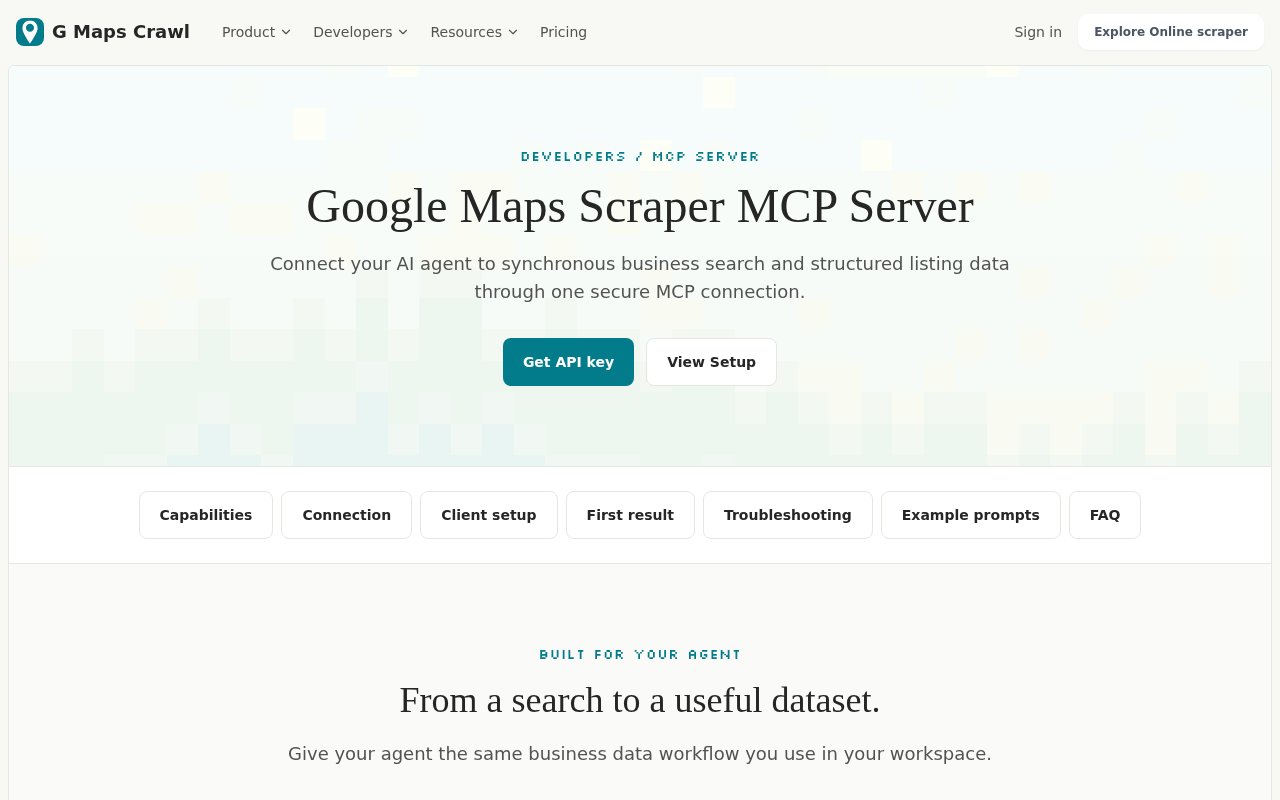
G Maps Crawl is a Google Maps business data service with a remote MCP server built for AI agents. It lets a compatible agent search by keyword and location, then receive a structured page of business listings without sending the user through a separate scraping dashboard. A result can include available listing attributes, addresses, contact details, ratings, and review counts. The MCP tool returns up to 20 businesses as JSON, which makes the service useful when an agent needs records it can sort, compare, summarize, or pass into another application rather than a page of links.
The MCP server exposes one focused tool named search_google_maps. The user connects a client to the hosted /api/mcp endpoint and supplies a G Maps Crawl API key through an Authorization bearer header. The transport is stateless Streamable HTTP, and there is no OAuth sign-in flow for the endpoint. Official setup examples cover Claude Code, Cursor, VS Code, Codex, MCP Inspector, and other clients that support remote HTTP plus custom headers. Credentials are meant to stay in an environment variable or protected client setting, outside prompts. Once connected, the agent can send a query, choose a source page, set language options, and decide whether to request extra contact enrichment.
Results arrive directly in structuredContent, so an agent doesn't need to create a long-running job and poll for completion. A successful source page search uses one API request unit even when no businesses are found, and each page returns at most 20 businesses. The returned fields can be missing, and G Maps Crawl notes that source observations may be cached. That is a sensible constraint for local business research, where a listing may not publish a phone number, website, or other field. A test credential returns simulated fixtures without consuming live search units, giving teams a way to confirm tool discovery, authentication, and response handling before using their allowance. New searches need a fresh client request ID, while a retry after a timeout should preserve the same ID and unchanged input. This gives integrations an explicit way to distinguish a new operation from a retry.
The main audience is people building agent workflows around local business research. A sales researcher can ask for plumbers in a city and turn the result into a reviewed prospect table. A market analyst can compare categories, ratings, and review counts across one or more carefully controlled searches. An operations team can bring available business and contact fields into CRM or reporting work. Developers can use the same service through its REST API, while the MCP endpoint removes the need to teach an agent a custom HTTP contract. G Maps Crawl also publishes an optional agent skill with operation references, result schemas, retry guidance, and a REST fallback, though API credentials and plan entitlement are still required.
What sets this offering apart is the narrow, synchronous connection between an agent and a business search result. It isn't a general browser automation server and it doesn't expose a collection of unrelated tools. The MCP surface provides business search only, which keeps the available action easy to inspect and control. The wider G Maps Crawl product also has a hosted online scraper and a browser extension, but those are separately packaged products with separate allowances. The MCP server shares the API allowance, not an Online subscription. It also doesn't provide an MCP export or email-sending tool, so saving a file, updating a CRM, or contacting a business remains the responsibility of the connected agent or another application. Rate limit, quota, authorization, and service errors are returned for the agent to handle. The setup guide advises stopping at a quota denial and checking usage rather than rotating keys, since extra keys don't increase the allowance.
Access is freemium. G Maps Crawl states that MCP works on free and paid API plans. The free API allowance includes 20 monthly requests, while paid API plans increase the number of searches. API usage is counted by accepted source page search, and paid overages or higher-volume options are described on the pricing page. People assessing it should account for the 20-business page limit, the lack of OAuth, and the need for a client that can set a custom authorization header. They should also review source terms, privacy rules, marketing requirements, and suppression obligations before using listing data. For a controlled agent workflow that needs structured local business records, it offers a direct path from a prompt to usable JSON.
Key Features
- Synchronous business search
- Structured JSON listing results
- Remote Streamable HTTP endpoint
- Bearer API key authentication
- Simulated test credentials
- Optional contact data enrichment
Pros & Cons
What we like
- Returns usable records directly to an agent
- Works with several custom-header MCP clients
- Test fixtures don't consume live search units
- Published schemas make responses easier to handle
Room for improvement
- Each result page is limited to 20 businesses
- The MCP surface exposes business search only
- Clients must support custom authorization headers
- Online subscriptions don't include MCP allowance
Frequently Asked Questions
What is the G Maps Crawl MCP server?
Which agent clients can connect?
Is G Maps Crawl free?
How does an MCP search count against usage?
Best For
Featured in
Alternatives to G Maps Crawl
Rememori
Embedded memory engine for AI agents in TypeScript with zero dependencies

Demi AI
Demi helps busy professionals eliminate repetitive admin work across their favorite tools.

Lindy
No-code AI agents that handle email, meetings, and recurring workflows
Vapi
Build voice AI agents that take and place phone calls
Our take
Tool Index Editorial · Oct 2026· 3.5/5
G Maps Crawl gives AI agents a focused MCP tool for Google Maps business search. We found a straightforward contract that returns up to 20 businesses as structured JSON in the same response, with test credentials for simulated calls and explicit retry guidance. The free API includes 20 monthly requests. Paid API plans shown on the product page start at $15 per month for 1,000 requests and $65 for 5,000.
This is useful for controlled prospecting, local market research, and listing enrichment, especially when an agent needs records rather than links. It isn't a general scraping server, and every accepted search page counts even when empty. Clients need remote HTTP and custom authorization headers because there is no OAuth flow. Users also remain responsible for source terms, privacy, marketing consent, and suppression rules.
Editorial opinion from the Tool Index team, written from the public product pages. Not a user review.
Reviews (0)
Badge builder
Add G Maps Crawl to your website
Choose a badge style and size, preview it here, then copy the generated HTML. Badge images are self-contained SVGs and do not require an external script.

<a href="https://toolindex.net/tools/g-maps-crawl?ref=badge" target="_blank" rel="noopener">
  <img src="https://toolindex.net/badge/g-maps-crawl/medium.svg" alt="G Maps Crawl - Listed on Tool Index" width="180" height="50" />
</a>How to use the badge
- 1. Pick the style, size, and theme that fit your layout.
- 2. Copy the generated HTML from the code block.
- 3. Paste it into your footer, homepage, or press page.
Standard badge available
The standard listing badge is available now. Score and circle badges are limited to tools currently ranked in the top 10 of a category.
Badge clicks return visitors to this profile with a referral tag so the source remains identifiable.
Related Tools

OpenBenchmarks
Public, externally validated benchmarks that help agents pick SaaS APIs

Almanac
A hosted, source-cited wiki that turns your files into context your AI agents can use

Wizard
Self-extending Rust terminal AI agent that works with any model

Chariot
Elastic cloud infrastructure for deploying and scaling AI agent fleets with persistent storage
Work on G Maps Crawl? Request listing access or correction