
Heard
iOS EPUB reader with on-device text to speech and a free library of classic literature
Gallery
About Heard
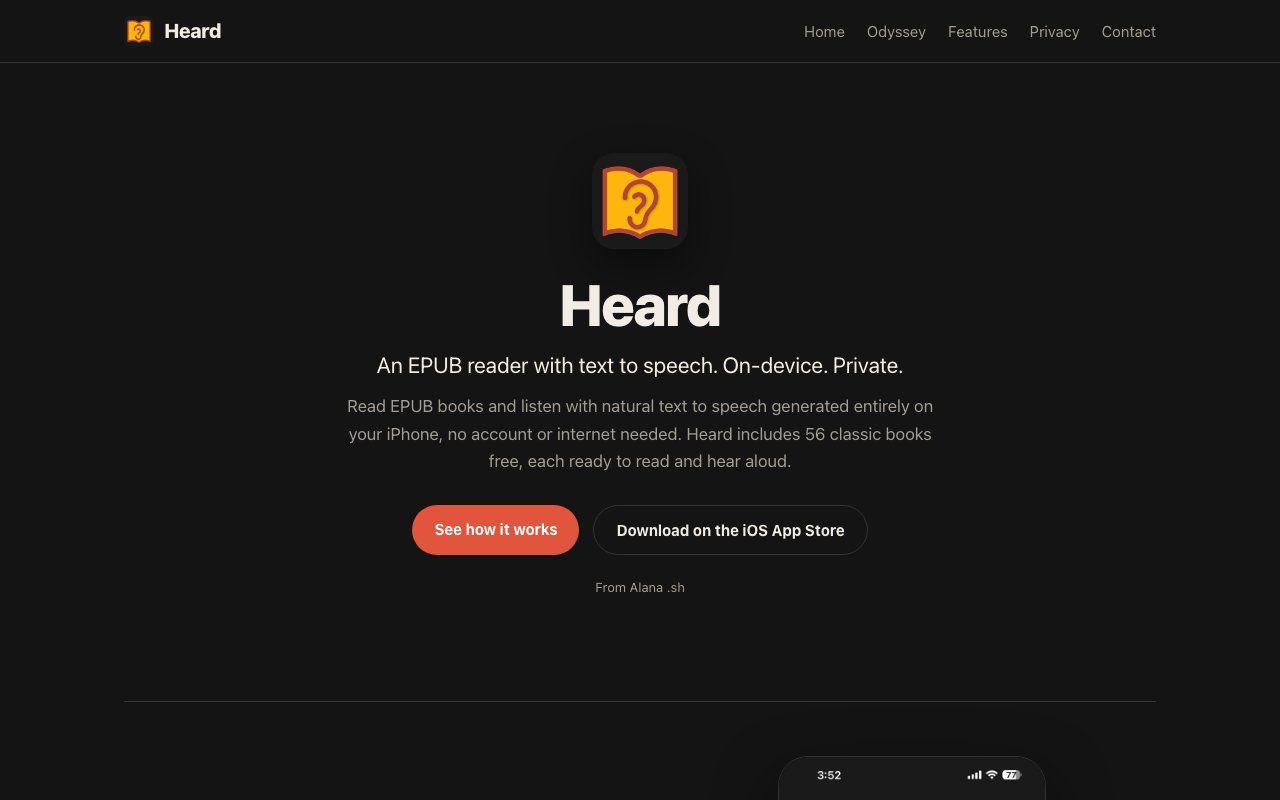
Heard is an iOS app that reads EPUB files aloud using neural text to speech generated entirely on your device. It solves a specific problem for readers who want audiobook-style listening without streaming services, subscriptions, or internet dependency. You load an EPUB, tap play, and the app reads page after page with natural sounding narration while you follow along or just listen. The entire speech synthesis pipeline runs locally on your iPhone, which means no account creation, no cloud uploads, and no waiting for a server to respond.
The app ships with a built-in library of 56 classic books sourced from Project Gutenberg. These are public domain works that include the major names from English literature and beyond. Jane Austen, Fyodor Dostoevsky, Charles Dickens, Homer, and dozens of others are there ready to read or listen to immediately after installing. For readers who want to start exploring without hunting for content or figuring out how to sideload files, this starter collection covers considerable ground. Every book in the library is formatted for the app and ready to narrate out of the box, so you can pick one and start listening within seconds of your first launch.
Beyond the built-in classics, you can import your own EPUB files. If you have purchased e-books elsewhere, downloaded DRM-free titles, or have a personal library of EPUBs accumulated over the years, Heard will read those too. The import process brings them into the same interface with the same playback capabilities, so your own books sit alongside the classics without any distinction in how they are handled. This flexibility makes Heard useful as a general purpose EPUB reader with TTS, not just an app for reading old literature.
What makes Heard different from the TTS features built into iOS or the accessibility reader you might already use is the quality of the neural voice model running on device. System voices have improved over the years, but many readers still find them robotic or fatiguing over long listening sessions. Heard bundles its own neural speech model, which produces more natural intonation and pacing. The tradeoff is that speech synthesis takes a few seconds when you first read a page, but once generated, playback is instant. This makes repeated listening smooth while still keeping everything local.
The reading interface covers the customization you would expect from a proper e-book reader. You can switch between light, dark, and sepia modes depending on your environment and preference. Font size adjusts for comfortable reading. You get a choice of serif, sans-serif, or monospace typefaces if you have strong opinions about how text should look. These controls affect the visual reading experience when you are following along with the narration or reading silently on your own.
Narration flows continuously from one page to the next. You do not have to tap to advance or manually trigger each page. Set it going at the start of a chapter and it will keep reading through to the end unless you stop it. For commuters, runners, or people doing household chores, this hands-free continuous playback is the main appeal. You can absorb a book while your eyes and hands are busy elsewhere.
Offline support is a core feature, not an afterthought. Because speech synthesis happens locally, you do not need a network connection once the app is installed. You can listen on a plane, in a subway tunnel, in a remote cabin, or anywhere your iPhone works but your signal does not. For travelers or anyone tired of apps that stop working the moment connectivity drops, this matters.
The target audience is iOS users who read digital books and want an audio option that respects their privacy and works without infrastructure. That includes accessibility-minded readers who find audio easier than visual text, commuters who want to make use of travel time, and anyone who absorbs information better through listening than reading. It also appeals to readers who care about not sending their reading habits to a third party server.
The app is free to download and the entire classic library is included without payment. There is no visible mention of in-app purchases, premium voice packs, or subscription tiers on the landing page. The business model is unclear, which could mean it is a passion project, ad-supported, or simply not monetized yet. For readers looking to try it out, there is no paywall to get past. The limitation is platform: Heard is iOS only. Android users and anyone who prefers reading on a desktop or e-ink device will need to look elsewhere.
Key Features
- On-device neural text to speech
- Offline EPUB reading and listening
- Built-in library of 56 classic books
- Import your own EPUB files
- Light, dark, and sepia reading modes
- Continuous page-to-page narration
Pros & Cons
What we like
- No account, internet, or subscription required
- Natural sounding neural voices generated locally
- Free library of public domain classics included
- Privacy-focused with no data sent to servers
Room for improvement
- iOS only, no Android or desktop version
- Limited to EPUB format, no PDF or other e-book types
- Voice options may be narrower than cloud services
- Unclear long-term development or support plans
Frequently Asked Questions
What is Heard?
Is Heard free?
Does Heard require an internet connection?
Can I use my own books with Heard?
Best For
Featured in
Alternatives to Heard
View all
CalendHub
Smart scheduling and calendar management for teams
Kevin Gabeci Toolkits
Seven AI toolkits for writing books, making music, cutting video, and building agents.

Confluence
Atlassian's long-running team wiki that anchors many enterprise knowledge stacks
Kibu
Vertical software for disability service providers covering compliance, documentation, and programming
Reviews (11)
Decent with some rough edges
Picked Heard for the price, stayed for the quality. What stands out is how it handles natural sounding neural voices generated locally. My only gripe is unclear long-term development or support plans. Glad I made the switch.
Recommended without reservation
Hadn't planned on switching, but Heard was hard to ignore. What stands out is how it handles no account, internet, or subscription required. The core workflow is smooth once you are set up. Worth it for what I get out of it.
Does the job, a few gripes
Tried Heard on a side project first, then rolled it out everywhere. The defaults are sensible, so I was not fighting settings on day one. Performance has been steady even when I lean on it hard. Mostly using it for reading classic literature aloud without an audiobook subscription. My only gripe is ios only, no android or desktop version. No regrets so far.
Finally something that fits
Hadn't planned on switching, but Heard was hard to ignore. The defaults are sensible, so I was not fighting settings on day one. It just works, day after day, without surprises. Found it works best for reading classic literature aloud without an audiobook subscription. No regrets so far.
Exactly what I needed
Picked Heard for the price, stayed for the quality. The offline epub reading and listening is more useful than I expected. The interface stays out of my way, which I appreciate. Found it works best for converting personal epub library to audio offline. Easy yes for anyone weighing the same trade offs.
It just works
Three months of Heard later, here is what holds up. The defaults are sensible, so I was not fighting settings on day one. It has shaved real time off my week. Found it works best for listening to e-books during a commute or workout. It earns its place in my stack.
Genuinely impressed
Started using Heard casually, now it is pinned in my dock. Where it really wins is built-in library of 56 classic books. Worth it for what I get out of it.
It just works
Came to Heard after getting frustrated with what I had before. Performance has been steady even when I lean on it hard.
Solid daily driver
Found Heard on a Show HN thread and I am glad I clicked. The privacy-focused with no data sent to servers is more useful than I expected. Mostly using it for listening to e-books during a commute or workout. Glad I made the switch.
Quietly excellent
Came to Heard after getting frustrated with what I had before. The free library of public domain classics included is more useful than I expected. No regrets so far.
Exactly what I needed
Started using Heard casually, now it is pinned in my dock. What stands out is how it handles offline epub reading and listening. It earns its place in my stack.
Badge builder
Add Heard to your website
Choose a badge style and size, preview it here, then copy the generated HTML. Badge images are self-contained SVGs and do not require an external script.

<a href="https://toolindex.net/tools/heard?ref=badge" target="_blank" rel="noopener">
  <img src="https://toolindex.net/badge/heard/medium.svg" alt="Heard - Listed on Tool Index" width="180" height="50" />
</a>How to use the badge
- 1. Pick the style, size, and theme that fit your layout.
- 2. Copy the generated HTML from the code block.
- 3. Paste it into your footer, homepage, or press page.
Standard badge available
The standard listing badge is available now. Score and circle badges are limited to tools currently ranked in the top 10 of a category.
Badge clicks return visitors to this profile with a referral tag so the source remains identifiable.
Related Tools
Confluence
Atlassian's long-running team wiki that anchors many enterprise knowledge stacks
Asana
Project management for teams that live in projects, tasks and dependencies
Kevin Gabeci Toolkits
Seven AI toolkits for writing books, making music, cutting video, and building agents.

Logseq
An open-source outliner notes app where every bullet is a first-class block
Work on Heard? Request listing access or correction