
Hellomatik
Build governed AI agents around company data, procedures, and approvals
Gallery
About Hellomatik
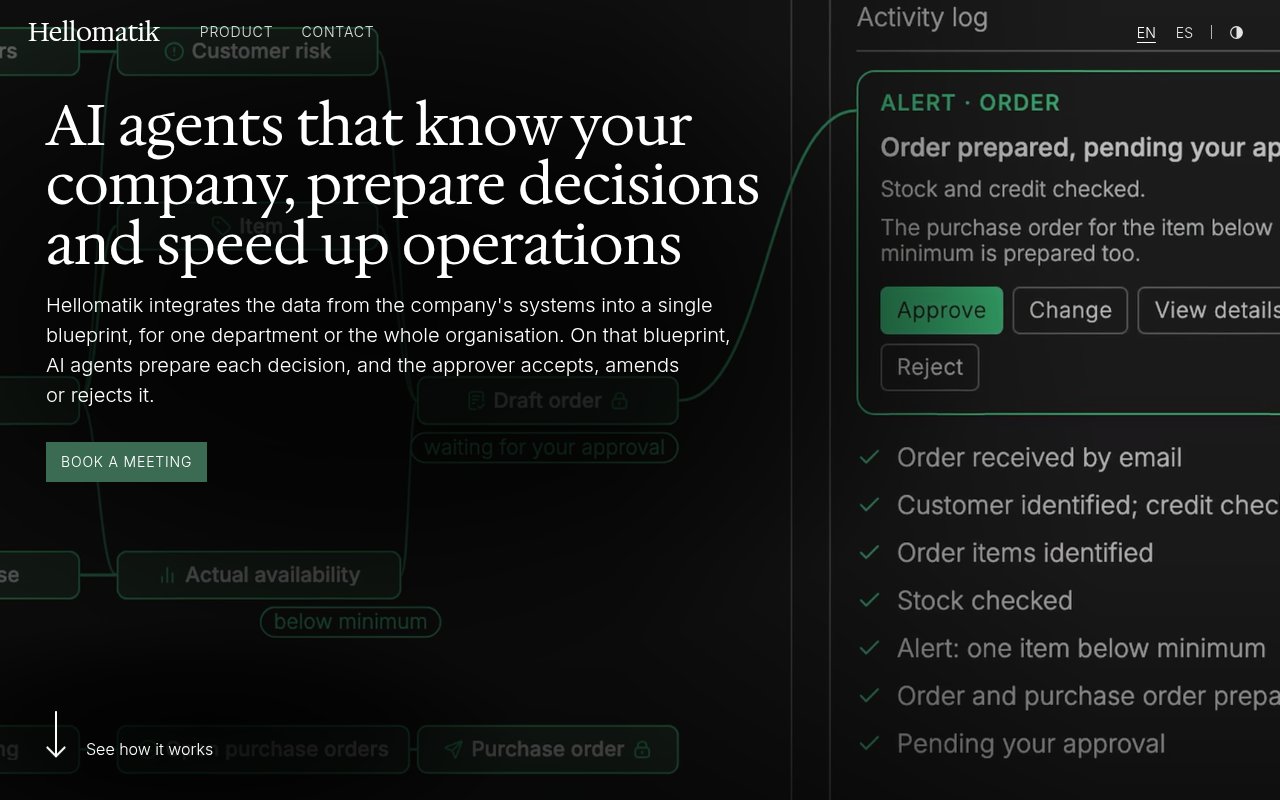
Hellomatik is an enterprise AI operations platform that connects a company's systems and turns its working rules into a shared blueprint. AI agents use that blueprint to prepare operational decisions, while the business chooses whether each result can proceed automatically or must wait for a person to approve, amend, or reject it. The goal is to reduce the repeated work of gathering records from email, an ERP, warehouse software, and other management systems before someone can act. It is aimed at real departmental processes rather than a general chat assistant, with each deployment centered on a specific decision the company wants to handle more consistently.
The company blueprint is the foundation of the product. It records what data the organization holds, how a procedure is carried out, and how each relevant figure is calculated. It also provides a consistent definition for business objects such as customers, orders, and items when source systems don't line up neatly. Reports answer business questions using the formulas in the blueprint, while alerts are raised when an answer changes. Hellomatik shows where a figure came from and when it was read, giving an approver a way to check the evidence without manually opening every connected system.
A run represents one execution of a procedure from source data to a final ruling. Hellomatik's supplier invoice example begins with an invoice received by email, retrieves the related purchase order and delivery note from the ERP, checks the agreed price and received quantity, then prepares the posting with discrepancies flagged. Finance can approve the proposal, change it, or reject it. The run stays in an operations log, and the decision, approver, and outcome stay in an approval log. This gives the workflow a visible trail rather than hiding the agent's work behind a conversational response.
The published examples span sales, purchasing, and logistics. An agent can draft a sales order from a customer's email after checking stock and credit limits, match supplier invoices to orders and deliveries, prepare an account summary before a call, or alert a team when a customer's ordering pattern declines. Logistics examples include finding unshipped orders, auditing freight invoices, drafting order status replies from several systems, and preparing responses to delivery issues with proof of delivery attached. The company selects the first decision to implement and can add further use cases over time, so the product is shaped around the organization's own procedures.
Human control is designed into the workflow. The business decides procedure by procedure which results run automatically and which require an explicit approval. When an approver changes or rejects a proposal, the agent can draft a correction to the procedure. That correction only takes effect after it is accepted, and then applies to similar decisions in the future. This approach gives operational teams a structured way to teach the system from reviewed outcomes. It also makes Hellomatik a stronger fit for work where consistency, traceability, and responsibility matter more than generating a quick one-off answer.
Hellomatik is best suited to established companies with meaningful transaction volume and data spread across several internal systems. Operations leaders, finance teams, sales administration, purchasing, and logistics can use it to prepare recurring decisions without removing the accountable person from the loop. The setup asks more of a customer than signing into a standalone app because useful agents depend on connected data, written procedures, formulas, approval boundaries, and system access. That work is also the product's main distinction. The agent is grounded in a company-specific operating model instead of relying only on a prompt and whatever context a user remembers to provide.
Access is sales led. The public site asks a prospective customer to book a meeting, explain the systems it uses, and name the decision it wants to start with. Hellomatik then provides a plan for going live. No public plan prices or self-service free tier are shown, and the terms describe the service as a paid business platform, so buyers should expect a scoped commercial deployment. This posture makes sense for cross-system operational work, but it means evaluation requires a conversation and likely an implementation effort. Teams should arrive with one bounded, high-value procedure and clear approvers if they want to judge the fit responsibly.
Key Features
- Unified company operations blueprint
- Cross-system data retrieval
- Configurable human approval controls
- Operations and approval logs
- Procedure learning from corrections
- Department-specific AI workflows
Pros & Cons
What we like
- Grounds agent work in company data and written procedures
- Keeps people responsible for sensitive operational decisions
- Shows source and reading time for reported figures
- Records every run and approval for traceability
Room for improvement
- No public pricing or self-service trial is shown
- Useful deployment requires access to internal company systems
- Initial setup depends on documenting procedures and formulas
- The enterprise operations focus is narrower than a general assistant
Frequently Asked Questions
What is Hellomatik?
Does Hellomatik make decisions without people?
How does Hellomatik learn from corrections?
How do companies get started with Hellomatik?
Best For
Featured in
Alternatives to Hellomatik

CalendHub
Smart scheduling and calendar management for teams
Kevin Gabeci Toolkits
Seven AI toolkits for writing books, making music, cutting video, and building agents.

Eased Into AI
Learn AI from zero. No jargon, no hype, just steps that work.

Fix It Gently
Calm, plain-English fixes for everyday tech problems.
Reviews (0)
Badge builder
Add Hellomatik to your website
Choose a badge style and size, preview it here, then copy the generated HTML. Badge images are self-contained SVGs and do not require an external script.

<a href="https://toolindex.net/tools/hellomatik?ref=badge" target="_blank" rel="noopener">
  <img src="https://toolindex.net/badge/hellomatik/medium.svg" alt="Hellomatik - Listed on Tool Index" width="180" height="50" />
</a>How to use the badge
- 1. Pick the style, size, and theme that fit your layout.
- 2. Copy the generated HTML from the code block.
- 3. Paste it into your footer, homepage, or press page.
Standard badge available
The standard listing badge is available now. Score and circle badges are limited to tools currently ranked in the top 10 of a category.
Badge clicks return visitors to this profile with a referral tag so the source remains identifiable.
Related Tools

Confluence
Atlassian's long-running team wiki that anchors many enterprise knowledge stacks
Asana
Project management for teams that live in projects, tasks and dependencies
Kevin Gabeci Toolkits
Seven AI toolkits for writing books, making music, cutting video, and building agents.

Logseq
An open-source outliner notes app where every bullet is a first-class block
Work on Hellomatik? Request listing access or correction