
Howcomet
An iPhone and iPad AI tutor for kids that asks a question back and keeps the answer
Gallery
About Howcomet
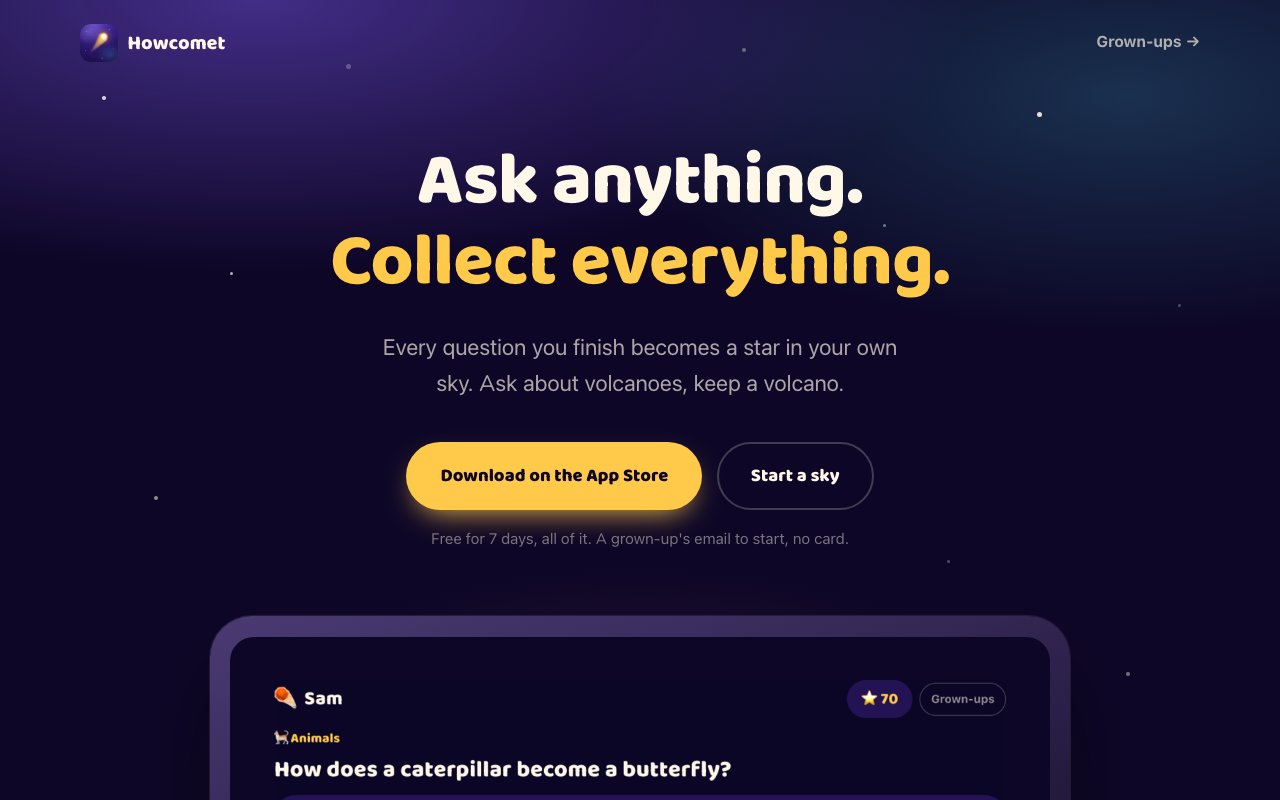
Howcomet is an iOS app that lets a child ask anything, gives back an answer written for their age, and then checks they actually understood it. Every question that gets finished turns into a star in the child's own sky. Ask about volcanoes and you keep a volcano. Over weeks those stars group into constellations by theme, covering animals, space, numbers and whatever else the child has been curious about, so the app slowly becomes a map of what one specific kid knows. It's built for iPhone and iPad rather than the web, and a grown-up sets it up before a child ever opens it.
The problem it's built around is that a chatbot answers and forgets. A child asks why their ears pop on a plane, gets a fluent paragraph, closes the app, and nothing is left behind for either of them. Howcomet keeps the thread going after the answer. A short game about what was just read comes next, and if the child gets it wrong the app explains the point again and lets them retry rather than moving on. Stars fade when they're left alone and brighten when the child comes back to them, so forgetting becomes visible instead of silent. Constellations dim the same way, which turns a whole abandoned topic into something a child can see going dark and choose to go back to.
Questions are typed or spoken, whichever suits the child, and speech is processed on the device so a young voice never leaves the phone or tablet. Answers come with pictures that move, showing rings, bars, orbits and waves, because some ideas land faster when you can watch them happen than when you read a paragraph about them. The team is clear that the games and the illustrations aren't invented by the model. Those are built by hand, and anything that doesn't check out gets thrown away rather than shown to a child. That's a narrower claim than most AI learning apps make, and a more honest one, since the site also says plainly that the tutor can get things wrong and points parents at the weekly log so they can check for themselves.
The parent side is where a lot of the design effort clearly went, because handing an AI to a child is a fair thing to worry about. Every question is screened before the tutor ever sees it, and when one is refused the child is told a grown-up will see it, and the grown-up does. Setup happens on the parent's own phone, so the password never lands on the child's tablet and the parent page can't be opened from the child's device. There are no ads, no trackers, no third-party analytics and no fonts pulled from someone else's server, and nothing is sold on. Each week the parent gets a page showing what the child asked and which stars are slipping away, which is closer to a record of a child's curiosity than a usage dashboard.
There's also nothing to buy inside the app. No coins, no packs, no chests, no timed offers. Stars are earned rather than bought, and the rewards are things a family agrees to in real life instead of virtual currency, so the incentive loop points back at the household rather than at another purchase. Screen time is capped by design too, since there's a daily limit on how much a child can earn, which means sitting there longer simply stops paying off. Families with more than one child get a single grown-up account with a separate sky per child, each with its own stars, its own reading level and its own goals, and nothing crosses between them.
It's aimed at parents of curious primary-school age children who want something more structured than an open chatbot but less rigid than a curriculum app, and who care about what a company does with a child's data. Nothing here is pitched at homework or test scores. The unit of progress is a question the child chose to ask, which makes it a better fit for the kind of kid who wants to know how volcanoes work than for a family looking to drill times tables. The privacy posture is stated plainly, with COPPA referenced directly and privacy and terms pages linked from the footer. If your worry is that an AI tutor is really an ad-supported data collection exercise wearing a cartoon font, that's the objection Howcomet has written most of its landing page against.
Access starts with a full seven-day free trial that needs only a grown-up's email address, with no card required, and everything in the app is included during that window. After that it's a paid subscription, and the site doesn't publish the price on the landing page, so you'll see it at checkout. One detail worth knowing is what happens if you stop paying, since the sky stays put and the child can still look through everything they built, they just can't ask new questions. The reasoning given is that months of a child's work shouldn't disappear because a card expired, and it's a small policy that tells you something about how the rest of the app was thought through. Distribution is through the App Store, and there's no Android or web version listed yet.
Key Features
- Age-adjusted answers to any question
- Comprehension game after every answer
- Stars and constellations that track what's remembered
- Animated diagrams built by hand
- Question screening with parent visibility
- Weekly parent report on questions and fading topics
Pros & Cons
What we like
- Checks understanding instead of just answering and moving on
- No ads, trackers, third-party analytics or in-app purchases
- Parent setup and password stay off the child's device
- Each sibling gets a separate sky, reading level and goals
Room for improvement
- iOS only, with no Android or web version listed
- Subscription price isn't published on the site
- Free access is a seven-day trial rather than a lasting free tier
- Aimed at younger children, so older students will outgrow it
Frequently Asked Questions
What is Howcomet?
Is Howcomet free?
Is it safe for children?
What happens if we stop paying?
Best For
Featured in
Alternatives to Howcomet
View all
Apatero AI
The creator studio for AI image, video, audio, 3D, and avatars, now at apatero.ai.

SoloDevStack
A solo developer blog built on head-to-head tool comparisons, 580+ posts deep.
Apatero Studio
Creator studio for AI image, video, audio, 3D, and avatars. Every model worth using, in one workspace.

Melodex
Turn your idea into an AI-generated music video
Our take
Tool Index Editorial · Oct 2026· 3.5/5
Howcomet is an iPhone and iPad curiosity app for children aged 5 to 14 that answers a question, checks understanding with a short game, and saves the result as a star that fades until reviewed. Parents get screening, weekly visibility, separate profiles for siblings, and setup controls kept off the child's device. We like that speech stays on device and that the site directly acknowledges both the risks of child facing AI and the possibility of wrong answers.
The app starts with a full seven day trial and no card, but the subscription price is not published on the site. There is no Android or web version, and this is not a curriculum or homework system. Screening and comprehension checks reduce risk, but they do not remove the need for a parent to review surprising claims and monitor use. Howcomet has more educational structure and privacy thought than a generic chatbot, though the undisclosed ongoing cost and narrow platform support hold it back.
Editorial opinion from the Tool Index team, written from the public product pages. Not a user review.
Reviews (0)
Badge builder
Add Howcomet to your website
Choose a badge style and size, preview it here, then copy the generated HTML. Badge images are self-contained SVGs and do not require an external script.

<a href="https://toolindex.net/tools/howcomet?ref=badge" target="_blank" rel="noopener">
  <img src="https://toolindex.net/badge/howcomet/medium.svg" alt="Howcomet - Listed on Tool Index" width="180" height="50" />
</a>How to use the badge
- 1. Pick the style, size, and theme that fit your layout.
- 2. Copy the generated HTML from the code block.
- 3. Paste it into your footer, homepage, or press page.
Standard badge available
The standard listing badge is available now. Score and circle badges are limited to tools currently ranked in the top 10 of a category.
Badge clicks return visitors to this profile with a referral tag so the source remains identifiable.
Related Tools
Apatero AI
The creator studio for AI image, video, audio, 3D, and avatars, now at apatero.ai.
Kevin Gabeci Toolkits
Seven AI toolkits for writing books, making music, cutting video, and building agents.

Warp
The modern terminal reimagined with AI and collaboration

Bolt.new
Prompt-to-deployed full-stack app inside the browser
Work on Howcomet? Request listing access or correction