
Insomnia
Open-source API client for REST, GraphQL, gRPC, and WebSockets. Postmans more polished, less corporate cousin.
Gallery
About Insomnia
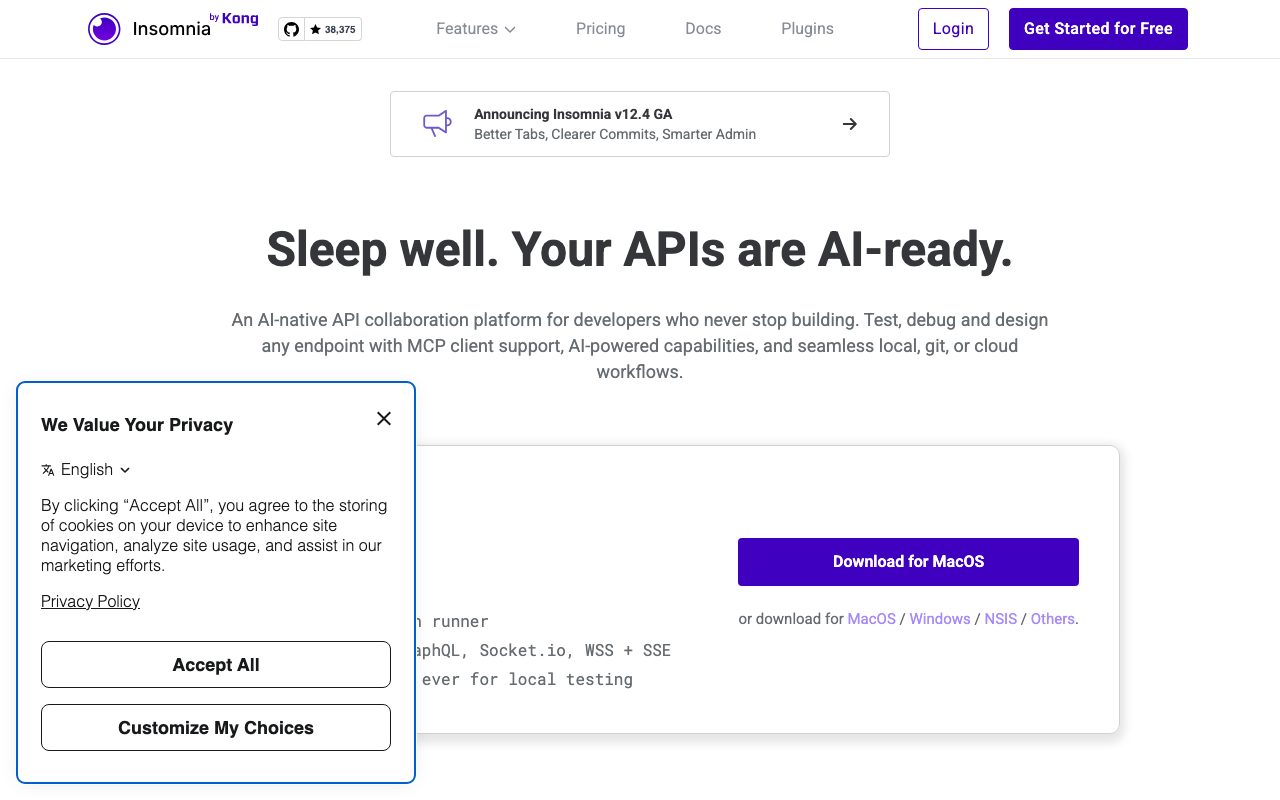
Insomnia is the API client developers reach for when Postman feels like it grew too many features. It's a clean, fast desktop app for testing REST, GraphQL, gRPC, and WebSocket endpoints. The UI stays out of your way. The keyboard shortcuts make sense.
Insomnia was acquired by Kong in 2019 and continues to ship steady updates. There was a brief drama in 2024 when Kong moved some features behind a login wall, which prompted a fork (Kongthus, then Yaak and others). Most of that has since settled, and Insomnia remains a solid choice.
If you're tired of Postman's bloat or curious about a leaner alternative, Insomnia is the obvious pick. The desktop app is the main attraction, and it's still free for the core feature set.
What Insomnia actually does
Insomnia is a desktop app for designing, testing, and debugging APIs. You create requests, organize them in collections, set up environments with variables, and chain requests for testing flows. It supports REST, GraphQL, gRPC, WebSockets, and SOAP if you must.
The git sync feature lets you store collections in a repo and share them with the team like code. That's a more honest workflow than Postman's cloud-first model, especially for teams that already use git for everything.
Request and response handling
Make a request, see the response, inspect headers, run scripts on it. The response viewer handles JSON, XML, HTML, and binary cleanly. The request builder supports all the auth flavors (Basic, Bearer, OAuth 2, AWS, Hawk, NTLM) without making you read docs.
GraphQL and gRPC
Insomnia does GraphQL well. Schema introspection, variable autocomplete, and a clean query editor. gRPC works too, with proto file imports and bidirectional streaming. These are first-class, not bolted on.
Who Insomnia is for
Backend developers, API designers, and frontend engineers who consume APIs daily. Anyone Postman feels too heavy for. Teams who want a desktop-first workflow rather than a SaaS dashboard.
It's not the right pick if you need automated test runs in CI (you can use Inso CLI but it's less polished than Newman) or fancy collaboration features. For solo and small-team API work, Insomnia is excellent.
Insomnia pricing
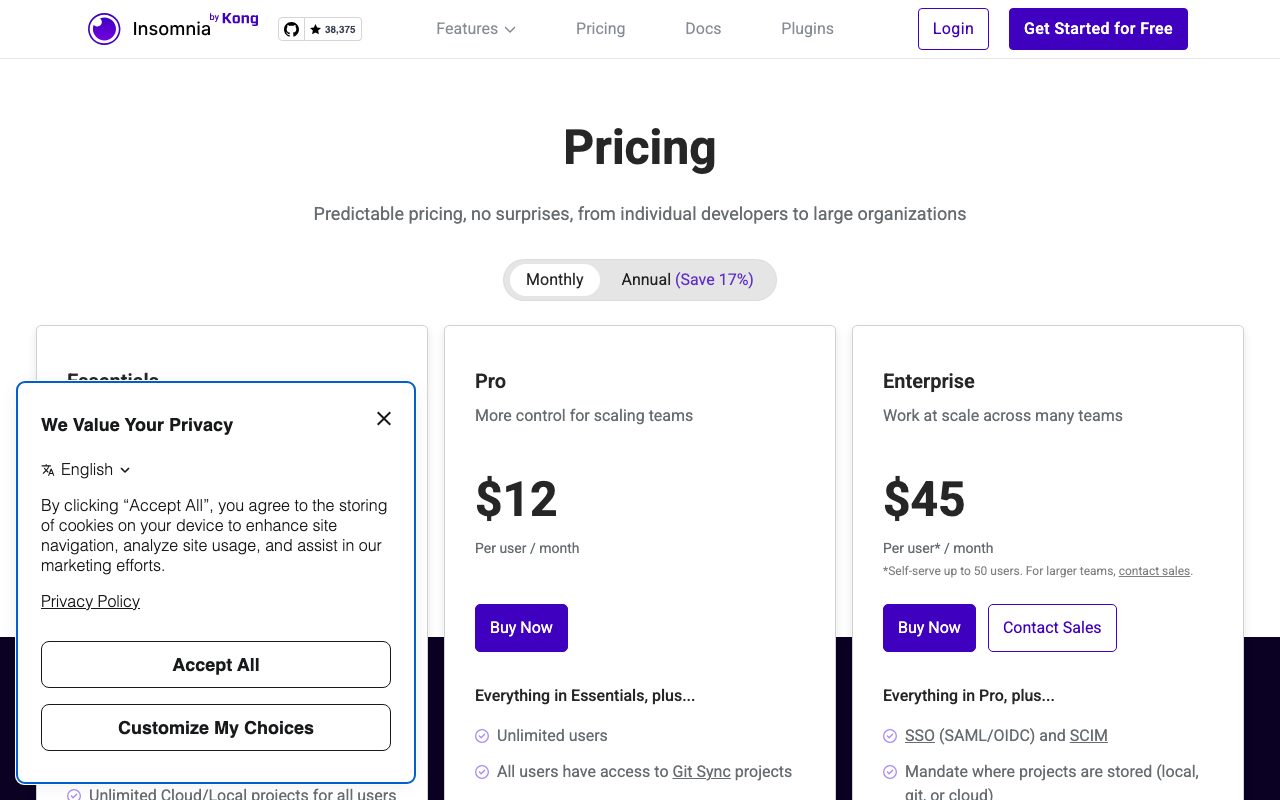
Free for the desktop app and personal use. Pro at $5 per user per month adds end-to-end encrypted cloud sync. Team at $12 per user per month adds RBAC and collab. Enterprise pricing is custom.
For most developers, free is plenty. The paid tiers are reasonable if you need cloud sync. Compared to Postman's pricing, Insomnia is cheaper at every tier.
Features worth knowing
Environments and variables
Define dev, staging, and prod environments with their own base URLs, tokens, and variables. Switch with a dropdown. Variables interpolate into requests cleanly.
Git sync
Store your workspace in a git repo. Branches, diffs, merges. For team workflows that are already git-native, this beats cloud sync.
Plugins and templating
Insomnia supports plugins for custom auth flows, response transforms, and template tags. The plugin ecosystem is smaller than Postman's but covers most needs.
Inso CLI
Run requests from the command line. Useful for CI smoke tests. Not as polished as Postman's Newman, but functional.
The tradeoffs
The Kong drama left a bitter taste for some users. The 2024 cloud login requirement was rolled back partially after community pushback. If you're allergic to corporate strings on a free tool, the forks like Bruno or Yaak are options.
The plugin ecosystem trails Postman. The collab features are lighter. If you have a 100-person team standardizing on one API client, Postman or Bruno are more common picks.
Insomnia vs alternatives
The usual comparisons are Insomnia vs Postman, Insomnia vs Bruno, and Insomnia vs Hoppscotch. Postman is heavier and more featureful. Bruno is fully offline and git-native, the most popular post-drama fork. Hoppscotch is web-based and free.
For a clean middle ground, Insomnia still wins. See Insomnia alternatives or browse the best API clients.
Bottom line on Insomnia
Insomnia is the steady, mature API client that does what it should. The UI is faster than Postman. The features cover what most devs need. The price is right.
If you're picking an API client today and don't have strong feelings about Kong, Insomnia is a fine choice. If you do have feelings, Bruno is a worthy fork. Either way, Postman isn't the only option, and Insomnia made sure of that.
Common Insomnia questions
Is Insomnia really free? The desktop app with local storage is free for personal use. Cloud sync and team features are paid. For solo developers, the free tier covers most needs indefinitely.
Does Insomnia handle GraphQL well? Yes. Schema introspection populates autocomplete. Variable editing is sane. The query and response viewers are fast. For most GraphQL work, Insomnia matches dedicated GraphQL clients.
Can I use Insomnia in CI? Yes via Inso CLI. Run requests as smoke tests, run assertions, fail builds on regressions. The CLI is less polished than Newman (Postman's CLI) but functional.
What about the Kong drama?
Kong's 2024 changes pushing cloud sign-in for some features generated backlash. The team rolled back parts after community pushback. The desktop app remains free and locally usable. If you're sensitive to corporate strings on your tools, Bruno is the popular fork.
Does Insomnia support OpenAPI?
Yes. Import OpenAPI specs to generate request collections. Export collections back to OpenAPI. Useful when your API spec is the source of truth and you want collections to stay in sync.
Workflow tips for Insomnia
Use environments for everything. Dev, staging, prod environments with their own variables. Switch with a dropdown instead of editing URLs.
Chain requests for testing flows. Run a login request, capture the token, use it in subsequent requests. The chaining is faster than copying tokens by hand.
Store collections in git. The git sync feature treats collections as code. Diffs review nicely. New team members clone the repo and have all the API requests. This beats sharing exports.
Pair Insomnia with API mocking tools like Mockoon for offline development. You can swap base URLs between real APIs and mocks via environment variables. Browse tools for backend developers for related picks.
Real-world Insomnia scenarios
A backend developer uses Insomnia to test new endpoints during development. Quick request, see the response, iterate. Faster than writing curl commands. Cleaner than browser-based clients. The local-first model means no signup hassle.
A team uses Insomnia with git sync. Collections live in the repo with the code. New engineers clone the repo and have all the API requests. PR review covers API changes alongside code. The git-native workflow matches how the team already operates.
A QA engineer uses Inso CLI for smoke tests. Critical endpoints get hit on every deploy. Failures fail the build. Less polished than Newman but functional. The same collections work for manual testing and automation.
Productivity tips
Master the keyboard shortcuts. Insomnia is faster with keys than mouse. Cmd+N for new request, Cmd+L for the URL bar, Cmd+Enter to send.
Use environments to switch between dev, staging, and prod. Don't edit URLs by hand. The environment dropdown is your friend.
Save common request patterns as templates. Auth header structures, pagination params, response inspection scripts. Templates accelerate repetitive work.
For most developers, Insomnia hits the right balance of features and simplicity. It's not Postman. That's the point. Browse the Insomnia page for community reviews.
Why Insomnia stays relevant
The API client market in 2026 has more options than ever. Postman dominates by feature breadth. Bruno wins on git-native and offline. Hoppscotch wins on browser-based simplicity. Yaak is the new lean entry. Insomnia keeps holding its place by being the steady middle option.
The Kong stewardship gives Insomnia stability that smaller forks can't promise. The product gets regular updates. The infrastructure stays funded. For teams that want a tool they can rely on for years, that's worth something.
The desktop-first approach also matters. Browser-based tools are convenient until they break or your network dies. Insomnia works offline, sync optional. For developers who travel, fly, or work in restrictive networks, that's not a small thing.
For most developers, the choice between API clients is a matter of taste. Postman has more features, Insomnia has cleaner UX, Bruno has better git integration. Try a couple, pick what fits your workflow. Insomnia continues to be a solid pick that won't surprise you.
The Insomnia long bet
For Insomnia to keep its place, Kong needs to keep investing in the desktop app. The Kong drama in 2024 raised concerns about commitment to the free tier. So far the team has continued shipping. The trajectory looks stable but not exciting.
For developers picking an API client today, the practical advice is simple: try Insomnia, try Bruno, see which one feels right. Both are good. Both are free. Both will keep working. The category isn't where exciting innovation happens; it's where reliable tooling matters.
For teams already on Insomnia, there's no urgent reason to switch. Productivity is similar across the major options. Stick with what works for your workflow. Migration costs (relearning shortcuts, recreating environments) outweigh the marginal benefits of switching.
Tutorial / Demo
Key Features
- REST, GraphQL, gRPC, WebSocket, and SOAP support
- Open-source core under Apache 2.0
- Environment variables and template tags
- Plugin SDK in JavaScript
- Inso CLI for running collections in CI
Pros & Cons
What we like
- Cleaner UI than the obvious competitor
- Genuinely open source
- Strong protocol coverage including gRPC
Room for improvement
- Smaller community than Postman, fewer shared collections
Frequently Asked Questions
Is Insomnia free?
Insomnia vs Postman, which should I pick?
Does Insomnia support GraphQL and gRPC?
Is Insomnia open source?
Can I sync collections across machines?
Best For
Featured in
Tags
Alternatives to Insomnia

DeviceKit
Free Screen & Device Tests Online | Private Browser Diagnostics
Dagger
Programmable CI/CD pipelines as code in Go, Python, TypeScript, or Java. Runs locally and on any CI provider.

Playwright
Microsofts open-source end-to-end browser testing framework for Chromium, Firefox, and WebKit with one API.
Bruno
Git-friendly, fully offline API client that stores collections as plain text files in your repository.
Our take
Tool Index Editorial · May 2026· 4.4/5
If you're evaluating Insomnia, the headline is simple: open-source api client for rest, graphql, grpc, and websockets. postmans more polished, less corporate cousin, and most teams will get value out of the box.
Where it wins: Cleaner UI than the obvious competitor, Genuinely open source, and Strong protocol coverage including gRPC. Less impressive: Smaller community than Postman, fewer shared collections.
Bottom line: pick Insomnia when you need engineers preferring local-first tooling over cloud sync; look elsewhere if smaller community than Postman, fewer shared collections would be a dealbreaker.
Editorial opinion from the Tool Index team, written from the public product pages. Not a user review.
Reviews (6)
Insomnia, better than expected
Insomnia is one of those tools you stop noticing because it just works. Genuine strength: strong protocol coverage including gRPC. Main use case: graphQL teams who want a better client than Postman. Honest gripe: smaller community than Postman, fewer shared collections.
Cons
- Smaller community than Postman, fewer shared collections
Trade offs worth knowing about
The pitch for Insomnia sounded too good to be true. Mostly true. The thing I keep coming back to: strong protocol coverage including gRPC. Got real value out of plugin SDK in JavaScript. Mostly using it for solo developers wanting a free desktop API tool. One thing that bugs me: smaller community than Postman, fewer shared collections. Not perfect but better than the alternatives I tried.
Pros
- Strong protocol coverage including gRPC
- Genuinely open source
- Cleaner UI than the obvious competitor
Cons
- Smaller community than Postman, fewer shared collections
Pulled its weight from week one
Tried half a dozen options before landing on Insomnia. Real selling point: strong protocol coverage including gRPC. Got real value out of open-source core under Apache 2.0. It fits well for engineers preferring local-first tooling over cloud sync. Easy yes for anyone weighing the same trade-offs.
Stuck the landing for our team
Tried Insomnia on a side project first. Where it really wins is genuinely open source. Worth calling out the environment variables and template tags too. Mostly using it for engineers preferring local-first tooling over cloud sync. Would buy again without thinking twice.
It just works
Got Insomnia on the recommendation of someone I trust. Real selling point: cleaner UI than the obvious competitor. Rest, graphql, grpc, websocket, and soap support works the way you'd hope.
Decent tool, wrong fit
Took a few weeks for Insomnia to click, then it stuck. Where it really wins is genuinely open source. Worth calling out the inso CLI for running collections in CI too. Found it works best for gRPC services tested without writing custom clients. Honest gripe: smaller community than Postman, fewer shared collections.
Pros
- Cleaner UI than the obvious competitor
- Strong protocol coverage including gRPC
- Genuinely open source
Cons
- Smaller community than Postman, fewer shared collections
Badge builder
Add Insomnia to your website
Choose a badge style and size, preview it here, then copy the generated HTML. Badge images are self-contained SVGs and do not require an external script.

<a href="https://toolindex.net/tools/insomnia?ref=badge" target="_blank" rel="noopener">
  <img src="https://toolindex.net/badge/insomnia/medium.svg" alt="Insomnia - Listed on Tool Index" width="180" height="50" />
</a>How to use the badge
- 1. Pick the style, size, and theme that fit your layout.
- 2. Copy the generated HTML from the code block.
- 3. Paste it into your footer, homepage, or press page.
Standard badge available
The standard listing badge is available now. Score and circle badges are limited to tools currently ranked in the top 10 of a category.
Badge clicks return visitors to this profile with a referral tag so the source remains identifiable.
Related Tools

Kevin Gabeci
Solo developer building web apps, cozy browser games, and AI creator toolkits.
Coolify
Self-hostable, open source alternative to Heroku and Netlify

Warp
The modern terminal reimagined with AI and collaboration

Bolt.new
Prompt-to-deployed full-stack app inside the browser
Work on Insomnia? Request listing access or correction