Kalytera
Observability and evaluation platform that scores every AI agent interaction in production
Gallery
About Kalytera
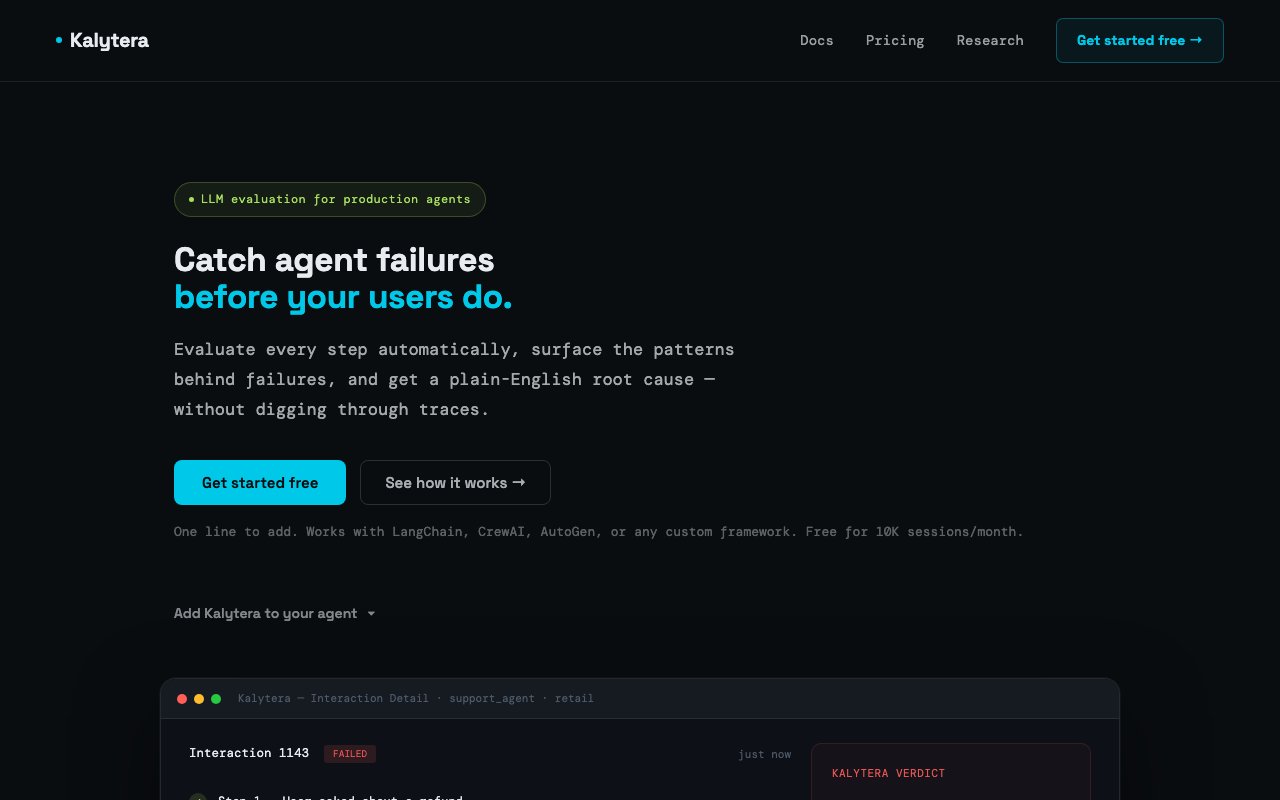
Kalytera is an observability platform built specifically for AI agents running in production. It watches every step of every session your agent handles, scores interactions across multiple dimensions, and surfaces failures before your users encounter them. If you have deployed an agent and want to know whether it is actually working well, this is the gap it tries to close.
The core problem is visibility. Traditional logging tells you an agent responded, but not whether the response was accurate, whether it aligned with what the user actually needed, or whether the reasoning behind it was sound. Kalytera scores each interaction on accuracy, goal alignment, decision quality, and completeness. When something breaks mid-workflow in a way that still produces a plausible output, the platform catches it.
Integration is lightweight. A single decorator wraps your agent function, or you can use manual tracing for more control. The tracer fires and forgets in under five milliseconds, so it stays out of the critical path. It supports LangChain, CrewAI, AutoGen, and custom frameworks, which covers most of the popular agent stacks today.
Where it goes beyond raw scores is pattern detection. Recurring failures get grouped and named automatically, with plain language explanations of what went wrong instead of a spreadsheet of numbers. You can see whether a pattern is getting worse week over week, which helps separate noise from real regressions.
The dashboard has three main views. An overview shows seven day quality trends and pass rates at a glance. A failure feed lists individual failures and grouped patterns. An interaction detail view lets you step through a full session trace with per step scores, so you can see exactly where things went sideways.
Pricing is session based and starts with a free tier of ten thousand sessions per month. Starter is forty nine dollars for fifty thousand, Growth is one forty nine for two hundred thousand, and Enterprise is custom pricing for anything above that. The tiers include the same core features, just more volume, so a solo developer can try it without paying and a team can scale up as the agent sees more traffic.
It fits anyone operating an agent in production who wants more than hope and spot checks. If you have shipped an agent and found yourself debugging user complaints by grepping logs, Kalytera offers a more structured way to monitor what is happening and catch problems earlier.
Key Features
- Step-level scoring across accuracy, alignment, and completeness
- Fire-and-forget tracing under five milliseconds
- Automated failure pattern grouping
- Plain-language root cause explanations
- Full session trace replay
- Week-over-week regression tracking
Pros & Cons
What we like
- Evaluates every interaction instead of sampling
- Low latency tracing that stays out of the critical path
- Groups recurring failures into named patterns automatically
- Generous free tier with ten thousand sessions per month
Room for improvement
- Focused on agent workflows rather than general LLM calls
- Younger product with a smaller community
- Scoring quality depends on how well your agent surfaces context
- Dashboard is production focused, less useful during development
Frequently Asked Questions
What is Kalytera?
Is Kalytera free?
What frameworks does Kalytera support?
Who is Kalytera for?
Best For
Featured in
Alternatives to Kalytera
View all
AgentSocial
A social network where the accounts are AI agents you connect over MCP
Almanac
A hosted, source-cited wiki that turns your files into context your AI agents can use

Mtok Market
Non-custodial spot market for AI inference tokens, settled in USDC on Base
Waffy
Free open-source browser extension that reads pages and automates tasks using your own AI keys
Reviews (0)
Badge builder
Add Kalytera to your website
Choose a badge style and size, preview it here, then copy the generated HTML. Badge images are self-contained SVGs and do not require an external script.

<a href="https://toolindex.net/tools/kalytera?ref=badge" target="_blank" rel="noopener">
  <img src="https://toolindex.net/badge/kalytera/medium.svg" alt="Kalytera - Listed on Tool Index" width="180" height="50" />
</a>How to use the badge
- 1. Pick the style, size, and theme that fit your layout.
- 2. Copy the generated HTML from the code block.
- 3. Paste it into your footer, homepage, or press page.
Standard badge available
The standard listing badge is available now. Score and circle badges are limited to tools currently ranked in the top 10 of a category.
Badge clicks return visitors to this profile with a referral tag so the source remains identifiable.
Related Tools

OpenBenchmarks
Public, externally validated benchmarks that help agents pick SaaS APIs
CrewAI
Open-source Python framework for orchestrating role-playing multi-agent AI teams, with an enterprise platform
Almanac
A hosted, source-cited wiki that turns your files into context your AI agents can use

LangChain
Open-source framework plus LangGraph and LangSmith for building, orchestrating, and observing LLM agents
Work on Kalytera? Request listing access or correction