
Kungfu
Open-source continuity layer that keeps agent work alive across models, crashes, and reviews
Gallery
About Kungfu
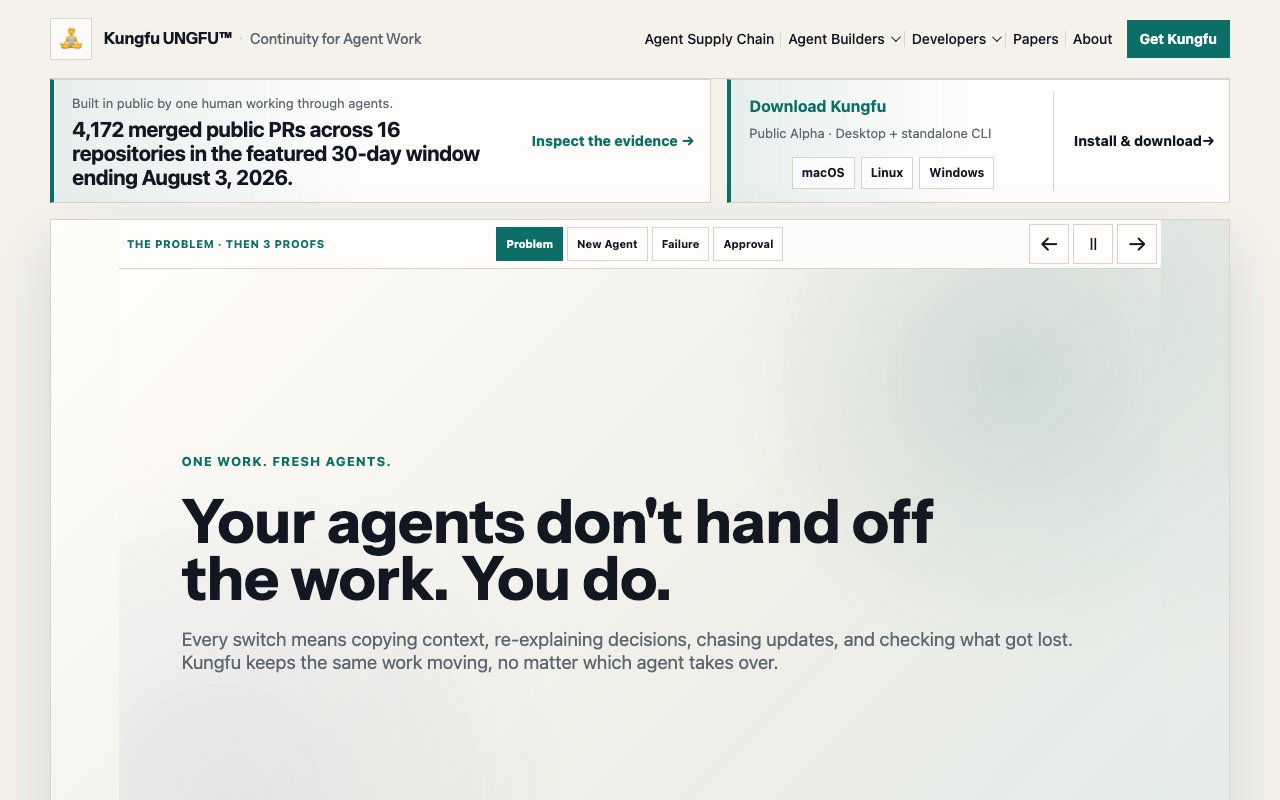
Kungfu is an open-source continuity layer for AI agent work. The problem it goes after is one anyone running coding agents has hit, the work an agent does is trapped inside a single session with a single agent. Kill the process, drop the connection, or switch from one model to another and the context, the decisions, and the half-finished task evaporate. Kungfu makes the work itself the durable thing, so a task can survive a new agent, a crashed process, or a dead connection without you manually copying context around.
It ships as two things you can actually install today. There's a standalone CLI, installed with a one-line script on macOS, Linux, or Windows, and a desktop app called Episodes that gives you a visual workspace over the same runtime, with builds published for Apple silicon Macs, x64 Linux, and x64 Windows. Both are in public alpha, currently at version 4.0.0-alpha.2. The install posture is unusually careful for developer tooling, it's per-user by default, it never asks for sudo or administrator rights, and it avoids touching system configuration. Each project gets a local .kungfu directory that holds the work and runtime state, which is where the continuity actually lives. It's designed to sit alongside whatever agent you already run, the site names Codex, Claude, and OpenCode explicitly, plus your own execution surface if you've built one. You don't change agents to adopt it, you wrap the work they produce.
The mechanics are more structured than a shared context file. Work is defined through explicit coordinates, meaning a decision with a stated pursuit, known sources, and a permitted scope. Inputs get frozen into a binding, the agent's actual run is recorded as an episode with receipts and consequences, and then a separate admission step decides whether the result gets accepted as a basis for the next piece of work. That last part is a deliberate design choice, agents can't self-approve their own completions. Review is separated from execution, which matters once you're running agents at a volume where nobody is reading every diff.
Underneath the product sit two pieces for builders. KFD is an open protocol for moving rooted work, receipts, and verdicts between independent agent hubs without those hubs sharing a control plane, a database, or customer relationships. The protocol's core distinction is that delivery isn't admission, bytes arriving at your hub doesn't mean your hub has to accept the work, the receiver always owns the verdict. libkungfu is the local runtime that preserves facts, action continuity, and evidence inside your own hub, and it runs without any central Kungfu infrastructure. The stated goal is that you build and own the hub, and Kungfu occupies only the interoperability layer. Users, accounts, billing, models, UI, and agent logic all stay yours.
The obvious audience is developers already deep into agent workflows, especially anyone juggling multiple agents on one codebase or building an agent-native product that needs to exchange work with other systems. The team dogfoods the protocol publicly on its own development, publishing verified work metrics, reviews, and releases, which is where the eye-catching merged-PR numbers on the homepage come from. That's a real signal about how the thing is used day to day, though as with any alpha you should expect rough edges and moving APIs.
What makes it different from the growing pile of agent memory tools is the emphasis on evidence and authority rather than recall. Most memory layers try to remember what an agent said. Kungfu tries to make the work itself portable and reviewable, with receipts for what happened and a human-controlled gate on what counts as done. That framing, closer to version control and code review than to a vector store, is unusual in this space. There's also a longer bet baked in, the site talks about an agent supply chain where agent products build trust on published evidence rather than claims, with KFD as the standard that lets independent hubs participate without surrendering control to a central platform.
Access is straightforward. The software is Apache-2.0 licensed, free to download, and the source is on GitHub under kungfu-systems. There's no pricing page and no paid tier today, a hosted Kungfu Cloud is described as a future option rather than a current requirement, and the company behind it, Kungfu Origin Technology Limited, publishes its capital and stewardship principles right on the site. If you want to see whether agent work can survive an agent swap, the cost of finding out is a curl command.
Key Features
- Work continuity across agent switches
- Standalone CLI and Episodes desktop app
- Separated human review and admission step
- Open KFD interoperability protocol
- libkungfu local runtime with no central server
- Per-user install with local .kungfu state
Pros & Cons
What we like
- Apache-2.0 licensed and free to download today
- Works alongside Codex, Claude, OpenCode, or your own agent surface
- No sudo required and state stays project-local
- Team publicly dogfoods the protocol on its own development
Room for improvement
- Public alpha, so APIs and workflows may still shift
- The coordinates and admission model has a real learning curve
- Younger project with a small community
- No hosted option yet, everything runs locally
Frequently Asked Questions
What is Kungfu?
Is Kungfu free?
Which agents does Kungfu work with?
How is Kungfu different from agent memory tools?
Best For
Featured in
Alternatives to Kungfu
Rememori
Embedded memory engine for AI agents in TypeScript with zero dependencies
Almanac
A hosted, source-cited wiki that turns your files into context your AI agents can use

Demi AI
Demi helps busy professionals eliminate repetitive admin work across their favorite tools.

Meltbox
A personal workspace and inbox for your AI agents to reach you wherever they run
Reviews (0)
Badge builder
Add Kungfu to your website
Choose a badge style and size, preview it here, then copy the generated HTML. Badge images are self-contained SVGs and do not require an external script.

<a href="https://toolindex.net/tools/kungfu?ref=badge" target="_blank" rel="noopener">
  <img src="https://toolindex.net/badge/kungfu/medium.svg" alt="Kungfu - Listed on Tool Index" width="180" height="50" />
</a>How to use the badge
- 1. Pick the style, size, and theme that fit your layout.
- 2. Copy the generated HTML from the code block.
- 3. Paste it into your footer, homepage, or press page.
Standard badge available
The standard listing badge is available now. Score and circle badges are limited to tools currently ranked in the top 10 of a category.
Badge clicks return visitors to this profile with a referral tag so the source remains identifiable.
Related Tools

OpenBenchmarks
Public, externally validated benchmarks that help agents pick SaaS APIs
Almanac
A hosted, source-cited wiki that turns your files into context your AI agents can use

Wizard
Self-extending Rust terminal AI agent that works with any model

Chariot
Elastic cloud infrastructure for deploying and scaling AI agent fleets with persistent storage
Work on Kungfu? Request listing access or correction