
LiminalML
Mastery-based deep learning platform for machine learning and software engineering topics
Gallery
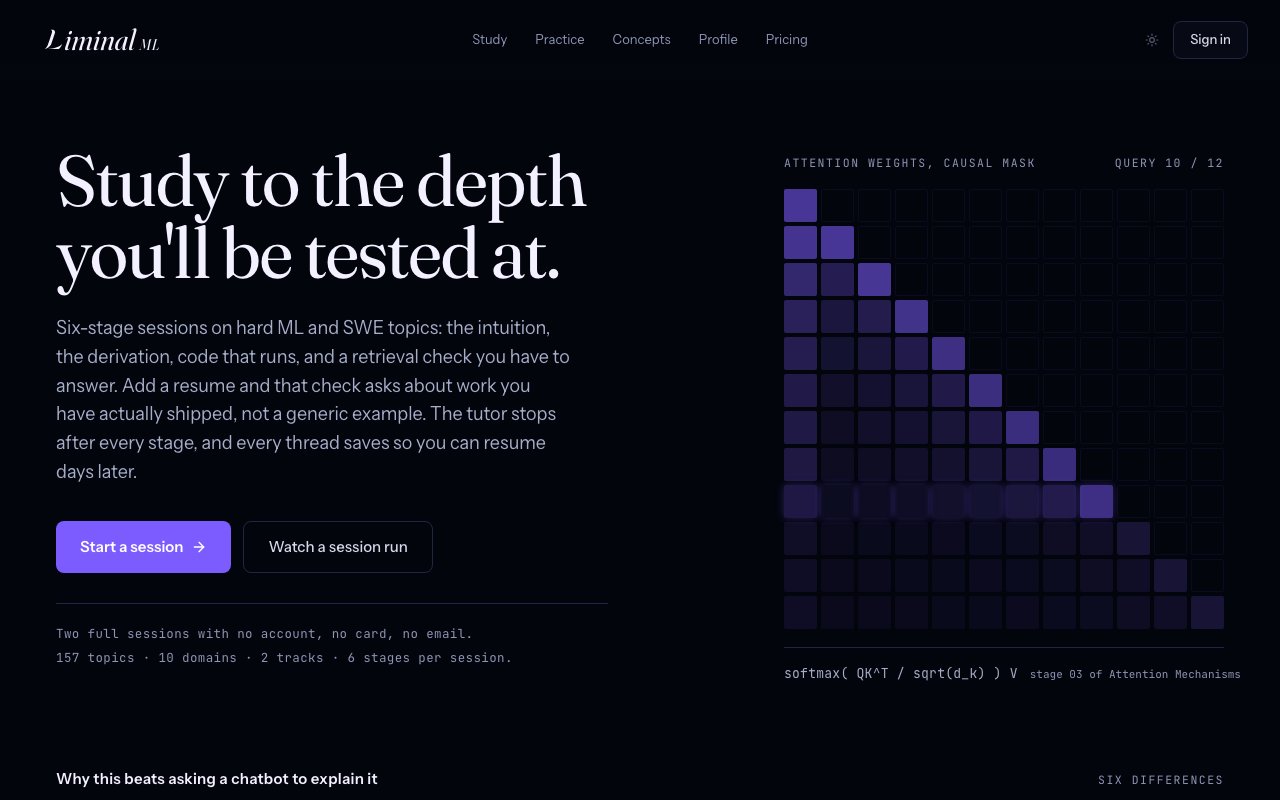
About LiminalML
LiminalML is an educational platform built around mastery-based learning for machine learning and software engineering. It offers structured sessions on technical topics, with each session broken into six stages designed to move from surface understanding to the kind of fluency you need to explain a concept from scratch. The goal is deep retention, not just exposure, which makes it different from video courses or documentation that you skim once and forget. The platform's design philosophy is that the pause between stages is the product. You're not racing through content. You're absorbing it.
The six-stage session format is the core of the product. Stage one sets the big picture context and frames the problem the concept solves. Stage two builds intuition through annotated visual diagrams that make abstract ideas concrete. Stage three works through the math step by step, with each term motivated rather than dropped in without explanation. Stage four provides production-quality PyTorch code with tests so you can see the concept implemented in a way that would actually run in a real codebase. Stage five presents five calibrated interview questions covering conceptual, implementation, applied, systems-level, and failure mode angles. Stage six is a retrieval check where you reproduce the concept unaided and get AI grading on what you missed. Sessions pause between stages and save progress, so you can spread a topic across multiple days without losing your place.
The topic library covers both ML and software engineering. On the ML side, there are 71 topics spanning five domains. Classical ML covers the foundations. Deep learning includes attention mechanisms, transformers, and modern architectures. Reinforcement learning and RLHF get dedicated sections. Training engineering covers the practical side of getting models to converge. Systems and MLOps round out the ML curriculum. The software engineering side has 86 topics across frontend, backend, system design, UI/UX, and CS fundamentals. The platform claims 157 topics total, with 17 concept pages publicly accessible so you can see the format before committing. That breadth makes it usable as a study resource for job preparation, not just a narrow slice of one domain.
One feature that sets LiminalML apart is resume integration. You can upload your resume, and the platform uses it to personalize the stage six retrieval checks by referencing your listed projects and experiences. Instead of generic scenarios, the system generates STAR stories from shipped projects you actually worked on. This makes the practice more relevant than abstract questions, since the scenarios connect to work you've actually done. The resume is optional and deletable, but for anyone doing interview prep, grounding practice in real experience makes answers more convincing and easier to recall under pressure.
The platform includes several supporting features beyond the core sessions. Revision cards provide compact topic summaries with core concepts and follow-up questions, useful for review before an interview. A practice lab lets you work on code implementations with line-by-line reviews. Profile context allows explanations to adapt to your background and focus areas, so someone with a research background gets different framing than someone coming from backend engineering. Session history lets you resume from your exact stopping point, which matters for sessions that take an hour or more to complete properly.
The platform is built on Claude, Anthropic's large language model. The tutoring, feedback, and question generation all run through Claude, which means the quality of explanations and code reviews depends on how well the prompts are engineered. For topics that are well covered in Claude's training data, this works smoothly. For niche or cutting-edge topics, results may vary. Recorded demo sessions don't require model calls, so you can see how the format works without using your session quota.
Pricing follows a freemium model. Guest users get two full sessions with no account required, which is enough to evaluate whether the format works for you. Free accounts get eight sessions per month, saved threads, five code reviews, and access to revision cards. The Pro tier costs nine dollars per month and unlocks unlimited sessions, unlimited code reviews, and early access to new topics. There's a seven-day trial for Pro. The pricing is low enough that the main barrier is whether the learning format clicks for you, not whether you can afford it.
The target audience is ML engineers, research engineers, and software engineers who want structured study rather than ad hoc searching. If you're preparing for technical interviews, ramping up on a new domain, or trying to go deeper on topics you only half-understand, LiminalML provides a more deliberate path than bouncing between blog posts and papers. The mastery-based approach is demanding, but that's the point. You don't skim. You work through the math, write the code, answer the questions, and prove you can reproduce the concept without aids. That's what mastery actually means.
Key Features
- Six-stage mastery sessions with retrieval checks
- Over 70 machine learning topics
- Over 80 software engineering topics
- Resume integration for personalized practice
- Runnable code examples per topic
- Progress saving across sessions
Pros & Cons
What we like
- Structured mastery format pushes for real retention
- Covers both ML and software engineering breadth
- Resume integration personalizes interview prep
- Low price point at nine dollars per month for unlimited
Room for improvement
- Quality depends on Claude's coverage of each topic
- Demanding format may not suit casual learners
- No video or instructor-led components
- Narrower focus than general coding bootcamps
Frequently Asked Questions
What is LiminalML?
Is LiminalML free?
What topics does LiminalML cover?
How does resume integration work?
Best For
Featured in
Alternatives to LiminalML

Apatero AI
The creator studio for AI image, video, audio, 3D, and avatars, now at apatero.ai.

SoloDevStack
A solo developer blog built on head-to-head tool comparisons, 580+ posts deep.
Apatero Studio
Creator studio for AI image, video, audio, 3D, and avatars. Every model worth using, in one workspace.

Melodex
Turn your idea into an AI-generated music video
Reviews (0)
Badge builder
Add LiminalML to your website
Choose a badge style and size, preview it here, then copy the generated HTML. Badge images are self-contained SVGs and do not require an external script.

<a href="https://toolindex.net/tools/liminalml?ref=badge" target="_blank" rel="noopener">
  <img src="https://toolindex.net/badge/liminalml/medium.svg" alt="LiminalML - Listed on Tool Index" width="180" height="50" />
</a>How to use the badge
- 1. Pick the style, size, and theme that fit your layout.
- 2. Copy the generated HTML from the code block.
- 3. Paste it into your footer, homepage, or press page.
Standard badge available
The standard listing badge is available now. Score and circle badges are limited to tools currently ranked in the top 10 of a category.
Badge clicks return visitors to this profile with a referral tag so the source remains identifiable.
Related Tools
Apatero AI
The creator studio for AI image, video, audio, 3D, and avatars, now at apatero.ai.
Kevin Gabeci Toolkits
Seven AI toolkits for writing books, making music, cutting video, and building agents.

Warp
The modern terminal reimagined with AI and collaboration

Bolt.new
Prompt-to-deployed full-stack app inside the browser
Work on LiminalML? Request listing access or correction