
LucidML
Turn a single image into a playable world that runs on a consumer GPU
Gallery
About LucidML
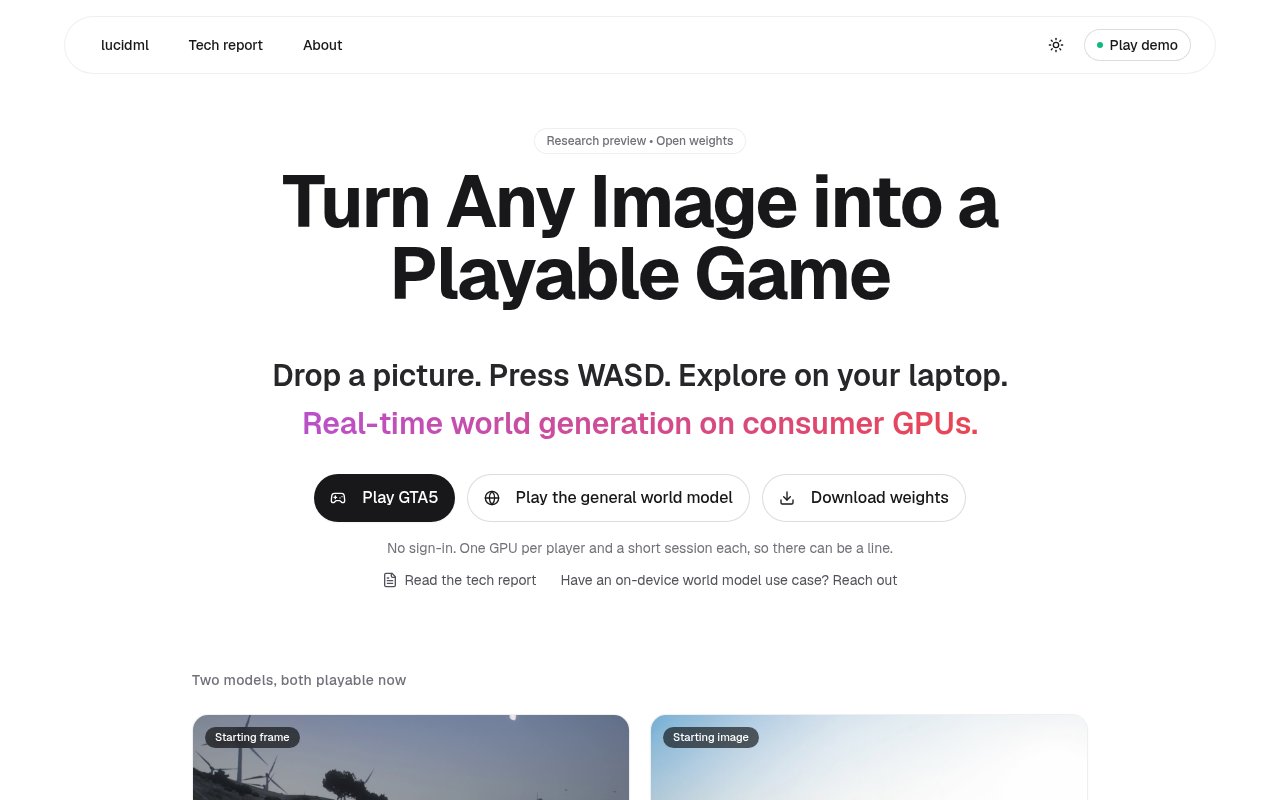
LucidML is a research-led world-model product that turns a still image into a scene someone can navigate in real time. A user supplies a picture, starts the generated world, and moves through it with familiar keyboard controls. The aim isn't simply to render another image or make a fixed video. It's to keep producing the next frame as the user explores, so the result behaves more like a playable environment. That makes LucidML relevant to teams exploring generative games, interactive prototypes, and new interfaces built around continuously generated visual spaces.
The product addresses a hard practical problem in world generation. Interactive models need to respond quickly enough that movement feels connected to the user's input, yet many ambitious video and simulation systems depend on remote clusters, long generation queues, or hardware outside the reach of a small team. LucidML has taken a different route. Its public material emphasizes real-time generation on consumer GPUs, with the model small enough to share a graphics card with a game and fast enough to react to keyboard input. The site frames local execution as a design goal rather than an afterthought.
The core workflow is deliberately easy to understand. An image establishes the initial scene, then the model preserves enough of its style and spatial structure to make the scene navigable. The user presses the standard WASD movement keys and sees new frames generated while moving through the environment. Public demonstrations also show a prompt being changed during an active rollout. In one example, the scene gains a pond, a person's clothing changes, and a desert becomes ice without cutting the stream. Those demonstrations point to a model that can take both movement and changing creative direction while generation continues.
LucidML also presents text-to-video examples, but its clearest identity is image-to-world generation. The difference matters for buyers. A conventional video generator returns a clip that is watched from beginning to end. LucidML is working toward a world that reacts as someone explores it. The company says each frame shown on its current product page was generated on one consumer GPU, and it highlights a live prompt-switching demonstration on an RTX 5090. That doesn't mean every laptop will deliver the same performance, but it does make the hardware target unusually concrete for an early world-model project.
The likely users are researchers, game developers, creative technologists, and companies testing interactive visual experiences. A small studio could use it to explore a scene before committing to a conventional production pipeline. A research group could examine how an image-conditioned model handles motion, continuity, and prompt changes. A product team could test whether an explorable generated setting fits an entertainment or simulation concept. It's less suitable for someone seeking a finished game engine, an asset marketplace, or a polished no-code builder. The site presents a model stack and an emerging capability, not a complete production suite.
What makes LucidML stand out is its combination of interaction and constrained compute. The company describes itself as a small research startup that builds image-to-world models from scratch and prioritizes quality per dollar and short iteration cycles. That focus is visible in the product positioning. Instead of leaning on scale alone, the team is trying to make useful world generation possible for independent developers and smaller organizations. The current public demos help visitors understand the direction, while the about page gives unusually direct context about the founder, research focus, and backing from GradCapital.
The release posture has two parts. LucidML publishes its GTA world model on Hugging Face with downloadable weights and inference code under the Apache 2.0 license, giving technical users an open route to local experimentation. The files let developers examine the release, run inference on their own compatible hardware, and build a client or research workflow around it without depending only on the hosted demonstration. The latest model shown on the main site is still labeled alpha and private beta, with access opening to a small number of researchers, developers, and companies through a call. There is no public commercial plan table or self-serve checkout. The open model is enough to explore the core idea, while teams seeking the newest hosted or partnership offering will need to confirm hardware expectations, deployment, support, and commercial terms directly.
Key Features
- Single-image world generation
- Real-time keyboard navigation
- Consumer GPU execution
- Live prompt switching
- Continuous frame generation
- Downloadable model weights
Pros & Cons
What we like
- Turns a still image into an explorable generated scene
- Targets consumer hardware instead of remote clusters
- Responds to movement while generation continues
- Open model weights support local experimentation
Room for improvement
- Private beta access is limited to selected users
- The latest private beta has no published commercial terms
- Performance expectations are tied to capable GPU hardware
- It's an early model stack rather than a complete game engine
Frequently Asked Questions
What is lucidml?
Does lucidml run locally?
Is LucidML available to everyone?
Who is LucidML for?
Best For
Featured in
Alternatives to LucidML
View all
Apatero AI
The creator studio for AI image, video, audio, 3D, and avatars, now at apatero.ai.

SoloDevStack
A solo developer blog built on head-to-head tool comparisons, 580+ posts deep.
Apatero Studio
Creator studio for AI image, video, audio, 3D, and avatars. Every model worth using, in one workspace.

Melodex
Turn your idea into an AI-generated music video
Reviews (0)
Badge builder
Add LucidML to your website
Choose a badge style and size, preview it here, then copy the generated HTML. Badge images are self-contained SVGs and do not require an external script.

<a href="https://toolindex.net/tools/lucidml?ref=badge" target="_blank" rel="noopener">
  <img src="https://toolindex.net/badge/lucidml/medium.svg" alt="LucidML - Listed on Tool Index" width="180" height="50" />
</a>How to use the badge
- 1. Pick the style, size, and theme that fit your layout.
- 2. Copy the generated HTML from the code block.
- 3. Paste it into your footer, homepage, or press page.
Standard badge available
The standard listing badge is available now. Score and circle badges are limited to tools currently ranked in the top 10 of a category.
Badge clicks return visitors to this profile with a referral tag so the source remains identifiable.
Related Tools
Apatero AI
The creator studio for AI image, video, audio, 3D, and avatars, now at apatero.ai.
Kevin Gabeci Toolkits
Seven AI toolkits for writing books, making music, cutting video, and building agents.

Warp
The modern terminal reimagined with AI and collaboration

Bolt.new
Prompt-to-deployed full-stack app inside the browser
Work on LucidML? Request listing access or correction