
Gallery
About Lynen
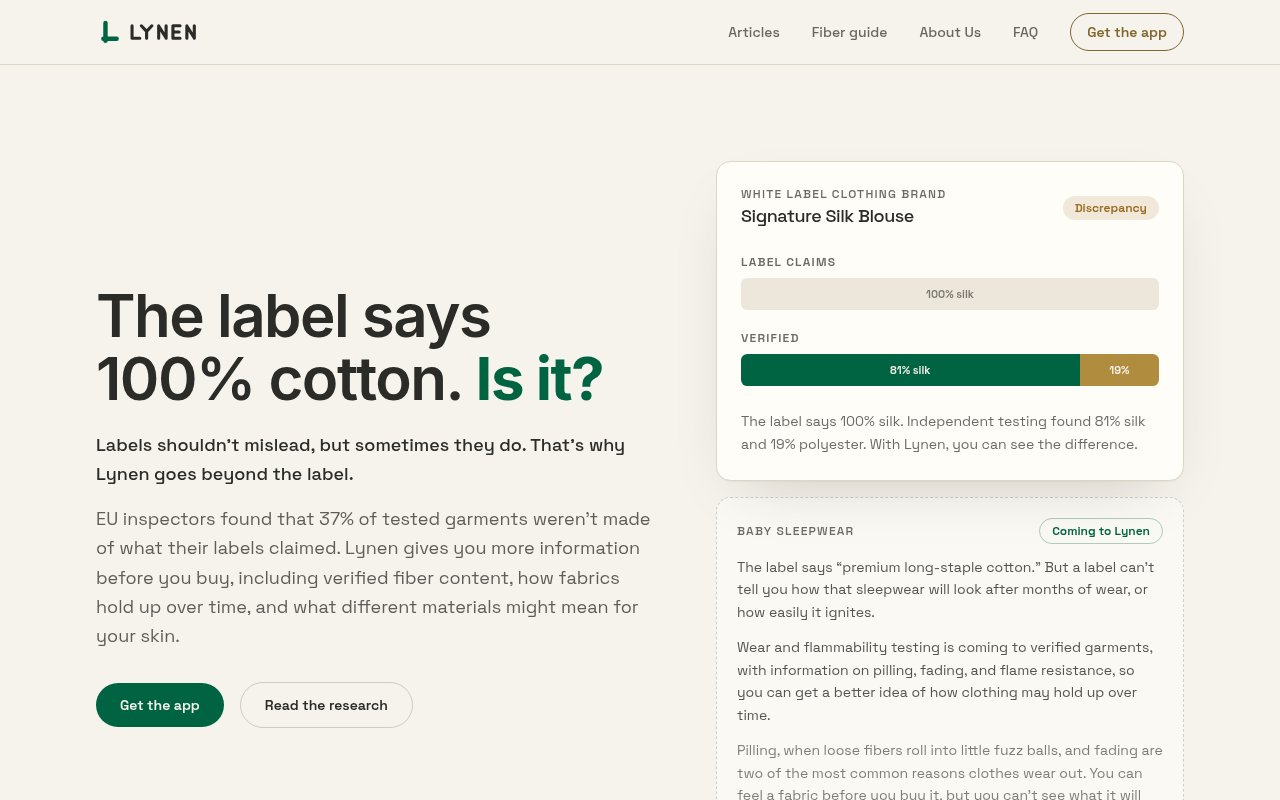
Lynen is a mobile app for checking what a garment is actually made from before or after buying it. It compares the fiber content printed on a clothing label with results from independent laboratory testing, then shows any meaningful difference plainly. The point is not to grade an entire fashion brand or repeat the manufacturer's claim. It is to give a shopper evidence about a specific tested product. That matters when the material affects comfort, durability expectations, price, or how a garment feels against sensitive skin. When Lynen doesn't have verified data for an item, it says the garment is not yet verified instead of filling the gap with an estimate.
The main workflow starts with the barcode on a clothing price tag. A shopper can scan an EAN or UPC code with the phone's camera, enter the number manually, or search by brand or product name. Lynen then places the label claim beside the tested fiber breakdown, including the size of any discrepancy. Sources are linked from verified records so the user can see where the figures came from. If an item isn't in the database, the user can submit it for future verification, and repeated requests help determine the testing queue. The scanner can be opened without an account, although an account is required for results, scan history, garment submissions, and personalized analysis. Barcode images are processed on the phone and aren't recorded or uploaded, and manual entry remains available for anyone who doesn't grant camera access.
Verification involves physical lab work rather than image recognition or a database guess. Lynen says it buys garments through ordinary retail channels, documents the purchase and chain of custody, and sends samples to independent accredited textile laboratories. The labs identify fibers through methods such as microscopy and solubility, then separate and weigh components under established standards including ISO 1833 and AATCC 20A. When a first test finds a discrepancy beyond accepted tolerance, Lynen sends a second sample to another accredited lab before publishing it. The company also states an important limit. Fiber testing destroys the sample, so a result is strong evidence about that product and production period, not a certificate for the exact shirt in a user's hands.
Lynen includes a research assistant called Ly for interpreting what a verified blend may mean for skin. Users can optionally add notes about sensitivities or conditions, and Ly reads those notes together with the tested composition and published research to produce a more relevant explanation. Each analysis shows the research it used. The site is careful about the boundary here. Ly offers general wellness information, not diagnosis, treatment, or medical advice, and it can be wrong when research is incomplete or doesn't match an individual's situation. Lynen says skin notes are private to the account, are passed to the AI model only when an analysis is written, and aren't used to train a model.
The app is most useful for shoppers who care about fiber content, people comparing expensive garments, and anyone trying to understand which materials tend to work for their skin. It can also help a buyer check whether a claimed silk, cotton, or blended item matches independent measurements. Its distinction from label scanners is straightforward. A basic scanner reads the manufacturer's label, while Lynen questions that label by commissioning lab tests and publishing the results beside the claim. Brand-rating services assess companies at a broad level, while Lynen stays focused on individual products. Where a garment has a linked textile certification or digital product passport, Lynen can put that record near its own verification data rather than treating the sources as interchangeable.
Lynen works on iPhone and Android and is free during its early access period, including Ly's personal fabric analysis. The company has indicated that pricing may later move to a small monthly amount, so today's free access shouldn't be read as a permanent pricing promise. Coverage is another practical limitation because every verified garment requires purchase, destructive testing, and review. A newly scanned item may have no result yet, and submitted garments can take weeks to reach verification. Wear testing for pilling and fading is planned but isn't live across the catalog, and the same is true of broader durability and flammability information shown as coming features. For the products it has checked, Lynen offers a traceable alternative to trusting a tag at face value.
Key Features
- EAN and UPC barcode scanning
- Independent fiber content results
- Label discrepancy comparisons
- Source-linked verification records
- Personalized Ly research assistant
- Garment verification requests
Pros & Cons
What we like
- Uses physical lab results instead of repeating label claims
- Shows sources and admits when a garment is unverified
- Supports camera scanning, manual entry, and product search
- Explains tested fabrics with optional personal context
Room for improvement
- Verified coverage grows slowly one garment at a time
- A sample result cannot certify the exact item in hand
- Free early access may move to paid pricing later
- Wear and broader durability testing are not live yet
Frequently Asked Questions
What is Lynen?
How does Lynen verify a garment?
Is Lynen free?
Does Ly provide medical advice?
Best For
Featured in
Alternatives to Lynen

PropGPT
iOS app that uses AI to analyze player props, spreads, and bets across major sports leagues

Expo
The React Native framework and cloud build service that ships native iOS and Android apps without touching Xcode.

Glide
No-code platform that turns spreadsheets and databases into mobile and web apps, with computed columns and AI actions.

Fix It Gently
Calm, plain-English fixes for everyday tech problems.
Reviews (0)
Badge builder
Add Lynen to your website
Choose a badge style and size, preview it here, then copy the generated HTML. Badge images are self-contained SVGs and do not require an external script.

<a href="https://toolindex.net/tools/lynen?ref=badge" target="_blank" rel="noopener">
  <img src="https://toolindex.net/badge/lynen/medium.svg" alt="Lynen - Listed on Tool Index" width="180" height="50" />
</a>How to use the badge
- 1. Pick the style, size, and theme that fit your layout.
- 2. Copy the generated HTML from the code block.
- 3. Paste it into your footer, homepage, or press page.
Standard badge available
The standard listing badge is available now. Score and circle badges are limited to tools currently ranked in the top 10 of a category.
Badge clicks return visitors to this profile with a referral tag so the source remains identifiable.
Related Tools

Sleep Suivour
Track your sleep, improve your rest
Glide
No-code platform that turns spreadsheets and databases into mobile and web apps, with computed columns and AI actions.
ProtoPie
High-fidelity prototyping tool that simulates sensor input, IoT triggers, and complex interactions without writing code.

FlutterFlow
Visual builder that compiles to real Flutter source code, producing native iOS, Android, web, and desktop apps from one project.
Work on Lynen? Request listing access or correction