
Maritime
Deploy, manage, and scale AI agents in isolated micro-VMs for about a dollar per agent
Gallery
About Maritime
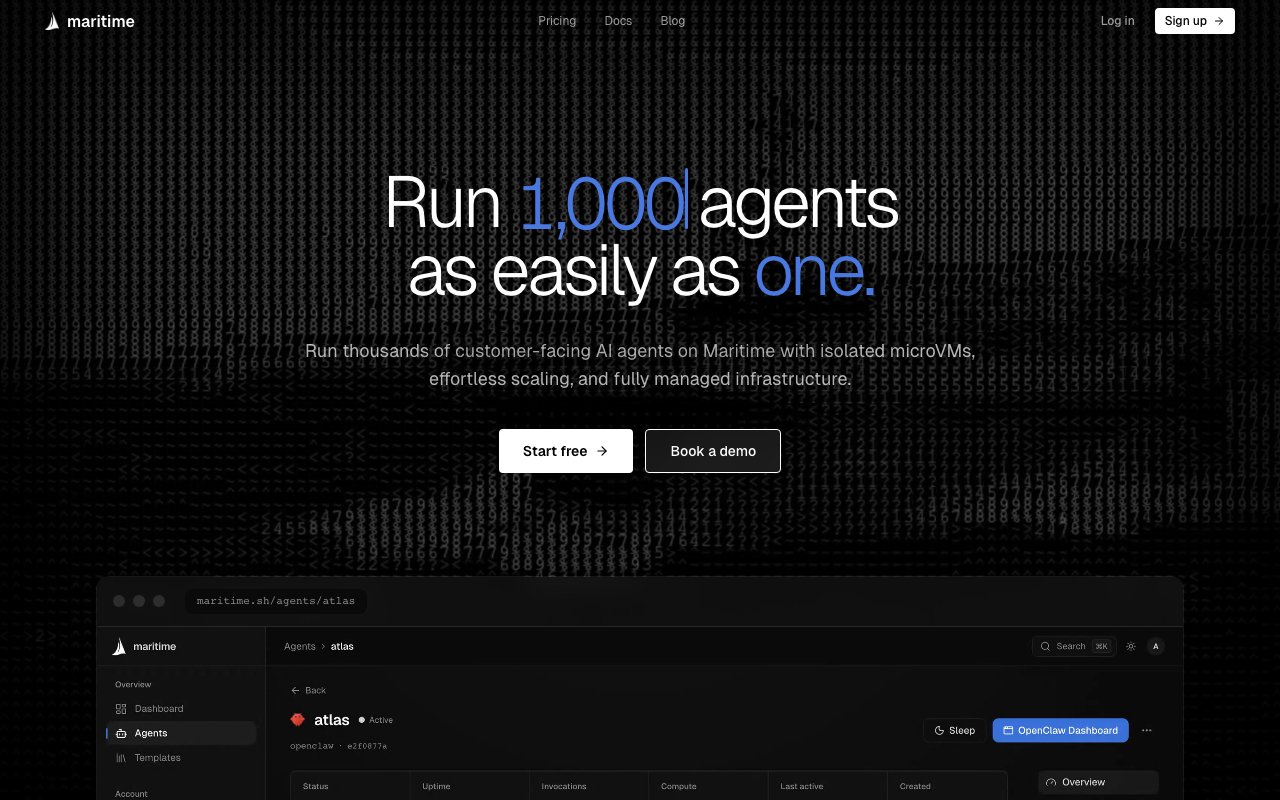
Maritime is a cloud hosting platform built specifically for deploying AI agents. Each agent runs in its own isolated micro-VM with a dedicated kernel, not a shared container or thread pool. The VMs sleep when idle and wake in roughly one second when a request arrives, which means you're not paying for compute time when your agents aren't doing anything. The whole point is to give you the isolation and security of dedicated infrastructure without the operational burden of managing that infrastructure yourself.
The problem Maritime addresses shows up the moment you try to move an agent from local development into production. If you're building a SaaS where each customer gets their own agent, you need proper isolation between tenants. You need secrets scoped to each agent. You need the ability to provision new environments programmatically as customers sign up. You could solve this with Kubernetes and a lot of YAML, but Maritime packages all of that into a managed service where the unit of deployment is simply the agent itself.
Deployment works through multiple channels depending on your workflow. There's a CLI for pushing directly from your terminal, SDKs in TypeScript and Python for provisioning agents from your own backend, and Git integration for automated deploys on push. Maritime auto-detects popular agent frameworks including CrewAI, LangGraph, OpenClaw, Hermes, and ZeroClaw. It reads your project structure, builds the environment, and hands you an API endpoint in about a minute. If you're using a framework it doesn't recognize out of the box, you can specify a custom stack with your own runtime configuration.
Each agent gets tagged with an external ID, which is how you tie an agent to a customer in your system. When a request comes in, Maritime routes it to the right VM based on that ID. You don't have to manage infrastructure per customer or think about networking. The platform handles DNS, load balancing, and the wake logic that brings a sleeping VM back online before the request times out.
The sleep and wake model is central to how Maritime keeps costs low. A traditional VPS charges you for every hour the machine runs, whether it's doing work or not. Serverless functions avoid that but introduce cold start latency that can break voice interactions or streaming responses. Maritime's approach sits in between. The VM is always there, technically, but it consumes minimal resources when asleep and can resume fast enough that cold starts aren't a problem. For voice and real-time applications, this is the detail that matters.
Secrets management is built into the platform rather than bolted on. You encrypt credentials once, and they're mounted only to the VM that needs them. There's no risk of one agent reading another agent's API keys because they're running in separate kernel spaces. The dashboard gives you telemetry on each agent, and webhooks fire for lifecycle events like deploys, wakes, and errors. If something breaks, you can SSH directly into the VM rather than parsing log streams.
Pricing is structured around agent count rather than compute time. The free tier includes three agents. Starter costs twenty dollars per month and covers twenty agents, with extra agents at a dollar fifty each. Growth at a hundred dollars per month covers a hundred agents at a dollar twenty-five per extra. Scale at five hundred dollars per month covers five hundred agents at a dollar per extra. Each agent gets a base allocation of one vCPU, two gigabytes of RAM, and five gigabytes of SSD. If an agent needs more resources, you can purchase add-ons for additional memory or storage. Enterprise customers can deploy on-premises for maximum density.
The target audience is developers and startups who want to ship agents to customers without building and maintaining the infrastructure layer themselves. If you've built something with CrewAI or LangGraph and your next problem is getting it into production with proper multi-tenant isolation, Maritime removes most of that operational overhead. Companies like Google, Samsung, and L'Oreal reportedly have developers building on the platform, though that doesn't tell you much about their specific use cases. The tradeoff is that you're relying on a newer vendor rather than a hyperscaler or your own metal, so it suits teams comfortable with that dependency in exchange for moving faster. The on-premises option exists for enterprises that need Maritime's deployment model but can't send data to a third-party cloud, which addresses the most common objection from regulated industries.
Key Features
- Isolated micro-VM per agent with dedicated kernel
- Sleep and wake with sub-second latency
- Support for CrewAI, LangGraph, and custom stacks
- Encrypted secrets mounted per VM
- Deploy via Git push, CLI, or SDK
- Live dashboard with telemetry and webhooks
Pros & Cons
What we like
- Each agent runs in true VM isolation, not just a container
- Sub-second wake times avoid cold-start latency on voice and streaming
- Pricing scales to about a dollar per agent at volume
- Multiple deployment methods including Git, CLI, and SDK
Room for improvement
- Newer platform with a smaller community than established cloud providers
- Limited to supported frameworks unless you bring a custom stack
- Base VM specs may require paid add-ons for memory-heavy agents
- Vendor lock-in if you rely heavily on their SDK patterns
Frequently Asked Questions
What is Maritime?
How much does Maritime cost?
Does each agent get its own isolated environment?
What frameworks does Maritime support?
Best For
Featured in
Alternatives to Maritime

Stack AI
No-code platform for building and deploying enterprise AI agents and workflows on a visual canvas

Almanac
A hosted, source-cited wiki that turns your files into context your AI agents can use

Demi AI
Demi helps busy professionals eliminate repetitive admin work across their favorite tools.
Vapi
Build voice AI agents that take and place phone calls
Reviews (0)
Badge builder
Add Maritime to your website
Choose a badge style and size, preview it here, then copy the generated HTML. Badge images are self-contained SVGs and do not require an external script.

<a href="https://toolindex.net/tools/maritime?ref=badge" target="_blank" rel="noopener">
  <img src="https://toolindex.net/badge/maritime/medium.svg" alt="Maritime - Listed on Tool Index" width="180" height="50" />
</a>How to use the badge
- 1. Pick the style, size, and theme that fit your layout.
- 2. Copy the generated HTML from the code block.
- 3. Paste it into your footer, homepage, or press page.
Standard badge available
The standard listing badge is available now. Score and circle badges are limited to tools currently ranked in the top 10 of a category.
Badge clicks return visitors to this profile with a referral tag so the source remains identifiable.
Related Tools

OpenBenchmarks
Public, externally validated benchmarks that help agents pick SaaS APIs
Almanac
A hosted, source-cited wiki that turns your files into context your AI agents can use

Wizard
Self-extending Rust terminal AI agent that works with any model

Chariot
Elastic cloud infrastructure for deploying and scaling AI agent fleets with persistent storage
Work on Maritime? Request listing access or correction