
Neurometric
A marketplace of task-specific small language models with flat monthly pricing and a tool-calling model
Gallery
About Neurometric
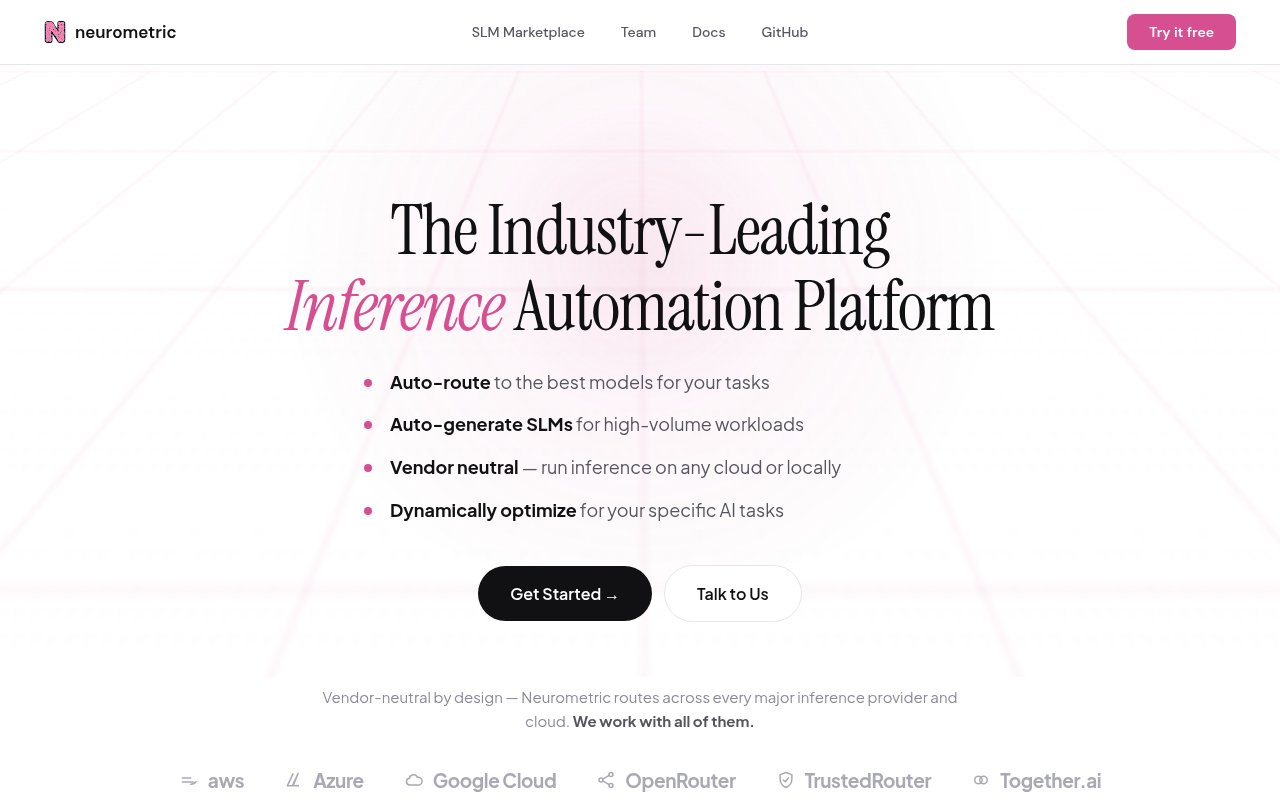
Neurometric is a platform for running AI tasks on small language models instead of frontier ones. Its marketplace lists task-specific models, each under 20 billion parameters and each tuned for one job, and its Studio routes work to the right model and falls back to a general LLM when quality drops. The pitch is simple. Most of what agents do is narrow and structured, and paying frontier prices for narrow work is the largest avoidable line on an AI bill. The problem it targets shows up in any agent that runs at volume. A frontier model is a fine way to prototype, but once the same classification, extraction or tool selection step runs a million times a day, the cost and latency of a general model become the ceiling on what the product can afford to do. Swapping in a smaller specialised model is the obvious fix, but finding, evaluating, hosting and monitoring dozens of them is its own project, and that project is what Neurometric productises.
The marketplace is organised by business function rather than by architecture. Categories include people management, accounting and finance, engineering and product, customer success and support, sales, legal and compliance, HR, marketing and content, document intelligence, developer tools and office assistant work, and the marketplace page counts 127 models at the time of writing. Models are described as fine-tuned for a single job, which is why the catalogue is long, and the categories map to teams rather than to model families, so a support lead can find the classifier for ticket routing without knowing what a base model is. Each hosted model is reachable through an OpenAI-compatible endpoint, so switching a call away from a large model is mostly a matter of changing the model name and the base URL, and there's a web playground for testing before you commit. The launch post also describes downloadable weights for teams that want to self-host. If no listed model fits, the build section takes a plain-language description of the task and the Auto-SLM Creator produces a purpose-built model.
Studio is the operational layer. It routes tasks to specialised models with automatic failover to a general LLM when confidence falls below a threshold you set, monitors each endpoint in real time for confidence, latency, throughput and cost, and evaluates candidate models against your actual workload across more than a hundred options. There's a free tier with no credit card that promises first results in under five minutes, a leaderboard for comparing models, and documentation and a GitHub repository linked from the site.
The tool-calling model is the piece that drew attention on launch. Published on TrustedRouter as neurometric/tool-choice, it does one thing, turning user intent into valid schema-bound tool calls, with a 32,768 token context and per-token pricing of roughly a cent per million input tokens and ten cents per million output tokens. Neurometric's argument is that tool selection is a narrow structured problem, and treating it as one changes the economics of the whole agent loop, claiming 70 to 90 percent lower cost per turn against frontier models while keeping your tool schemas off third-party providers.
The site leans on cost examples to make the case. The marketplace pricing page contrasts a resume to job matching task at roughly $225 a month on Claude Opus with a $3 flat rate on a marketplace model, and Studio's homepage promises a large cut in AI spend on day one with a worked daily saving. Those are the vendor's own comparisons and they assume the small model is good enough for the task, which is the assumption the evaluation tooling exists to test. The launch post also lists eleven general-purpose models alongside the task-specific ones, and the leaderboard ranks models so you can see how a candidate compares before you route traffic to it.
It's for teams building agents who have already felt the bill. Platform and ML engineers who want to move routine steps off frontier models without standing up their own inference fleet are the core audience, and the business-function categories suggest operations and back-office automation as much as consumer products. If you have one hot path that dominates spend, the marketplace's flat pricing is easy to reason about. If you have many, Studio's routing and monitoring is the part that matters. Either way, model quality on your specific task is still something you have to measure yourself, which is what the evaluation tooling is there for.
Access is freemium, with a few caveats. Browsing the marketplace and using the Studio free tier costs nothing. Hosted marketplace models are priced flat rather than per token, at $3 a month for a single model with unlimited API calls or $7 a month for up to three, with models locked for the billing term and custom SLMs on volume-based pricing with dedicated support. The tool-choice model on TrustedRouter is billed per token instead, and the company's own posts have quoted different hosting allowances over time, so check the current pricing page before budgeting. Contact for model questions is slms@neurometric.ai.
Key Features
- Marketplace of task-specific small models
- OpenAI-compatible hosted endpoints
- Studio routing with LLM failover
- Real-time endpoint monitoring
- Auto-SLM Creator for custom tasks
- Schema-bound tool-calling model
Pros & Cons
What we like
- Flat monthly pricing with no per-token charges on hosted models
- Drop-in endpoints keep code changes small
- Failover to a general LLM guards quality
- Free Studio tier with no credit card
Room for improvement
- Pricing differs across the marketplace, Studio and TrustedRouter
- Multi-model plan locks models for the billing term
- Model quality on your task still needs your own evaluation
- Fast-changing catalogue on a young platform
Frequently Asked Questions
What is Neurometric?
Is Neurometric free?
How do I call a model?
What is the tool-calling model?
Best For
Featured in
Alternatives to Neurometric

Almanac
A hosted, source-cited wiki that turns your files into context your AI agents can use

Demi AI
Demi helps busy professionals eliminate repetitive admin work across their favorite tools.

Lindy
No-code AI agents that handle email, meetings, and recurring workflows
Vapi
Build voice AI agents that take and place phone calls
Reviews (0)
Badge builder
Add Neurometric to your website
Choose a badge style and size, preview it here, then copy the generated HTML. Badge images are self-contained SVGs and do not require an external script.

<a href="https://toolindex.net/tools/neurometric?ref=badge" target="_blank" rel="noopener">
  <img src="https://toolindex.net/badge/neurometric/medium.svg" alt="Neurometric - Listed on Tool Index" width="180" height="50" />
</a>How to use the badge
- 1. Pick the style, size, and theme that fit your layout.
- 2. Copy the generated HTML from the code block.
- 3. Paste it into your footer, homepage, or press page.
Standard badge available
The standard listing badge is available now. Score and circle badges are limited to tools currently ranked in the top 10 of a category.
Badge clicks return visitors to this profile with a referral tag so the source remains identifiable.
Related Tools

OpenBenchmarks
Public, externally validated benchmarks that help agents pick SaaS APIs
Almanac
A hosted, source-cited wiki that turns your files into context your AI agents can use

Wizard
Self-extending Rust terminal AI agent that works with any model

Chariot
Elastic cloud infrastructure for deploying and scaling AI agent fleets with persistent storage
Work on Neurometric? Request listing access or correction