
Nore
Publish a polished blog from your Notion database without leaving Notion
Gallery
About Nore
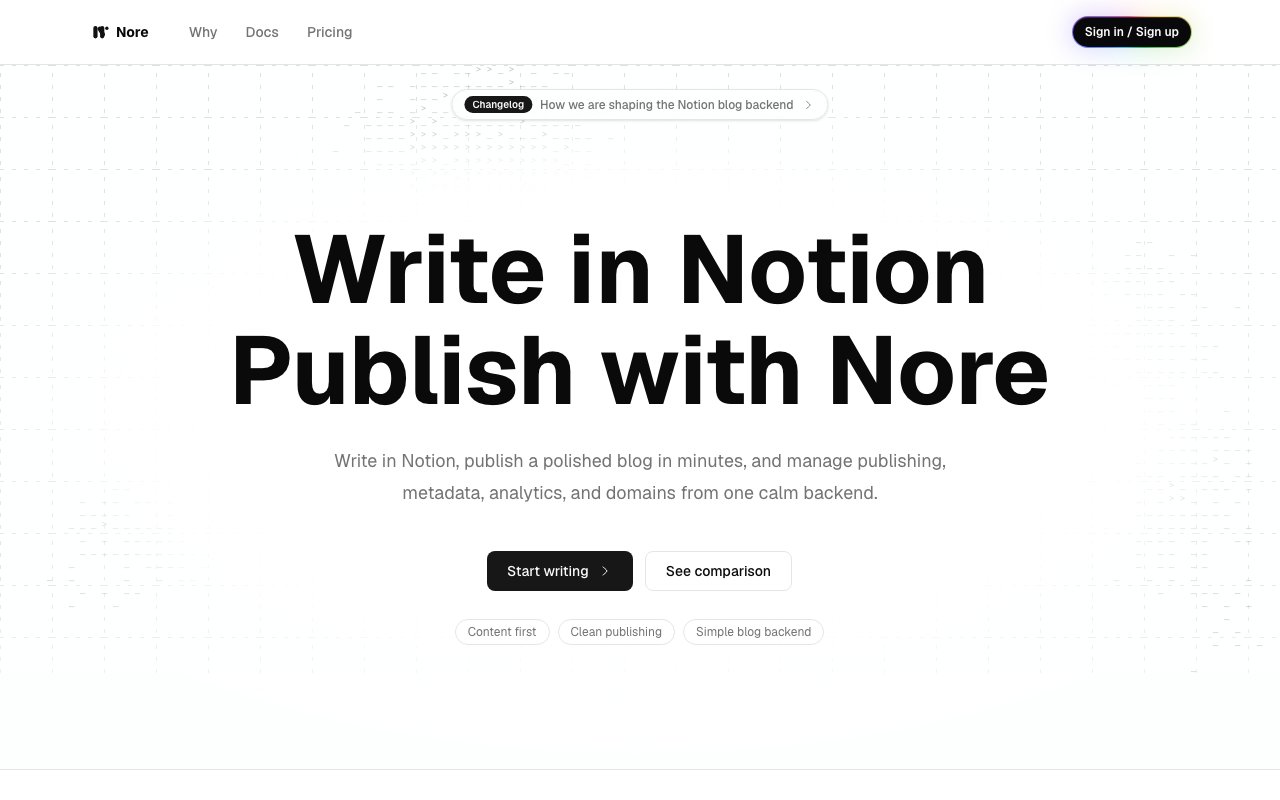
Nore is a publishing platform that turns Notion databases into public blogs. You write in Notion like you already do, and Nore reads your database to generate a complete blog with posts, author pages, tag pages, RSS feeds, and sitemaps. No migration, no new editor, no deploy workflow.
The connection works through Notion's database structure. You set up a database with posts, authors, tags, and status fields, and Nore reads from it. When you're ready to publish, you review changes in Nore's interface, which shows you what's new, what's updated, what's skipped, and what failed. You approve the publish and the site updates. The editorial queue gives you control over what goes live without leaving Notion as your primary writing tool.
On the published side, Nore generates blog indexes, individual post pages, tag pages, and author pages. It creates RSS feeds and sitemaps with stable slugs so links don't break when you edit. Images hosted in Notion get cached at the edge so they load quickly on the public blog. You get SEO tools for meta tags and Open Graph, plus analytics integrations for tracking what gets read.
For domains, you can use a subdomain on nore.sh or connect your own custom domain with SSL handled automatically. The platform also supports newsletter subscriptions, so readers can follow your blog through email.
Nore fits independent developers publishing product logs, startups running company blogs, creators building knowledge bases, and content teams who want editorial control without a CMS migration. If your writing workflow already lives in Notion and you want a public-facing blog without changing how you write, this is the gap it fills.
Pricing is simple. There's a 7-day free trial with full Pro features, no card required. Pro runs $5 per month, not as a subscription but as a one-time activation that you renew when you want to. Pro gives you up to 3 sites, unlimited posts, custom domains, theme switching, password-protected posts, pinned posts, and 100 monthly email credits. There's no automatic renewal, so you control when you pay.
Key Features
- Notion database to blog publishing
- Release review workflow before publish
- Custom domains with automatic SSL
- RSS feeds and sitemaps with stable slugs
- Edge-cached Notion image hosting
- Email newsletter subscriptions
Pros & Cons
What we like
- Keeps Notion as the primary writing tool
- No subscription, pay only when active
- Editorial review queue before anything goes live
- Images cached at edge for fast loading
Room for improvement
- Tied to Notion as the content source
- Limited to 3 sites on Pro plan
- 100 email credits per month caps newsletter reach
- Theme options may be narrower than custom builds
Frequently Asked Questions
What is Nore?
How much does Nore cost?
Can I use my own domain?
Who is Nore for?
Best For
Featured in
Alternatives to Nore
View all
Bear
A beautiful Markdown notes app for Apple devices that doubles as a writing tool

Frase
AI-assisted SEO content tool that turns SERP research into briefs, outlines, and optimized drafts inside one editor.

Confluence
Atlassian's long-running team wiki that anchors many enterprise knowledge stacks

ChatGPT
AI assistant for conversation and content generation
Reviews (0)
Badge builder
Add Nore to your website
Choose a badge style and size, preview it here, then copy the generated HTML. Badge images are self-contained SVGs and do not require an external script.

<a href="https://toolindex.net/tools/nore?ref=badge" target="_blank" rel="noopener">
  <img src="https://toolindex.net/badge/nore/medium.svg" alt="Nore - Listed on Tool Index" width="180" height="50" />
</a>How to use the badge
- 1. Pick the style, size, and theme that fit your layout.
- 2. Copy the generated HTML from the code block.
- 3. Paste it into your footer, homepage, or press page.
Standard badge available
The standard listing badge is available now. Score and circle badges are limited to tools currently ranked in the top 10 of a category.
Badge clicks return visitors to this profile with a referral tag so the source remains identifiable.
Related Tools

SoloDevStack
A solo developer blog built on head-to-head tool comparisons, 580+ posts deep.
Bear
A beautiful Markdown notes app for Apple devices that doubles as a writing tool
ChatGPT
AI assistant for conversation and content generation

Surfer SEO
Content optimization tool that scores drafts in real time against the top-ranking pages for any target keyword.
Work on Nore? Request listing access or correction